Skip to content

Free playbook · for agency owners

Every question about a client still routes back to you.

Build a working company brain for one client, in one afternoon, using the ChatGPT or Claude account you already pay for. No new tools. No code. And an honest account of exactly where it stops working.

About three hours Costs nothing new No technical skill 14 pages
Send me the playbook

Company email addresses only. One email, PDF attached.
Cover of The One-Client Brain, a build playbook for agency owners by EfficiaLabs.

The problem

Fourteen tools, one index — and the index is a person.

You hired people. You wrote SOPs. You keep a ChatGPT tab open all day. And everything still waits on you.

Email Slack Drive Notion CRM Calls YOU the human router

Why the obvious fixes failed

None of them failed because the tool was bad.

You dumped it all in Drive

And drowned in nested folders. You still can't find the SOP you wrote last month.

You wrote a proper SOP library

By month four half of it was outdated. Nobody went back to update it.

You keep AI tabs open

And re-introduce yourself fifty times a day. Brand voice, brief, SOP, again.

You hired more people

The team got bigger. The decision queue stayed exactly the same size.

They failed because the context was scattered, and the only complete index of it was you.

The part everyone gets wrong

You've been documenting the wrong half.

Most people document process. That's the easy half, and the half that rots fastest. The hard half — the half your team actually pings you about — is judgment.

Process

“Export the report on the 1st.”

Transfers fine in an SOP. Also the part that goes stale first.

Judgment

“Push back on this one, absorb that one.”

Never transfers in an SOP. This is 90% of what they ask you.

The judgment part — knowing which client request to push back on and which to just do — doesn't transfer by writing an SOP.

Agency owner, r/agency

What's inside · step one

Five files. About ninety minutes.

Everything the brain knows comes from these. Write them in Docs, Notion, or plain text.

01

client.md

Who they are, and what they're really buying.

02

promise.md

Signed scope, plus every change since, dated.

03

voice.md

How they sound. Approved work, banned words.

04

how.md

The 2–3 SOPs that actually apply here.

Skipped by all

05

decisions.md

Every judgment call, with the reason attached.

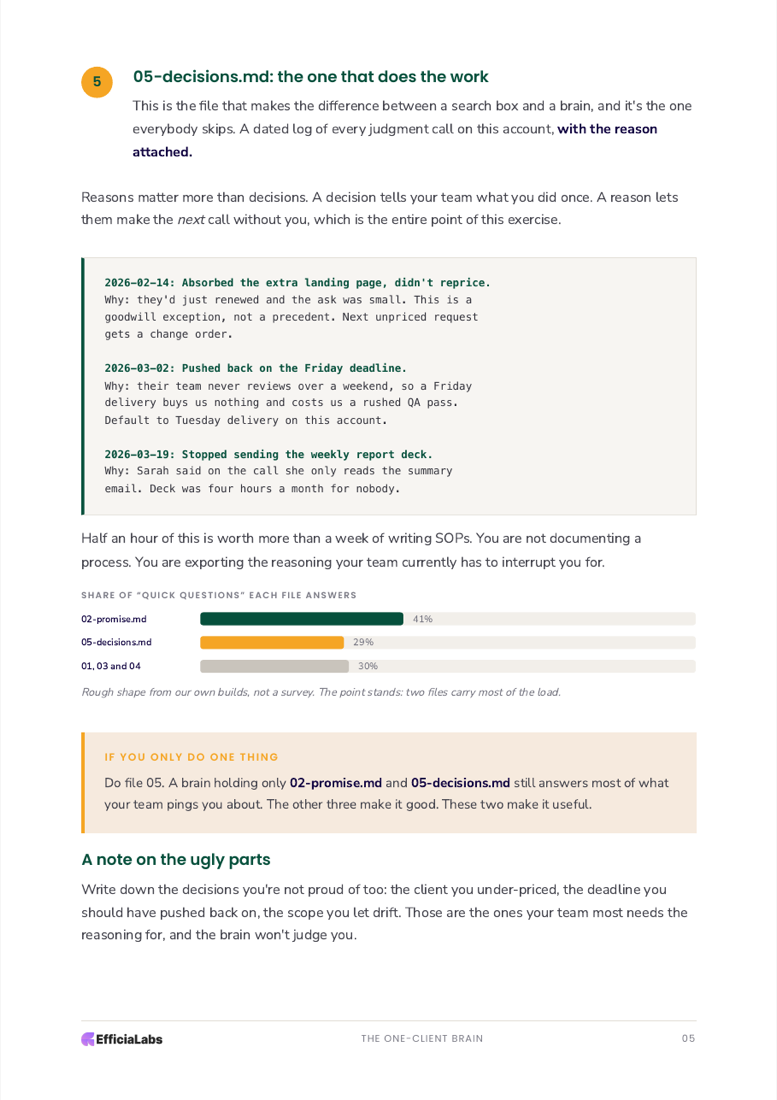
Reasons matter more than decisions. A decision tells your team what you did once. A reason lets them make the next call without you — which is the entire point.
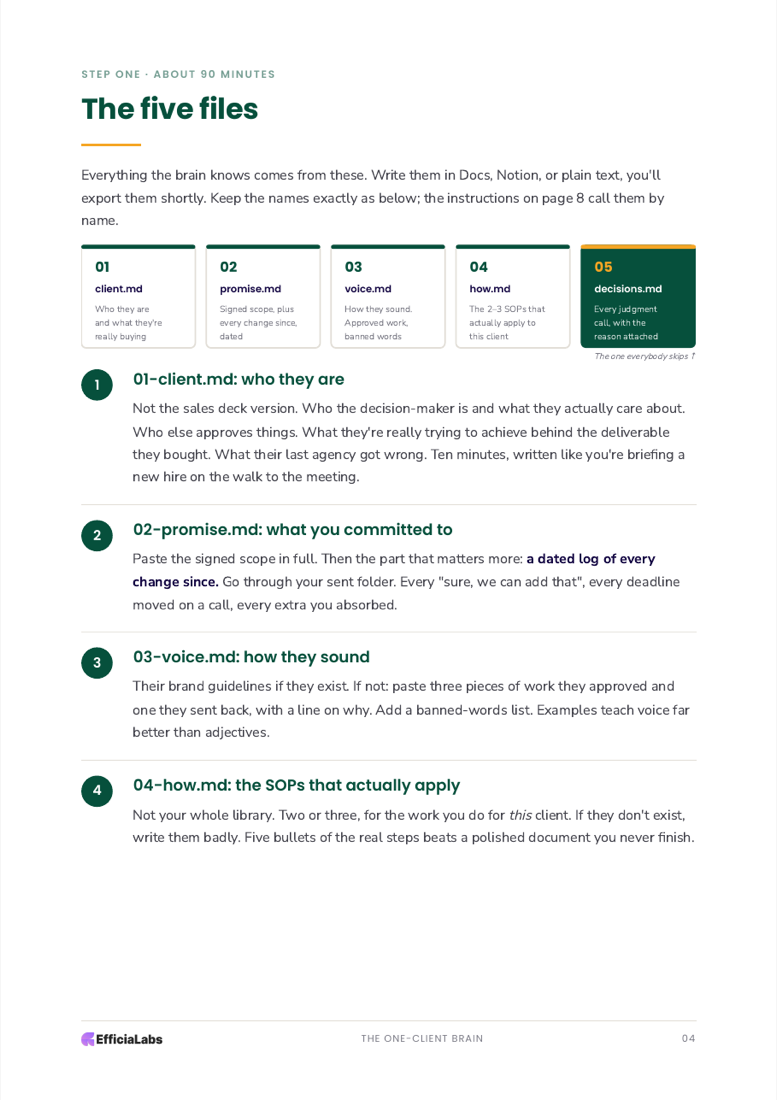
Page 4 of the playbook: the five files to write, each with what belongs in it.
Page 4 — what goes in each of the five files
Page 5 of the playbook: worked examples of a decision log, each entry paired with the reason behind it.
Page 5 — real decision-log entries, with the reasoning

The honest part

By week eight, it will lie to you.

Here's what nobody selling you an AI workflow mentions. Project knowledge is a snapshot, not a connection. You upload five files and the tool takes a copy. You edit the original; the copy never finds out. It won't announce this — it'll answer with total confidence from a scope document that changed a month ago, and cite its source, which makes it more convincing, not less.

100%80% 60%40% Build dayWeek 3 Week 5Week 8
With a 20-min weekly re-upload Without it

There are two full pages on this in the playbook, plus the manual fix that genuinely works. Build the thing first, then read them.

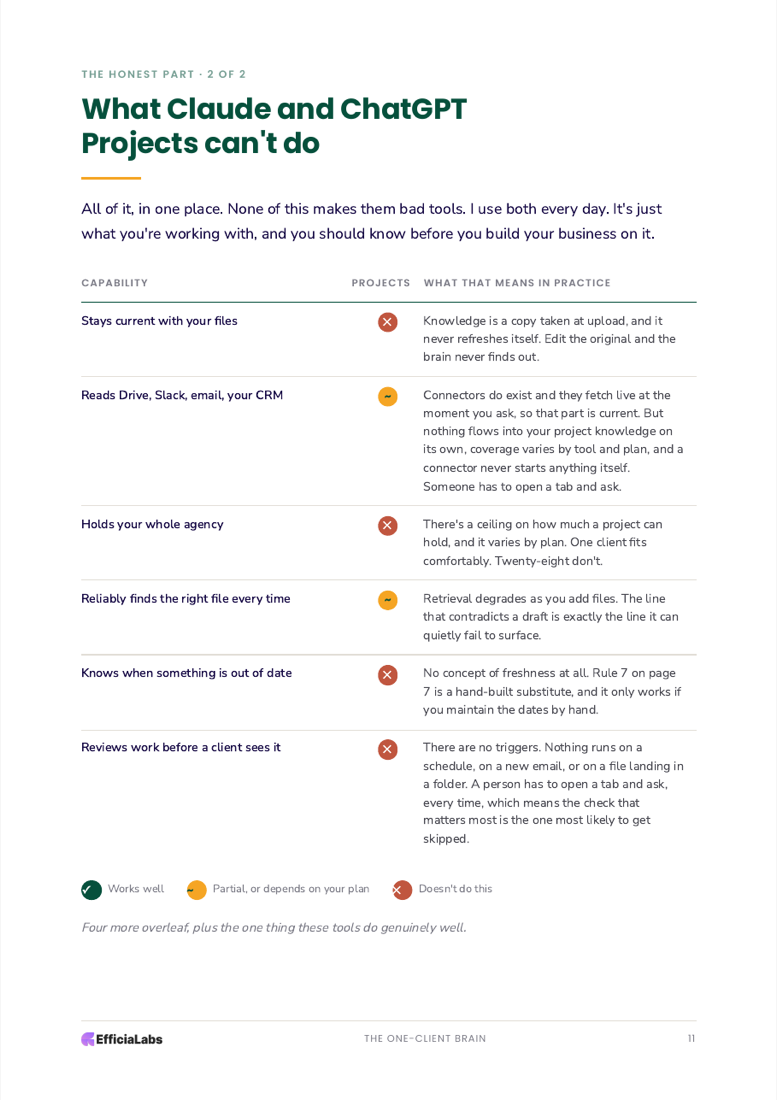
What Claude and ChatGPT Projects can't do

None of this makes them bad tools. I use both every day. It's just what you're working with.

CapabilityProjectsWhat that means in practice
Stays current with your filesKnowledge is a copy taken at upload. Edit the original and the brain never finds out.
Reads Drive, Slack, email, CRM~Connectors fetch live when you ask, but nothing flows in on its own. Someone has to open a tab.
Holds your whole agencyOne client fits comfortably. Twenty-eight don't.
Knows when something is out of dateNo concept of freshness at all. The playbook gives you a hand-built substitute.
Reviews work before a client sees itThere are no triggers. The check that matters most is the one most likely to get skipped.
Answers accurately from what you gave itThis part genuinely works, and it's why the afternoon is worth it.

By tonight

What you'll have when you finish

A working brain

A project in Claude or ChatGPT holding everything about one client.

Sourced answers

Every answer cites which file it came from, so anyone on your team can check it.

A decision log

The thing that actually transfers your judgment, not just your process.

Copy-ready instructions

The full project instruction block. Paste it in, change the client name, done.

The ten-minute test

Five real questions to throw at it, so you know within a day whether it works.

The honest limits

Two pages on where it breaks, when, and the fix that holds it together.
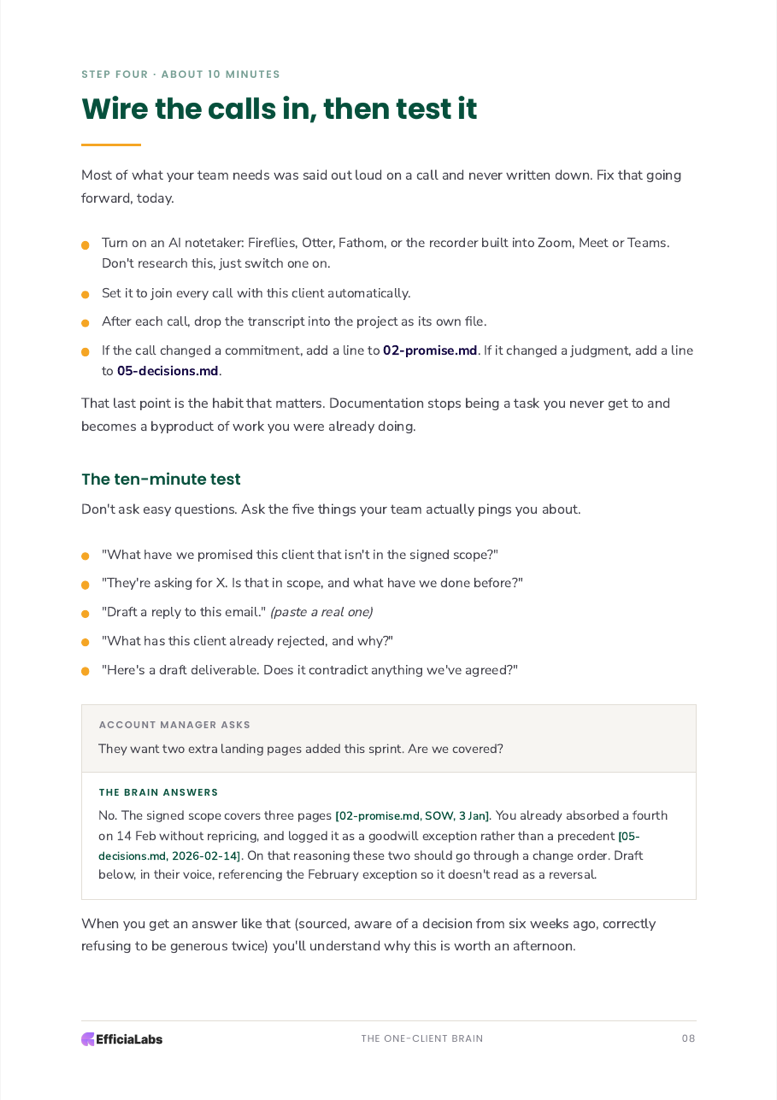
Page 8 of the playbook: the full project instruction block, ready to paste into Claude or ChatGPT.
Page 8 — the instruction block, ready to paste
Page 11 of the playbook: a table of what Claude and ChatGPT Projects cannot do, with what each limit means in practice.
Page 11 — the limits, spelled out

Get it

Send me the playbook

Free, 14 pages, PDF. Pick your messiest client and build them a working brain this afternoon.

Company email addresses only. One email with the PDF attached. Unsubscribe whenever.

Check your inbox.

The playbook is on its way. If it's not there in two minutes, have a look in Promotions or Spam — and reply to it either way, I read every one.

V

Vaibhav Sharan, co-founder of EfficiaLabs. Four years at Accenture building operational systems, now running EfficiaLabs entirely on the thing described in this playbook. I built it for myself first. Email me if you get stuck building yours — I'll answer either way.