

Gorgias vs Tidio vs Manychat vs Chatfuel for ecommerce comes down to the job. Gorgias fits support ops. Tidio fits on-site chat. Manychat fits social DMs. Chatfuel fits multi-channel AI. For $1M+ DTC brands, custom AI is often the stronger end state.
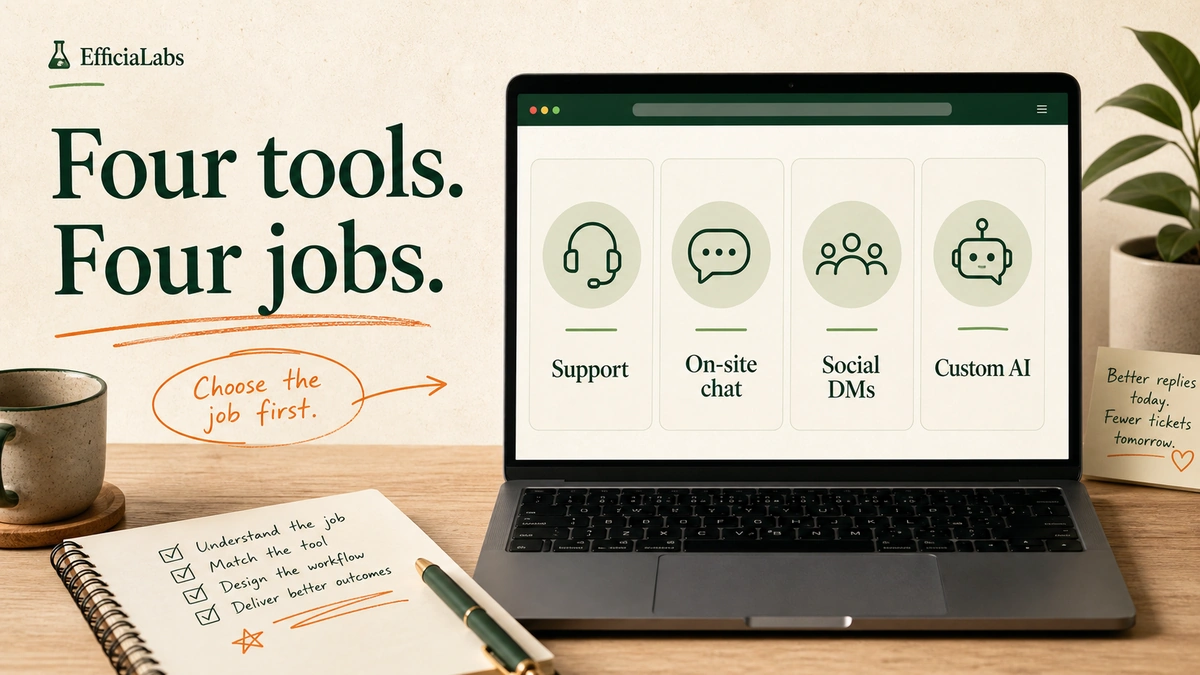
Some tools answer tickets.
All four get called chatbots. Terrible word. Useful category. Bad buying shortcut.
The question is not “Which chatbot is best?”
The question is: “What job is this bot allowed to own?”
Table of Contents
- TL;DR: which chatbot should you choose?
- Why this comparison is confusing
- Gorgias vs Tidio vs Manychat vs Chatfuel: the quick comparison
- When should you choose Gorgias?
- When should you choose Tidio?
- When should you choose Manychat?
- When should you choose Chatfuel?
- Why should $1M+ DTC brands consider custom AI?
- FAQs about Gorgias vs Tidio vs Manychat vs Chatfuel for ecommerce
TL;DR: which chatbot should you choose?
Choose Gorgias if support tickets are the fire. Choose Tidio if you need fast website chat. Choose Manychat if the sales motion starts in Instagram, TikTok, Messenger, or WhatsApp. Choose Chatfuel if you want broad social and web AI automation.
Build custom when the chatbot becomes part of the revenue system.
Not “nice to have.” Not “we should probably have AI.”
Support. Conversion. Refund policy. Product discovery. Order truth. Brand voice. Human review.
That is a different game.
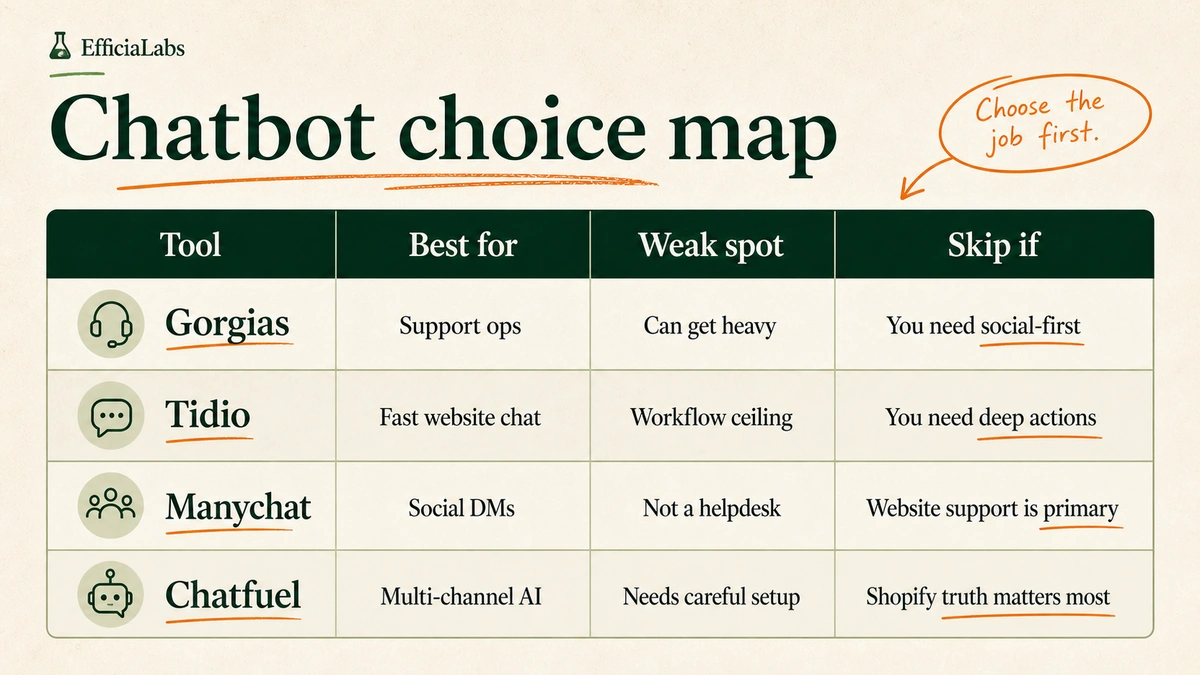
| Tool | Best for | Weak spot | When to skip | Pricing page |
|---|---|---|---|---|
| Gorgias | Support-heavy Shopify teams | Can become support infrastructure, not a sales system | You mainly need social DM automation | Gorgias pricing |
| Tidio | Fast on-site chat and simple AI replies | Workflow depth and custom actions | You need deep Shopify/app actions | Tidio pricing |
| Manychat | Instagram, TikTok, Messenger, and WhatsApp flows | Not a full ecommerce helpdesk | Website support is the main fire | Manychat pricing |
| Chatfuel | Multi-channel AI across social and web | Needs careful setup for store-specific truth | Shopify policy/order truth matters most | Chatfuel pricing |
In a sentence: SaaS chatbots are good for proving the workflow. Custom AI is better when the workflow is valuable enough to own.
Why this comparison is confusing
Gorgias, Tidio, Manychat, and Chatfuel are not four versions of the same thing.
They sit in different parts of the customer journey.
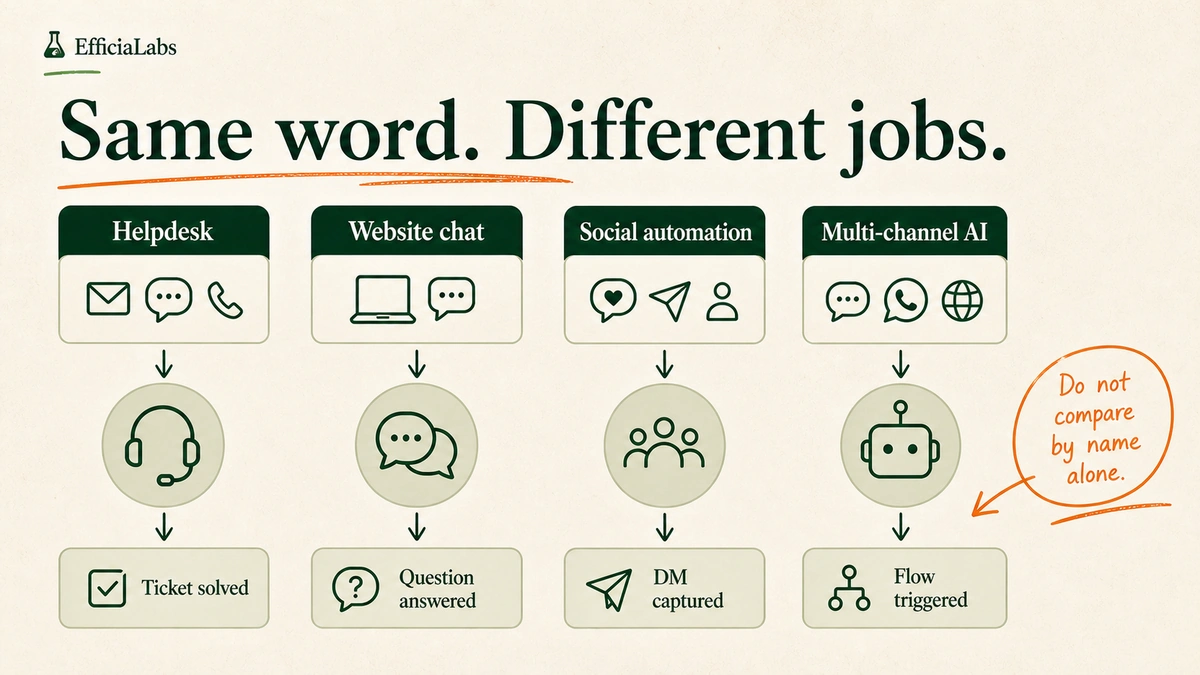
Gorgias is a customer support platform. Its pricing page groups the product around helpdesk, AI Agent, Automate, Voice, and ecommerce integrations.
Tidio sits closer to live chat plus AI support. Its pricing page presents Lyro AI Agent, Flows, live chat, help desk, and customer-service features.
Manychat is a social messaging automation tool. Its pricing page is organized around Instagram, Facebook Messenger, TikTok, WhatsApp, SMS, and email.
Chatfuel positions itself around AI agents for WhatsApp, Instagram, TikTok, Facebook Messenger, and a website widget.
Same label. Different jobs.
In 2024, Meta said more than 400 million people used Meta AI monthly, with 185 million weekly users, which explains why every messaging platform is rushing AI into the inbox.
In Q4 2025, Meta said US click-to-message ads revenue grew more than 50% year over year, a useful signal for brands comparing Manychat and Chatfuel.
In 2025, Klarna said its AI chatbot handled about 1.3 million customer interactions per month and reduced repeat inquiries by 25%, which shows the support upside. Also: Klarna is not your skincare brand. Context matters.
“Reflexive AI usage is now a baseline expectation at Shopify.”
- Tobi Lutke, Shopify CEO (CNBC)
“a business agent representing it and acting on its behalf, in its voice”
- Clara Shih, Meta head of business AI (CNBC)
For DTC brands with 5-50 FTEs, workflow beats category name. A lean team needs fewer tickets, better answers, cleaner routing, and more revenue.
In our work with DTC teams, the messy part is not “which chatbot has AI?” It is “which system knows the truth and when should it stop?”
That is the lens.
Gorgias vs Tidio vs Manychat vs Chatfuel: the quick comparison
| Criteria | Gorgias | Tidio | Manychat | Chatfuel |
|---|---|---|---|---|
| Primary job | Ecommerce support ops | Website chat and AI support | Social DM automation | Multi-channel AI automation |
| Best-fit team | Has a CX lead | Wants quick live chat | Sells through social DMs | Wants social plus web AI |
| Shopify/support depth | Strongest | Useful for lighter support | Not the main job | Setup-dependent |
| Social depth | Support channels first | Website first | Strongest social-first option | Strong channel coverage |
| Main ceiling | Ticket system, not conversion brain | Template and native-action limits | Weak helpdesk fit | Needs clean context |
| Pricing | Pricing page | Pricing page | Pricing page | Pricing page |
If support is painful, Gorgias wins more often.
If website questions are painful, Tidio is easier to justify.
If social messages are where demand starts, Manychat deserves the first look.
If the brand wants one broad AI layer across WhatsApp, Instagram, TikTok, Facebook Messenger, and the website, Chatfuel belongs.
If the workflow touches revenue, support, product truth, policy truth, and a specific brand voice, I would stop treating SaaS as the final answer. Use it as research.
Run the SaaS tool. Learn the questions. Learn the edge cases. Then build the system you actually need.
In our work, that discovery step is where the useful build spec appears.
Same pattern in AI customer support for Shopify. The model matters. The context pack matters more.
When should you choose Gorgias?
Choose Gorgias when the main fire is support operations.
You have tickets. Order questions. Returns. Subscription edits. Customers asking the same 17 things across 6 channels.
Gorgias is strongest when a DTC brand needs:
- A real ecommerce helpdesk.
- Omnichannel support conversations in one place.
- Shopify-native context.
- AI support inside a support-team workflow.
- Agent handoff when automation should stop.
Best for: support-heavy Shopify brands with ticket volume, macros, order workflows, and a human CX team.
Watch out for: buying Gorgias when the real problem is not support.
A shopper asks, “Will this fit a 6-foot guy?” The answer is part policy, part product logic, part conversion copy. A generic support workflow gives you a tidy ticket. Not always the sale.
That distinction matters for $1M+ brands. At that size, repeated buyer objections are not “support tickets.” They are buried conversion research.
When should you choose Tidio?
Choose Tidio when speed matters.
You want a website chat widget, live chat, basic flows, and AI answers from your knowledge base.
Tidio is strongest when a DTC brand needs:
- On-site chat without a heavy implementation.
- Basic customer-service automation.
- Fast FAQ handling.
- Simple flows for lead capture or support routing.
- A lower-friction starting point than a full helpdesk migration.
Best for: earlier teams that want website chat and AI support without rebuilding CX.
Watch out for: workflow ceilings.
Templates are useful until the best answer requires a product quiz, size logic, Recharge subscription state, Loop return status, Klaviyo segment, and a founder-approved tone rule.
Then you are no longer asking, “Can the bot reply?”
You are asking, “Can the bot act inside the business?”
For that ceiling, read the EfficiaLabs guide to using Claude for Shopify customer support. The point is context quality.
When should you choose Manychat?
Choose Manychat when the conversation starts on social.
Instagram comments. TikTok comments. Facebook Messenger. WhatsApp replies. Creator campaigns. Comment-to-DM. DM-to-coupon.
Manychat is strongest when a DTC brand needs:
- Comment-to-DM automation.
- Social campaign capture.
- Influencer or creator-funnel follow-up.
- Instagram and TikTok lead handling.
- WhatsApp or Messenger flows tied to marketing moments.
Best for: social-first DTC brands where discovery, intent, and first-party capture happen in the inbox.
Watch out for: pretending social automation is the same as customer support.
A shopper replying “link?” on Instagram is not the same as a customer asking why a subscription order renewed early. The first is a marketing flow. The second is account support with risk attached.
When should you choose Chatfuel?
Choose Chatfuel when the brand wants broad channel coverage with AI automation.
Chatfuel is strongest when a brand needs:
- WhatsApp automation.
- Instagram and TikTok conversation handling.
- Website widget coverage.
- AI agent-style responses across channels.
- One system for several lightweight customer interactions.
Best for: brands that want social plus web automation without stitching together too many tools.
Watch out for: store truth.
The harder the question, the more the answer depends on approved context.
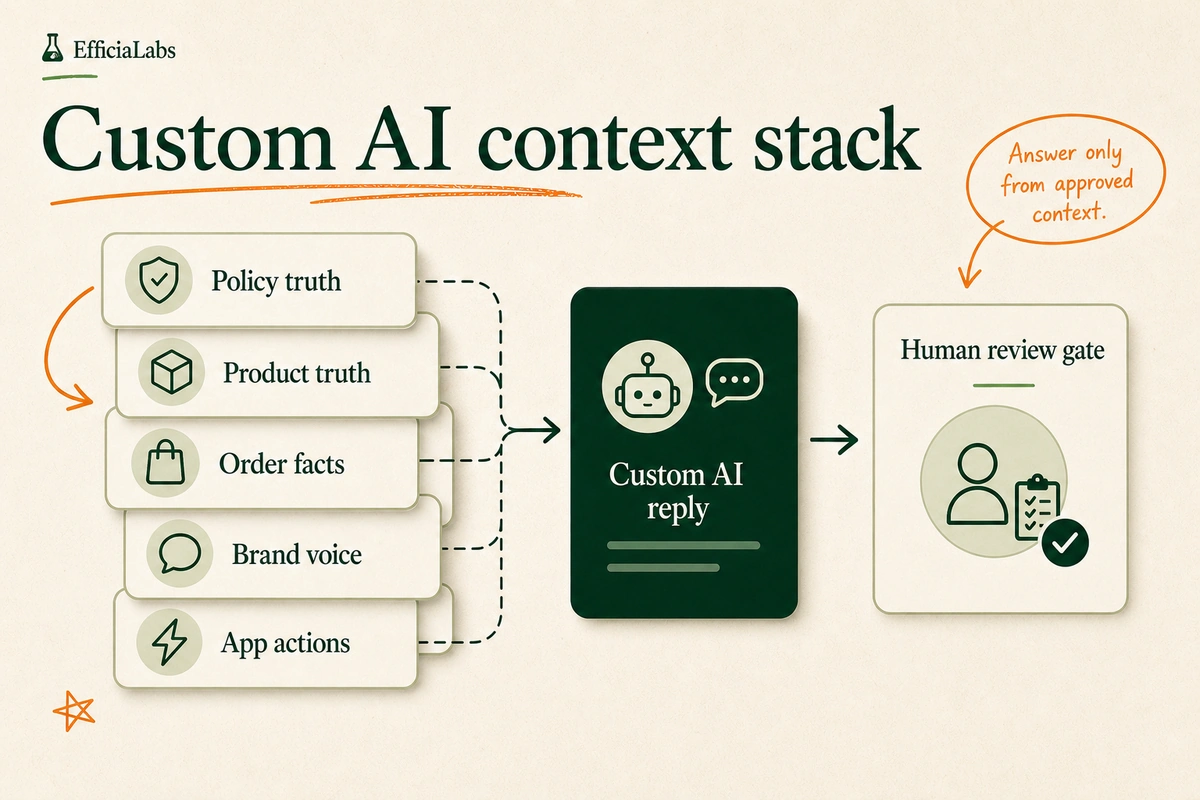
Policy truth. Product truth. Order facts. Inventory logic. Discount rules. Subscription status. Escalation rules. Tone rules. Review rules.
If those live in scattered docs, Slack threads, Shopify notes, Klaviyo flows, and someone’s head, the chatbot is not the problem.
Fresh bread. Burnt oven.
Why should $1M+ DTC brands consider custom AI?
SaaS tools rent you a workflow. Custom AI lets you own the workflow.
For a small store, renting is fine. You need coverage. You need speed. You need to stop answering “Where is my order?” for the hundredth time.
For a $1M+ DTC brand, the math changes.
The bot is no longer just a support shortcut. It touches conversion, retention, product education, and operational load.
Custom AI wins when the brand needs:
- Brand voice rules, not a tone slider.
- Shopify and app API actions.
- Better objection handling for skeptical shoppers.
- Clear marginal AI cost control.
- No forced fit into someone else’s product roadmap.
Do not read this as “custom is always cheaper.”
It is not.
Custom has setup cost, QA, monitoring, and maintenance. A store that needs a 30-minute install should use SaaS.
But once volume grows, the brand should know answer cost, model choice, retrieved context, called actions, and human review gates.
That is why AI in DTC statistics are useful only after the operating question is clear. Adoption is not the goal.
This is where EfficiaLabs usually enters the conversation.
We build custom AI systems for DTC brands that have outgrown “chatbot as widget” thinking. In our work, the best chatbot brief starts as a support complaint and ends as an operations map.
More control over brand voice.
More control over Shopify and app integrations.
More control over marginal cost.
More control over what the AI is allowed to say.
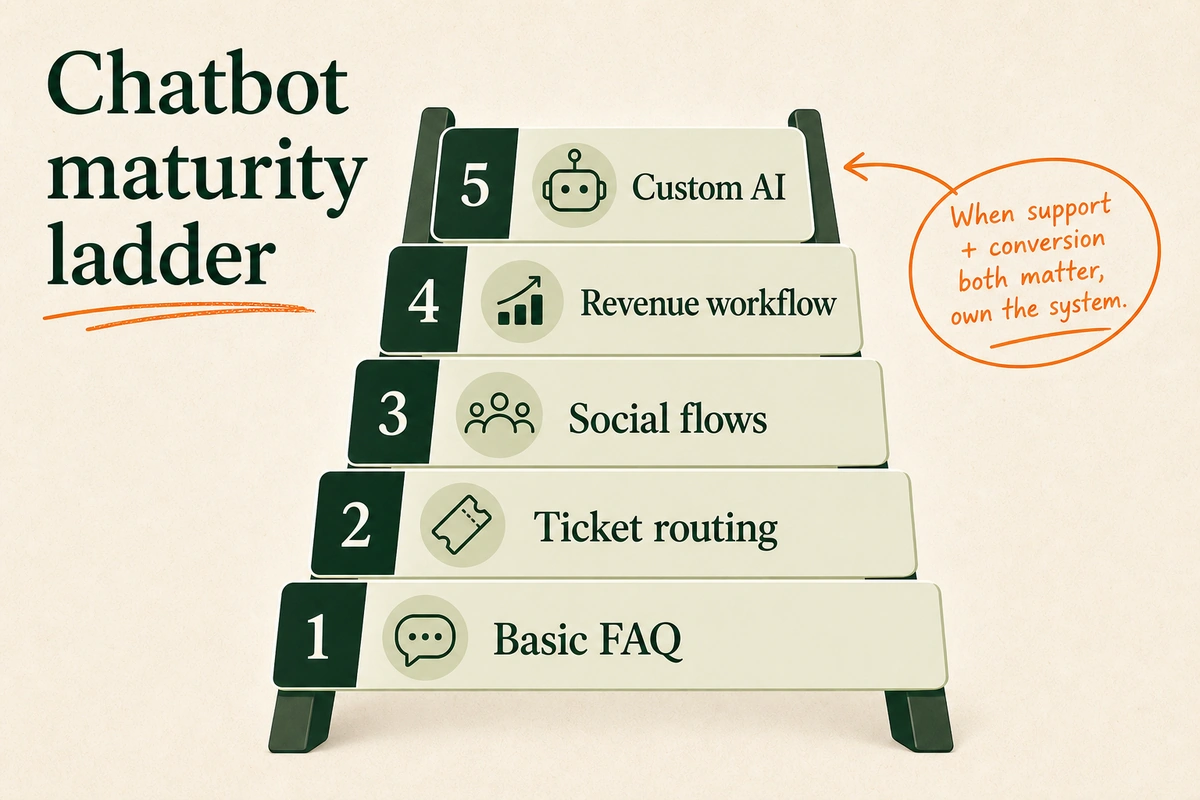
Start with one painful workflow. Support triage. Order lookup. Product discovery. Inventory questions. A skeptical buyer flow.
Then measure what breaks, what converts, and what humans still need to own.
That same pattern applies beyond support. See EfficiaLabs on AI profitability loops for Shopify stores, AI use cases in B2B commerce, and Shopify inventory automation.
Context first. Draft second.
Always.
FAQs about Gorgias vs Tidio vs Manychat vs Chatfuel for ecommerce
Which is best for Shopify stores?
Gorgias is the strongest fit when “best for Shopify” means support operations. Tidio fits Shopify stores that want fast website chat. Manychat fits Shopify brands where social DMs create demand. Chatfuel fits brands that want multi-channel AI across social and web.
Which is best for Instagram and WhatsApp automation?
Manychat and Chatfuel are the strongest fits for Instagram and WhatsApp automation in this comparison.
Manychat is cleaner for social DM automation, comment-to-DM flows, and creator campaign capture. Chatfuel fits broader AI automation across social and web.
Which is best for reducing support tickets?
Gorgias is the clearest pick for reducing support tickets when the store already has meaningful support volume.
Tidio can reduce simple website questions. Chatfuel can help when support questions arrive through social and web. Manychat can reduce repetitive social DMs.
When should a DTC brand build a custom chatbot instead?
Build custom when the chatbot needs to do more than reply.
Good triggers:
- The brand does $1M+ and support or conversion questions show up every day.
- The same buyer objections keep appearing before purchase.
- The team needs Shopify and app actions, not just answers.
- The brand voice is specific enough that generic AI replies feel wrong.
- The cost and quality of SaaS conversations are becoming hard to control.
If the store only needs a quick widget, use SaaS.
If the store needs an AI operating layer, build custom.

No comment yet, add your voice below!