

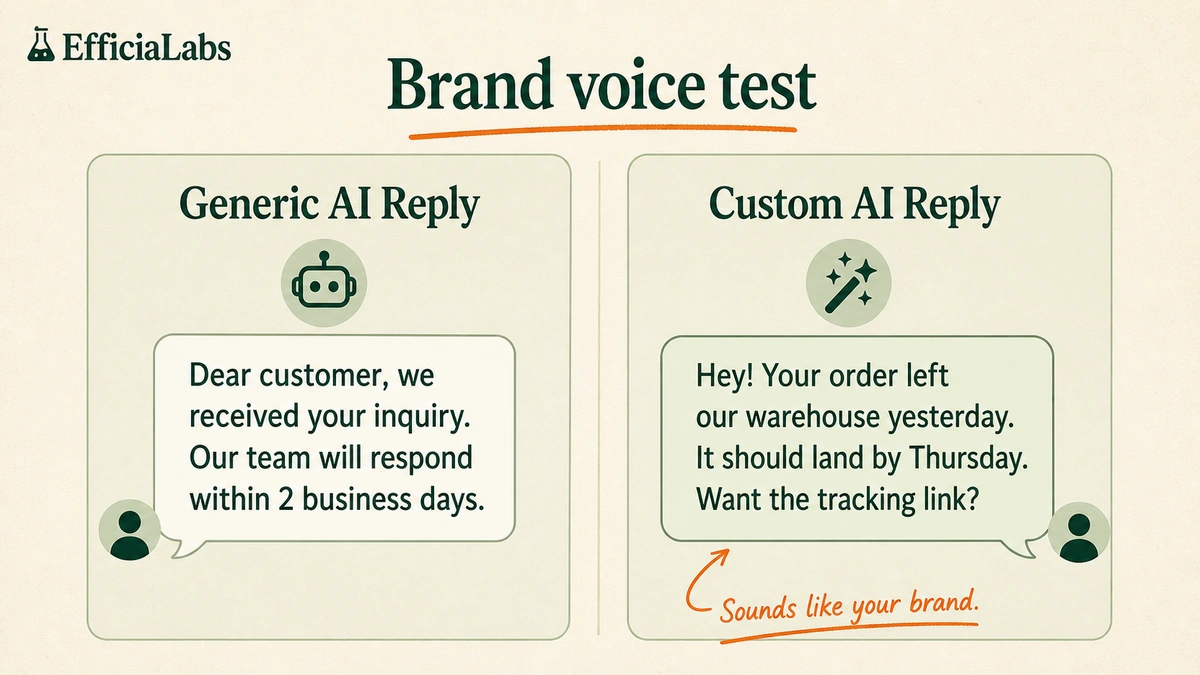
A client sent me a screenshot last month. One of their long-time customers had written in about a delayed order. Stressed, loyal, three years of repeat purchases. What they got back from the Zendesk AI: “Dear Customer, I have received your inquiry and will process it accordingly. Thank you for your patience.”
The brand sells premium candles. Their whole thing is warmth, craft, personal touch. Their human agents write like a friend. The AI wrote like a DMV form.
They were paying $825 a month for it.
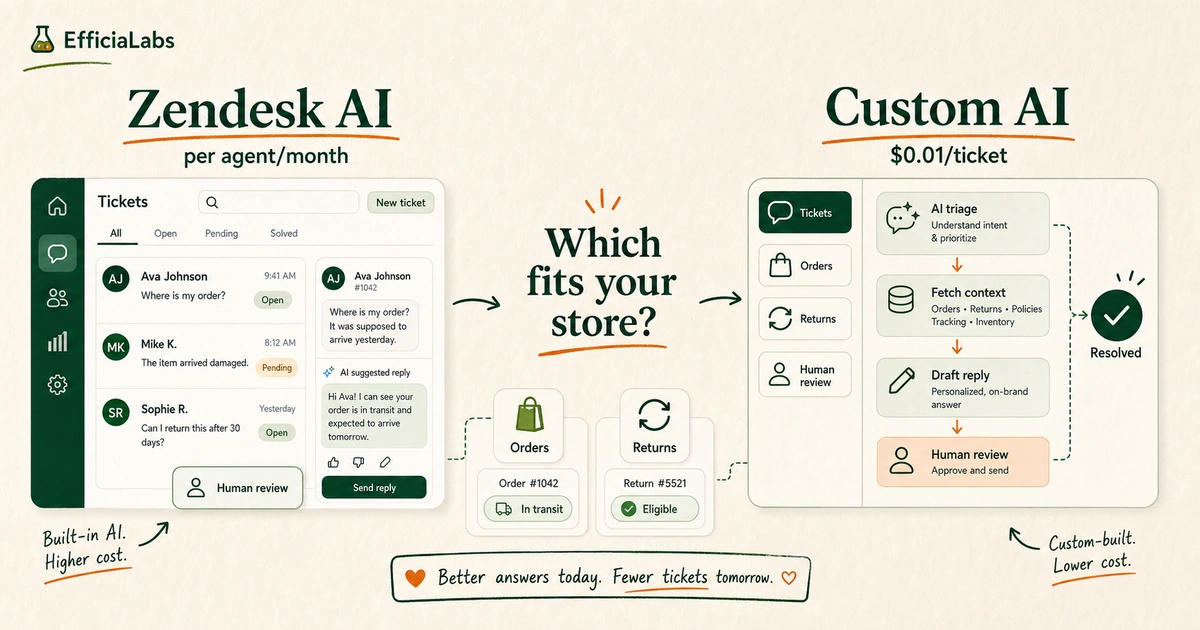
That’s the Zendesk customer support AI vs custom AI problem in one screenshot. Zendesk AI wins in specific scenarios. Custom AI wins in others. Here’s the full math so you can decide which fits your store.
TL;DR
Zendesk AI has three billing layers. Most brands only discover this after signing. Automated Resolutions (AI-closed tickets) are billed above your plan’s included allowance and the per-AR rate is not published.
Custom AI runs at approximately $0.01 per ticket with no per-agent fee and no overage surprises. For Shopify brands that care about brand voice and multi-platform integrations, custom AI is almost always the better long-term fit.
Table of Contents
– TL;DR
– What Zendesk AI actually includes in 2026
– What Zendesk AI actually costs
– What “custom AI” actually means for a Shopify brand
– The real cost comparison
– What Zendesk AI does well
– Where Zendesk AI falls short for DTC brands
– When Zendesk AI still makes sense
– The 3-question framework
– Frequently asked questions
– The verdict
What Zendesk AI actually includes in 2026
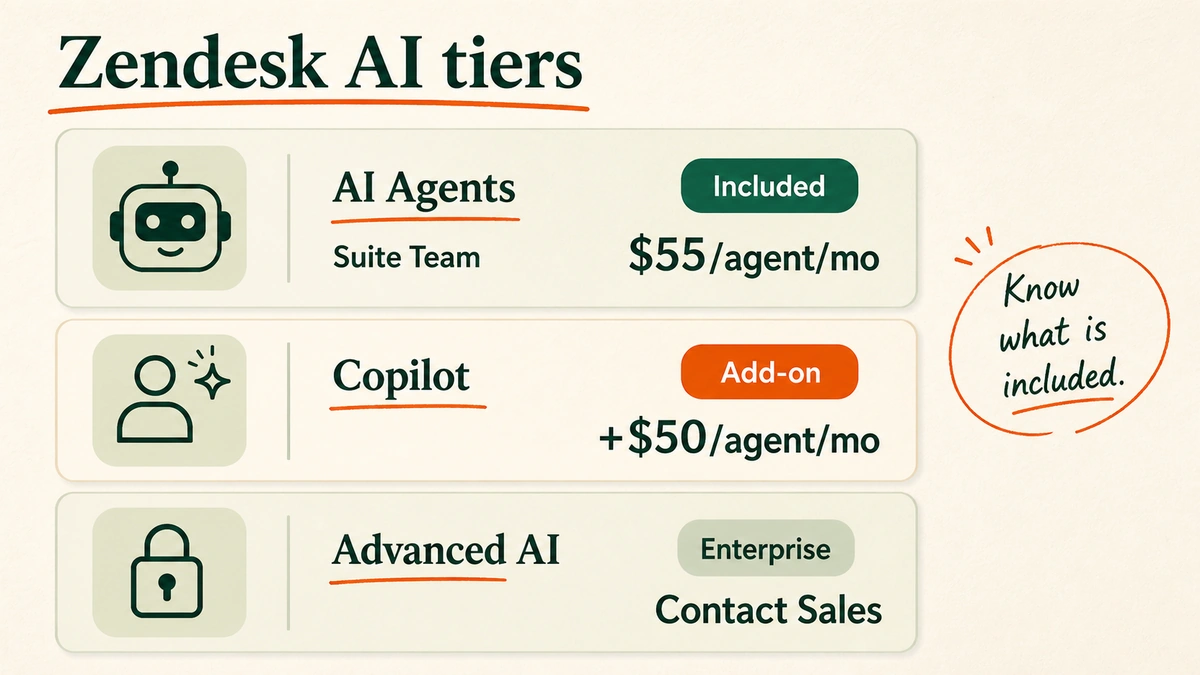
Zendesk AI is not one product. It is three. Each priced or gated separately.
AI Agents
Included in Suite Team at $55 per agent per month. These are the bots that handle front-line replies: FAQs, order status, return policy questions. They respond without a human touching the ticket. This is the layer most brands assume they are buying when they sign a Zendesk contract.
Copilot
An add-on at $50 per agent per month. Copilot does not automate. It assists. It drafts replies for your human agents to review before sending. Useful if your brand has high-stakes tickets where every reply needs a human check. Not useful if your goal is to reduce the number of humans needed.
Advanced AI
Enterprise only. Contact sales. Intelligent triage, generative AI for voice, sandbox environments. If you are running a 10–25 person Shopify brand, this tier is not for you.
The point: most brands signing Zendesk contracts think “AI is included.” It is. But the AI that actually resolves tickets autonomously (AI Agents) is just the entry layer.
Getting to the full AI stack costs significantly more, and the pricing is layered in a way that is easy to miss.
What Zendesk AI actually costs
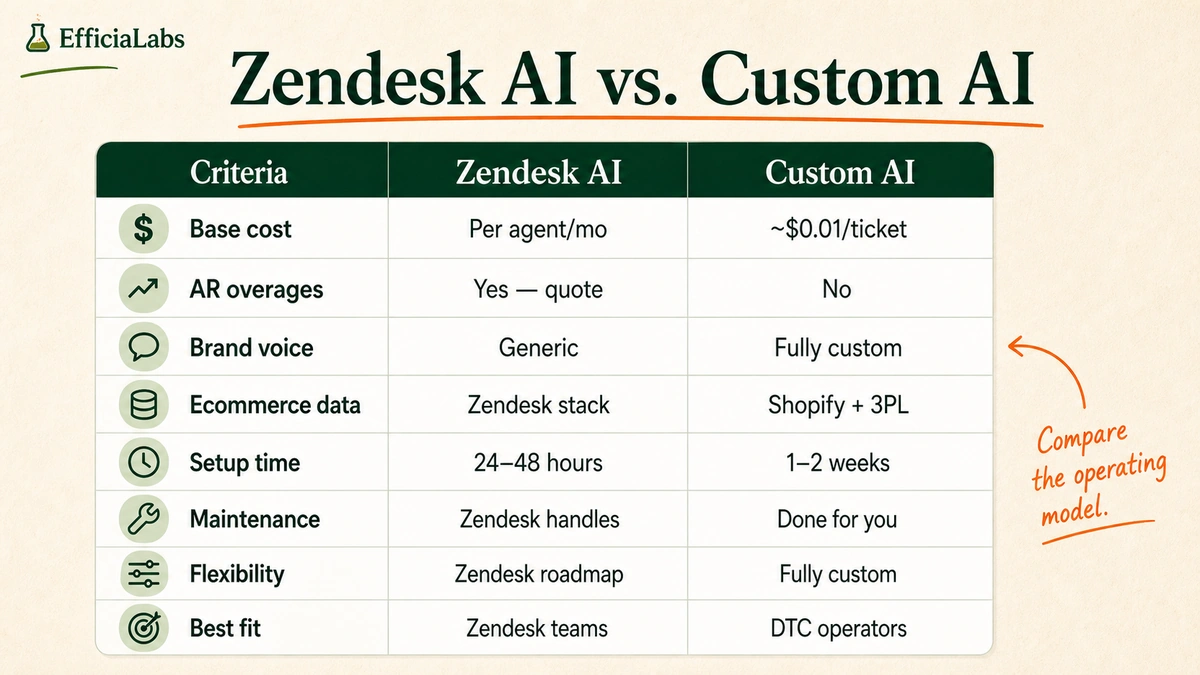
The headline numbers: Suite Team is $55 per agent per month. Suite Professional is $115 per agent per month. Copilot adds $50 per agent per month on top of any Suite plan.
A five-agent team on Suite Professional with Copilot: $165 × 5 = $825 per month.
But that is the base. There is a second layer most brands miss.
Every Zendesk Suite plan includes a set number of Automated Resolutions (ARs): tickets fully closed by AI without human involvement. Once you exceed that included allowance, Zendesk charges per additional AR. The per-AR overage rate is not published on their pricing page. You have to contact sales to get it.
In practice: at 500 tickets per month you are almost certainly within your included AR allowance. At 2,000 or 5,000 tickets per month, you are almost certainly exceeding it. Your true monthly cost is higher than the plan rate.
Pro tip: Before signing any Zendesk AI contract, ask specifically: “How many Automated Resolutions are included in my plan tier, and what is the per-resolution overage rate?” If they cannot give you a clear number, that is information.
What “custom AI” actually means for a Shopify brand
Not a developer project. That is the misconception worth clearing up first.
Custom AI for customer support means an AI built specifically for your store: trained on your tone, your product catalog, your return policy, your edge cases, integrated into your actual stack without your team writing a single line of code.
We build it, deploy it, maintain it. You connect your platforms and approve the voice guidelines. That is roughly the full extent of the effort on your side.
In our work with DTC brands, I have seen this framing consistently catch founders off guard. They expect a six-month engineering project. It is not that.
The customer service AI chatbot for Shopify guide covers the technical side if you want to go deeper.
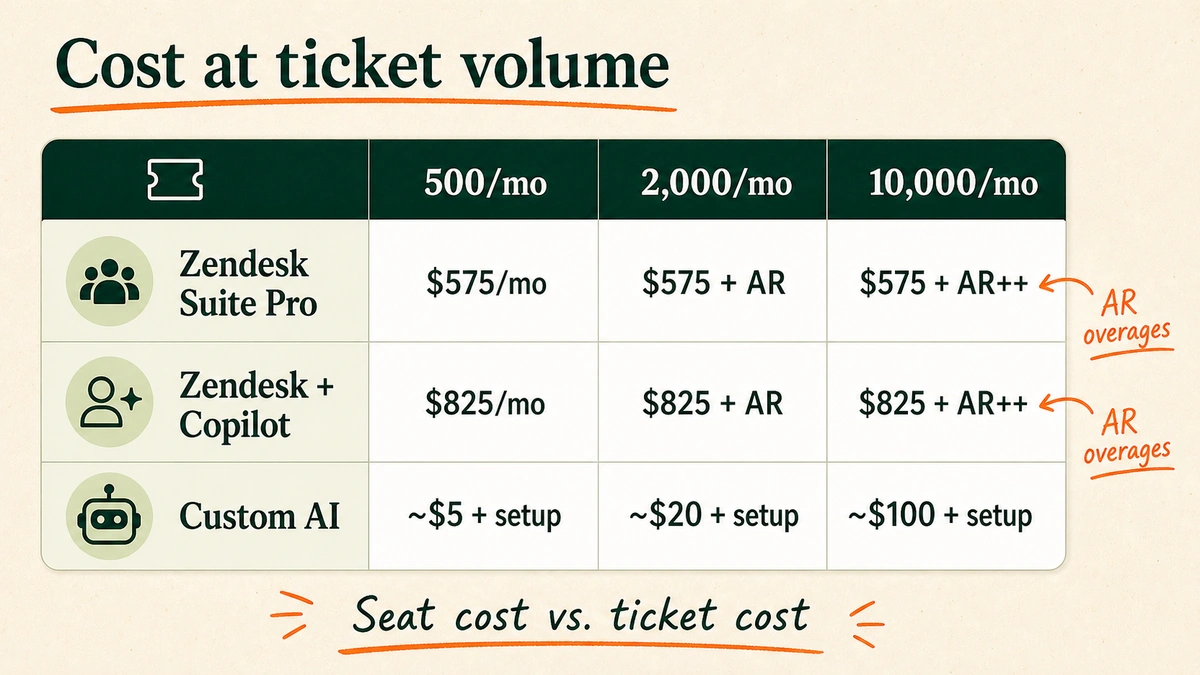
The integration layer is where custom AI pulls ahead. A custom build can connect to:
- Support platforms: Zendesk, Gorgias, Gmail, Freshdesk: wherever your tickets live today, without switching platforms
- Ecommerce ops: Shopify (live order data, inventory), Loop Returns (return eligibility and status), 3PL shipping providers like ShipBob and ShipStation
- Financial and vendor systems: payment platforms, discount apps, vendor databases, bank account integrations
When a customer asks “Where is my order?” the AI checks live shipment data and answers accurately. When they ask “Can I return this?” the AI checks the order date against your policy and gives a real answer.
Not a scripted deflection. Not “we will get back to you.” An answer.
The real cost comparison
A hypothetical: a 15-person Shopify brand in the US. Five support agents. 3,000 tickets per month.
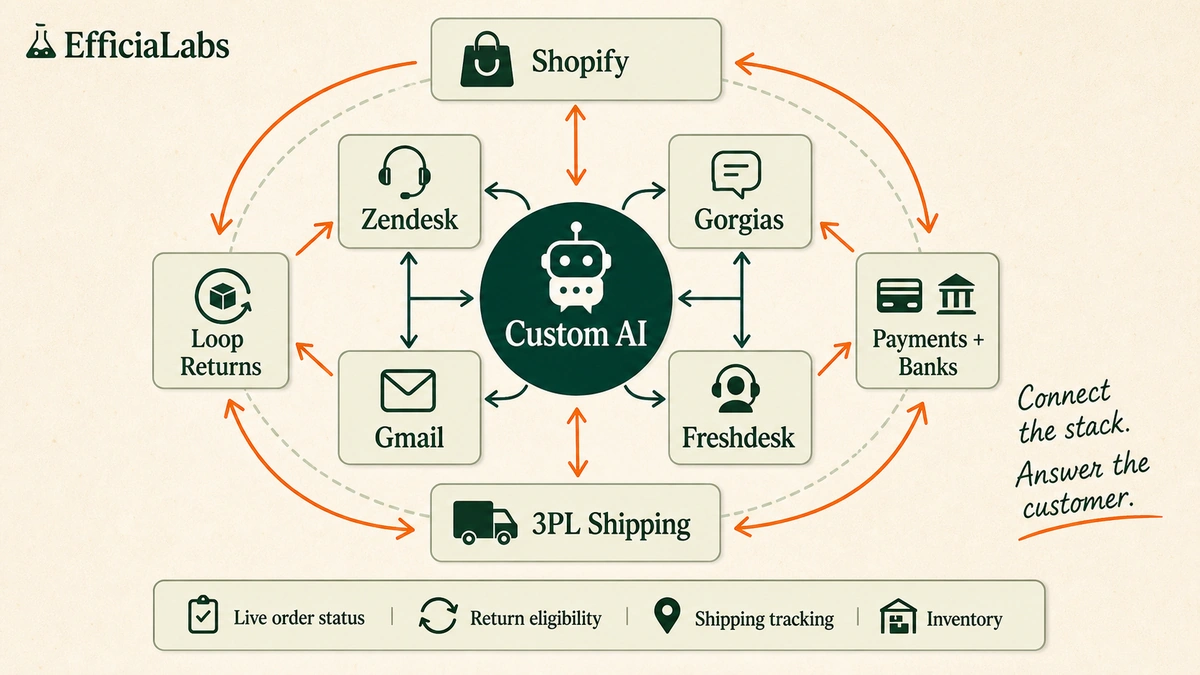
| Ticket volume | Zendesk Suite Pro (5 agents) | Zendesk + Copilot (5 agents) | Custom AI |
|---|---|---|---|
| 500 per month | $575/mo | $825/mo | ~$5/mo + setup |
| 2,000 per month | $575 + AR overages* | $825 + AR overages* | ~$20/mo + setup |
| 10,000 per month | $575 + significant AR overages* | $825 + significant AR overages* | ~$100/mo + setup |
*Zendesk does not publish per-AR overage rates. Request a quote before committing.
Zendesk’s cost is anchored to headcount. Five agents always costs five times the plan rate, regardless of whether AI handles 10% or 90% of tickets.
Custom AI scales with actual usage. At $0.01 per ticket, 3,000 tickets per month costs $30 to run.
The setup cost is a one-time investment. At the cost difference between $825 per month and $30 per month, the math pays back quickly. For broader context on how DTC brands are using AI to improve unit economics, 49 AI in DTC statistics for 2026 is worth reading before any tooling decision.
What Zendesk AI does well
Credit where it is due.
Zendesk AI has real advantages for specific use cases:
- Fast deployment: 24–48 hours from signup to live AI agents. No new vendors to evaluate or onboard.
- Built-in QA automation: Monitors reply quality, flags outliers, and gives your support team a weekly performance scorecard.
- Native analytics and reporting built directly into the workspace.
- High automation ceiling: AI agents can automate up to 80% of customer interactions in well-configured deployments. h/t Zendesk CX Trends 2025
- Multilingual support: 79 languages on the Advanced tier. Useful if you sell globally without human translators.
For brands where support is a cost center, where the goal is tickets closed correctly without particular attention to tone: Zendesk AI delivers.
Note: The 79-language multilingual capability is exclusive to the Advanced tier, which is enterprise-only and requires a sales conversation. Suite Team and Suite Professional have more limited language coverage out of the box. I have not seen a custom AI deployment match that full language breadth without specific build work for each target market.
Where Zendesk AI falls short for DTC brands
Brand voice
Zendesk AI replies in a generic help-desk register. Formal. Correct. Impersonal. You can add instructions to the bot configuration, but you are working against the platform’s defaults. The result is usually still a notch below what a human agent trained in your voice would write.
For a brand where the post-purchase experience is part of the product (beauty, wellness, premium apparel, anything with a community), generic AI replies are a brand problem, not just a CX problem. We’ve tested this across DTC brands in beauty, home goods, and outdoor gear: the gap in perceived brand quality between generic and custom AI replies is noticeable from the first ticket. The guide on how to match AI voice to your brand voice in customer support goes deeper here, but the short version: “Dear Customer” is a churn signal.
Ecommerce integrations
Zendesk AI operates within the Zendesk ticket record. It does not natively pull live Shopify order data, Loop Returns eligibility, or 3PL shipment tracking. You can build custom integrations through their API, but that is an engineering project, and you are back to needing a developer.
Flexibility and roadmap lock-in
You are on Zendesk’s product roadmap. New features ship when Zendesk decides. Pricing models change when Zendesk decides. The per-AR billing layer, for example, appeared as Zendesk shifted toward usage-based pricing. If your support workflows depend on specific AI behavior, changes you did not request will affect you.
Ticket volume economics
The platform fee does not get cheaper as you scale. 10,000 tickets at $0.01 is $100 per month. 10,000 tickets on Zendesk is $575 at minimum, plus whatever AR overages the volume triggers.
When Zendesk AI still makes sense
Honest answer: there are real scenarios where Zendesk is the right call.
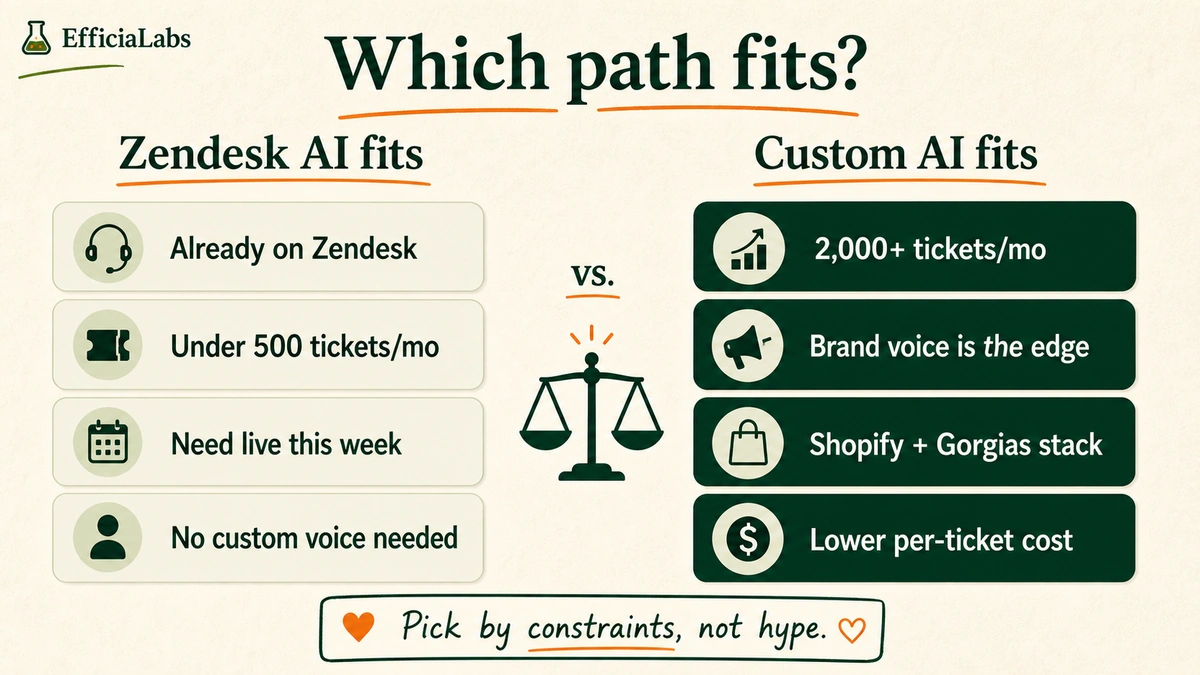
- You are already fully committed to the Zendesk workspace and the switching cost is real.
- You need AI live this week, not in two weeks.
- You are processing fewer than 500 tickets per month and the cost difference does not justify the disruption.
- Your team relies on Zendesk’s built-in reporting, macros, and workflow automations that would take time to rebuild elsewhere.
In these situations, the disruption outweighs the savings.
Where it gets harder to justify: if you are already paying for Suite Professional plus Copilot at $825 per month and your AI replies still sound generic. That is the scenario where the math and the brand impact both point toward custom.
If you are evaluating ticketing platforms more broadly, Gorgias vs Tidio vs Manychat vs Chatfuel for ecommerce covers how the main options compare for DTC brands.
The 3-question framework
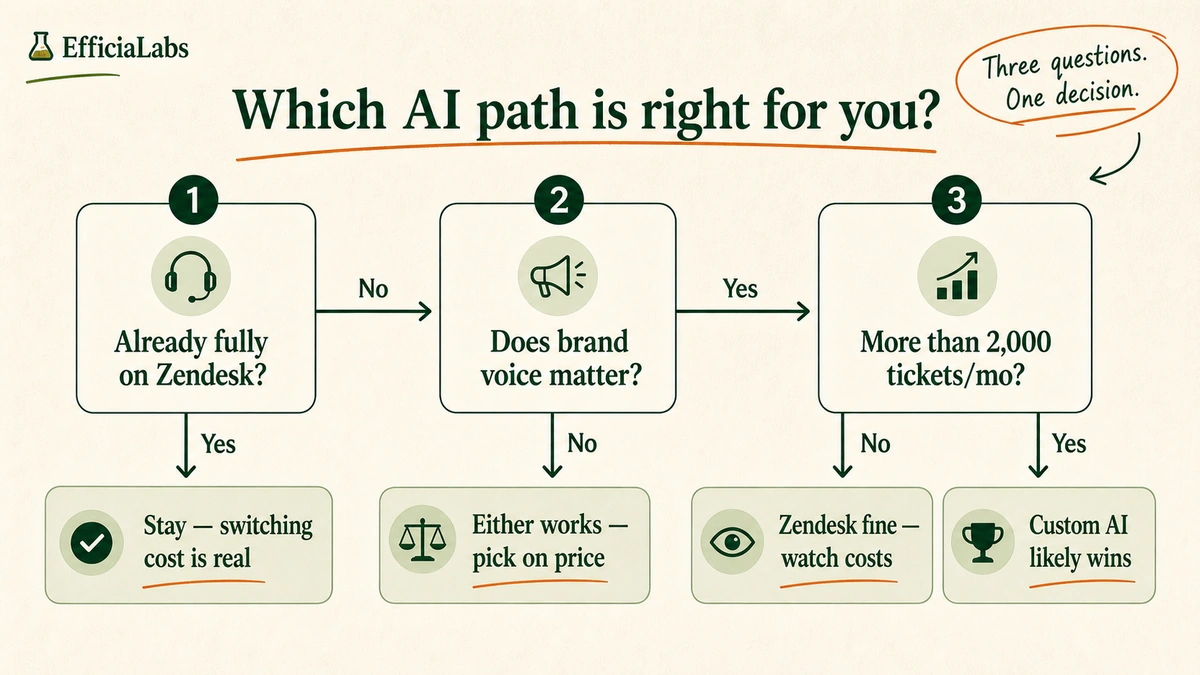
Not sure where you fall? Three questions.
Q1: Are you already fully committed to Zendesk?
If yes, and your agents live in the Zendesk workspace daily, the switching friction is real. Custom AI can layer on top of Zendesk, so you do not have to rip anything out, but you are adding a vendor. Still worth evaluating the cost math. Go to Q2.
If no, you are choosing your stack fresh. Go to Q2.
Q2: Does your brand voice matter to your customers?
If no, cost is probably your only decision variable. Run the numbers from the table above.
If yes, and your brand is built on warmth, personality, or a specific tone your customers recognize and respond to, generic AI replies carry risk. One “Dear Customer” to the wrong customer at the wrong moment is a review. Go to Q3.
Q3: Do you process more than 2,000 tickets per month?
Pro tip: Check your support platform’s analytics dashboard before answering this. The number you need is total monthly ticket resolutions: that is the AR count Zendesk would bill against.
If no: Zendesk AI works for now. Watch what happens to your bill when you hit AR overages as volume grows.
If yes: custom AI almost certainly wins on cost alone before you factor in brand voice or integrations. The setup investment pays back within a few months at that volume.
Frequently asked questions about Zendesk AI vs. custom customer support AI
Is Zendesk AI good for small ecommerce stores?
For stores processing under 500 tickets per month that are already on Zendesk, yes. The AI Agents tier is included in Suite Team at $55 per agent per month, setup is fast, and the cost difference versus custom AI at low volume is small. The main limitation at any size is brand voice. Zendesk’s AI replies are generic by default.
How much does Zendesk AI actually cost per ticket?
It depends on your volume and whether you are exceeding your included Automated Resolutions allowance. A five-agent team on Suite Professional paying $575 per month across 2,000 tickets works out to $0.29 per ticket at the base rate, assuming you stay within your AR allowance.
Once you exceed it, the per-AR overage adds to that cost. Zendesk does not publish the overage rate.
Custom AI runs at approximately $0.01 per ticket at any volume. For a broader look at the provider landscape, the best company for ecommerce AI customer care compares how providers are structured.
Can custom AI integrate with Shopify order data?
Yes. Custom AI connects to Shopify’s API to pull live order status, shipping tracking, inventory levels, and return eligibility. It answers “Where is my order?” with a real tracking update and “Can I return this?” with a policy-based yes or no. No human in the loop. This is the most common reason DTC brands choose custom over platform AI.
How long does it take to build and deploy custom AI?
In our experience, a basic custom AI deployment takes one to two weeks from kickoff to live. That includes brand voice calibration, integration setup across your platforms, and a QA pass to confirm replies meet your standards.
Nothing goes live until the output sounds right. If you want a full breakdown of what the build involves, the customer service AI chatbot for Shopify guide covers the architecture and process.
Does EfficiaLabs replace Zendesk, or work alongside it?
Either. We build on top of Zendesk: the AI handles Tier-1 tickets automatically while your agents manage escalations in the Zendesk workspace as before. Or we replace it entirely if the brand is ready to move to Gorgias, Gmail, or another platform.
Most of the stores we work with are not on Zendesk. They use Gorgias or Gmail, and we build directly into those.
The verdict
If you are fully committed to Zendesk and processing fewer than 500 tickets per month, the economics do not justify switching. Use Zendesk AI. Keep a close eye on your AR usage as volume grows.
If you are above 2,000 tickets per month, care about how your replies sound, and want AI that pulls live data from your Shopify store: custom AI wins. The cost is lower, the brand fit is better, and you are not dependent on Zendesk’s roadmap decisions.
The same framework applies if you are on Gorgias instead of Zendesk. The breakdown is in Gorgias customer support AI vs custom AI: which is better?. If you want a broader comparison of AI customer care providers by fit and cost, the best company for ecommerce AI customer care in 2026 covers the full landscape.
Ecommerce founders already have enough on their plate. If the math points to custom AI and you want it built, deployed, and maintained without your team touching anything technical: that is what we do. Every client I work with gets my personal attention, and we do not call it done until the replies sound like your brand.
Reach out when you are ready.
— Vai
Sources
- Zendesk Suite pricing: zendesk.com/pricing (verified June 2026)
- Zendesk AI features overview: zendesk.com/service/ai
- Zendesk AI Agent tier comparison: gravity.cx/blog/zendesk-ai-agent-advanced-guide
- Zendesk Automated Resolutions overage pricing: not publicly disclosed on zendesk.com/pricing as of June 2026. Contact Zendesk sales directly for current per-AR rates and included AR counts per plan tier before signing.

No comment yet, add your voice below!