

Here is how to match AI voice your brand voice in customer support: give the AI the same operating context you would give a new CX hire. Strong reply examples. Product facts. Policy rules. Banned phrases. Escalation triggers. Weekly review. A tone prompt gives you polite sameness. A support system gives you replies that sound like you and stay accurate.
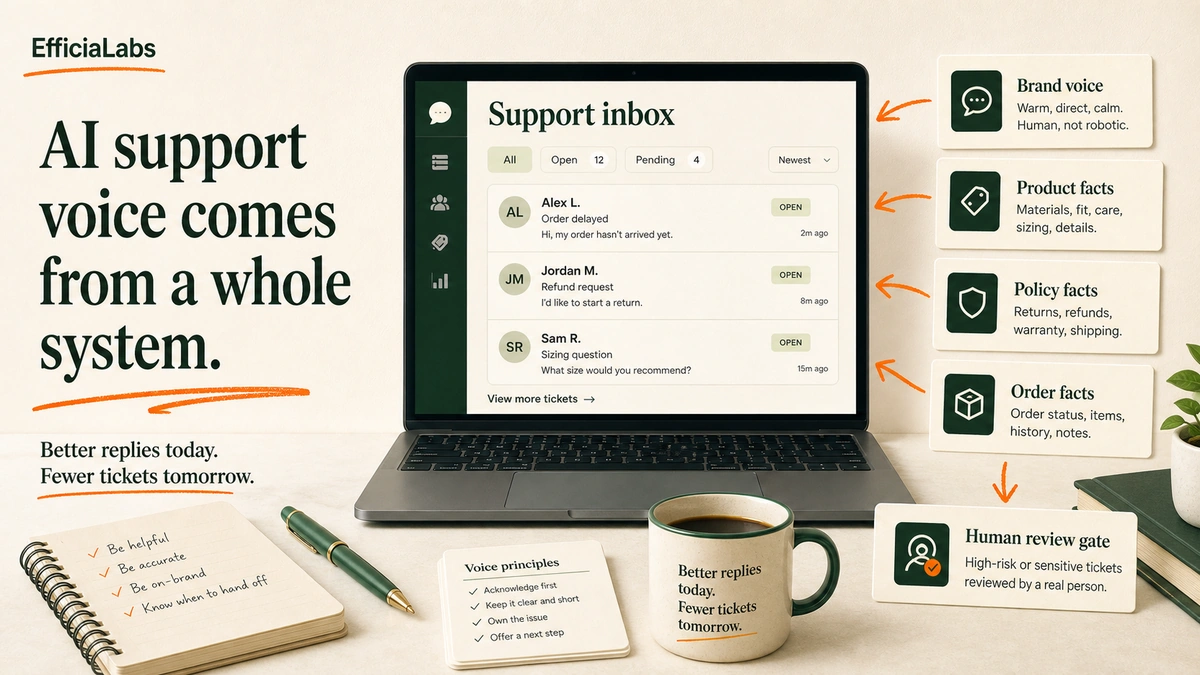
A customer writes:
“This was supposed to arrive yesterday. I needed it for a trip.”
Bad:
“We sincerely apologize for the inconvenience and appreciate your patience.”
Looks fine. Feels dead.
Better:
“That timing is frustrating. Send me your order number and I’ll check what happened before we make the next move.”
Same problem. Different human.
That is the gap. Most AI support tools can answer. Fewer can answer in your brand’s voice while respecting policy, shipping rules, and customer mood.
Table of Contents
- In a sentence
- How to match AI voice your brand voice in customer support without generic replies
- What does brand voice mean in a support ticket?
- Build the AI support voice pack before touching prompts
- Turn your voice into rules the AI can follow
- Use this prompt to test whether AI has your voice
- Set escalation rules so on-brand does not become risky
- Review AI replies weekly like a CX lead, not a prompt hobbyist
- FAQs about matching AI voice to your brand voice in customer support
In a sentence
AI support voice is not tone alone. It is tone plus product truth, policy truth, order facts, handoff rules, and review. The job is not to make AI sound pleasant. The job is to make it sound like your best CX hire on a good day.
How to match AI voice your brand voice in customer support without generic replies
Yes. But not by asking it to “be friendly.”
That is how you get airport-lounge English. Smooth. Pleasant. Nobody’s.
The reason is simple. AI defaults to the average of what it has seen unless you give it stronger local truth. Contentstack frames this as the sameness problem: generic AI creates tone drift, terminology errors, and bland consensus when it is not grounded in brand-specific rules.
Support makes this harder than marketing.
In a welcome email, the reader is calm. In support, the customer is often annoyed, worried, rushed, or asking about money. A cute brand voice can become irritating on a damaged-item ticket. A casual voice can become risky on a refund exception. A confident voice can become dangerous if the AI invents a policy.
This is why I do not treat AI support voice as a copywriting task. In our work with Shopify brands, the better analogy is onboarding a new CX hire.
You do not tell a new hire, “Be warm and helpful,” then leave them alone in Gorgias.
You show them the best replies. You explain when to apologize. You give them the refund policy. You tell them which tickets go to a senior agent. Then you review their work until the pattern sticks.
Do the same with AI.
What does brand voice mean in a support ticket?
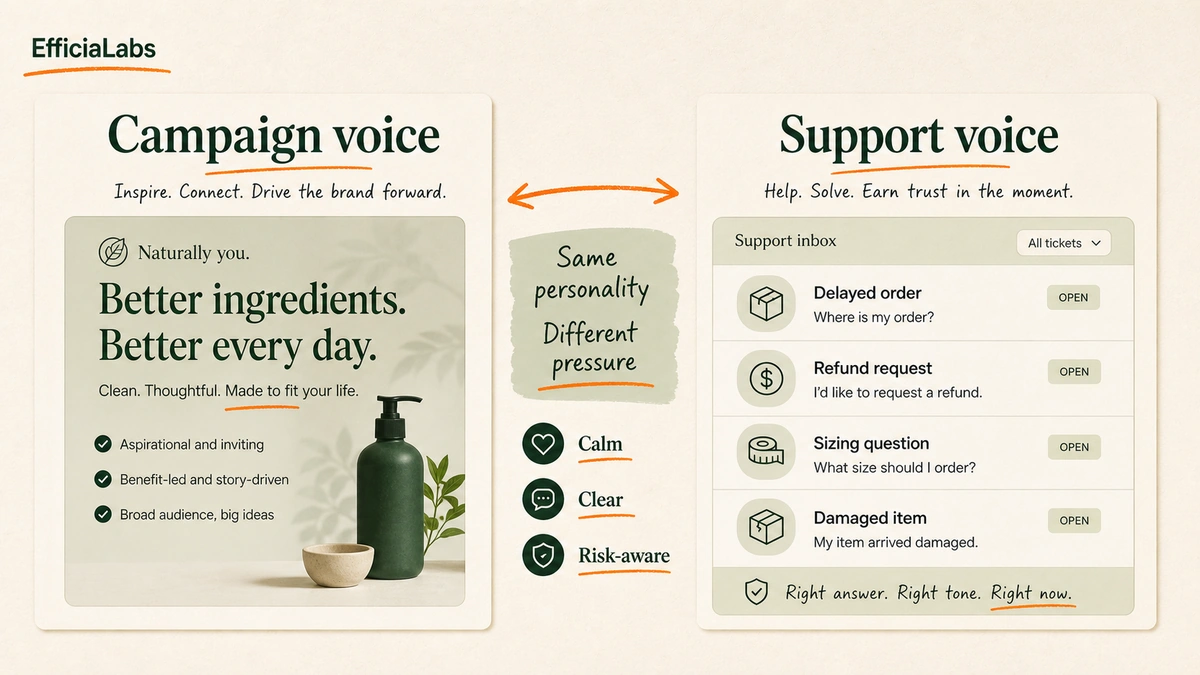
Brand voice is the stable personality behind how your brand communicates. In support, tone is how that personality adjusts to the ticket in front of it.
Why this article exists:
- In 2026, Contentstack names 3 common failure modes: tone drift, terminology errors, and perspective loss.
- In 2026, Gorgias organizes support-voice guidance around 4 operating moves: guidance, help resources, feedback, and regular training.
- In 2026, Gleap answers 3 chatbot voice questions, but stays broad on Shopify support operations.
Marketing voice can be punchy. Support voice needs judgment.
A skincare brand can sound calm and sensory in campaigns. But if a customer reports irritation, the support reply must become precise, careful, and escalation-ready. A sportswear brand can sound energetic on Instagram. But when a VIP order misses a race weekend, the reply should be fast, accountable, and specific.
Use this working table:
| Ticket type | AI tone | Must include | Hand off when |
|---|---|---|---|
| Delayed order | Calm, direct | Tracking status, next step, timeline caveat | Customer needs it by a fixed date |
| Refund request | Clear, fair | Return window, condition rules, link or next step | Outside policy or repeat complaint |
| Sizing question | Helpful, practical | Fit notes, measurements, exchange policy | Customer mentions medical, safety, or event deadline |
| Damaged item | Accountable | Photo request, replacement path, apology | Expensive item or second failure |
| VIP or influencer | Personal, careful | Acknowledge relationship, avoid canned reply | Any complaint, deadline, or public post threat |
Notice what is missing.
“Friendly.”
Friendly is not enough. The AI needs to know what helpful looks like when the customer is confused, annoyed, or one reply away from a chargeback.
The Gorgias guide on AI tone of voice gets close to this support reality. It points to help docs, macros, feedback, and handover rules as training inputs for AI Agent. That matters because the reply style and the reply source are connected.
The voice improves when the facts improve.
Build the AI support voice pack before touching prompts
Most teams start with the prompt.
Wrong order.
Start with the pack.
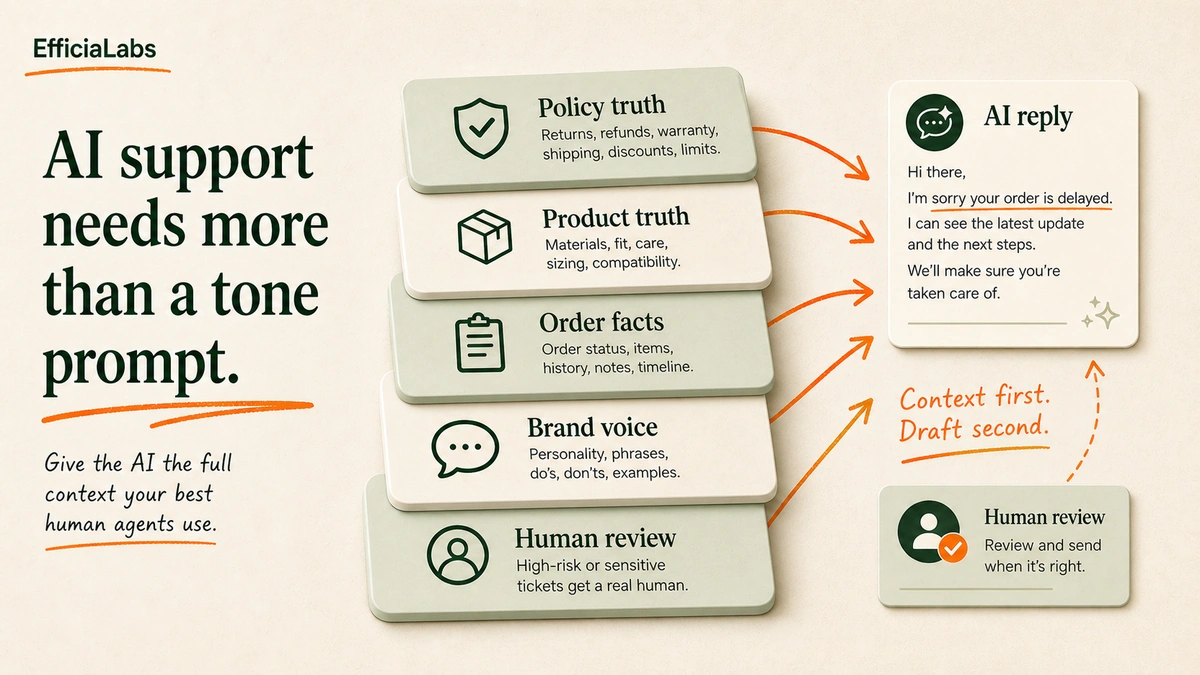
An AI support voice pack is the small, practical version of your brand book. It is not a 40-page PDF. It is the material the AI needs to write support replies the way your best agent would.
Build it from these parts:
- 10-20 strong past support replies: Pick replies that sound like the brand and solved the ticket cleanly.
- Best macros: Include the macros agents actually use, not the ones nobody trusts.
- Refund, shipping, warranty, discount, and cancellation policies: Use the latest approved language.
- Product language from PDPs: Pull how you describe fit, materials, bundles, ingredients, use cases, care instructions, and limitations.
- Customer review language: Capture how customers describe the product in their own words.
- Founder or brand phrases: Add the phrases that make the brand recognizable without turning the AI into a parody.
- Banned words and risky claims: Include phrases the AI must never use.
- Escalation rules: Tell the AI when to stop drafting and route the ticket to a person.
Pro tip: Keep the first voice pack short enough for a CX lead to edit in one sitting. A useful 2-page pack beats a beautiful brand book nobody updates.
This is also where custom AI starts to matter. A generic chatbot can store a voice prompt. A serious customer service AI chatbot for Shopify needs product data, order data, policy data, help docs, and review gates in the same workflow.
Tiny example.
If your brand sells lotion candles, “soy candle” can be the wrong phrase. The right phrase might be “lotion candle” or “cosmetic grade soy wax.” That is not a tone issue. That is product truth.
If your brand avoids medical claims, the AI must know that “helps eczema” is not allowed, even if a customer review says it.
If your brand has a 30-day return window, the AI must not offer 45 days because it wants to sound generous.
Voice is not decoration.
It is the way your rules show up in a reply.
Turn your voice into rules the AI can follow
Adjectives are where brand voice projects go to die.
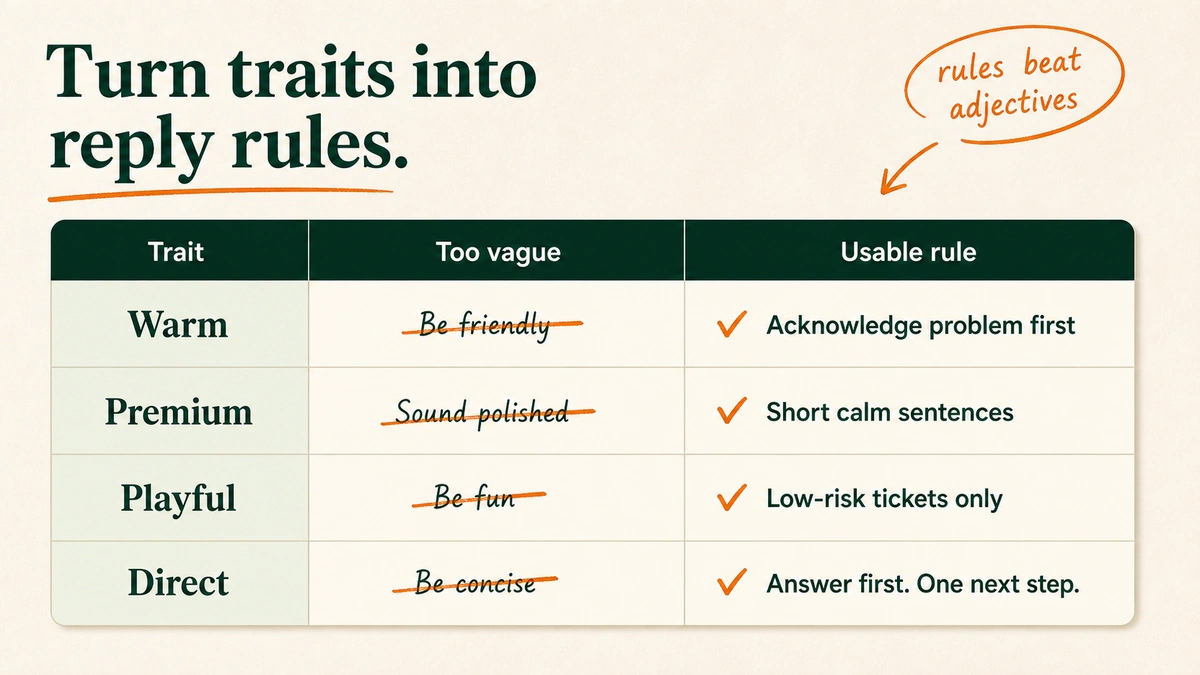
“Warm.” “Premium.” “Playful.” “Helpful.” Fine for a workshop. Weak for an AI system.
Translate each trait into observable behavior:
| Voice trait | Bad instruction | Better support rule |
|---|---|---|
| Warm | Be warm and friendly | Acknowledge the customer’s problem in the first sentence before giving instructions. |
| Premium | Sound premium | Use short, calm sentences. No slang. No over-apologizing. No exclamation marks on complaint tickets. |
| Playful | Be fun | Use light phrasing only on low-risk tickets like sizing, product discovery, or order excitement. |
| Direct | Be concise | Lead with the answer. Then give one next step. Avoid three-paragraph explanations. |
Here is the difference.
Off-brand:
We sincerely apologize for the inconvenience and appreciate your patience while we look into this matter.
On-brand:
That should not have arrived that way. Send us a photo and your order number and we’ll fix it.
Same function. Less fog.
The Reddit operator thread captured the real-world version of this. One ecommerce commenter said people expect AI to “just know their vibe,” but it works more like training a new employee with feedback and a style guide. h/t r/ecommerce.
AI can get close, but only if you feed it the right context. – Bart At Tidio
That is the mental model.
Do not ask the AI to have taste. Give it examples of taste.
Use this prompt to test whether AI has your voice
Do not test voice on fake happy-path tickets.
Test it where your team normally edits the most.
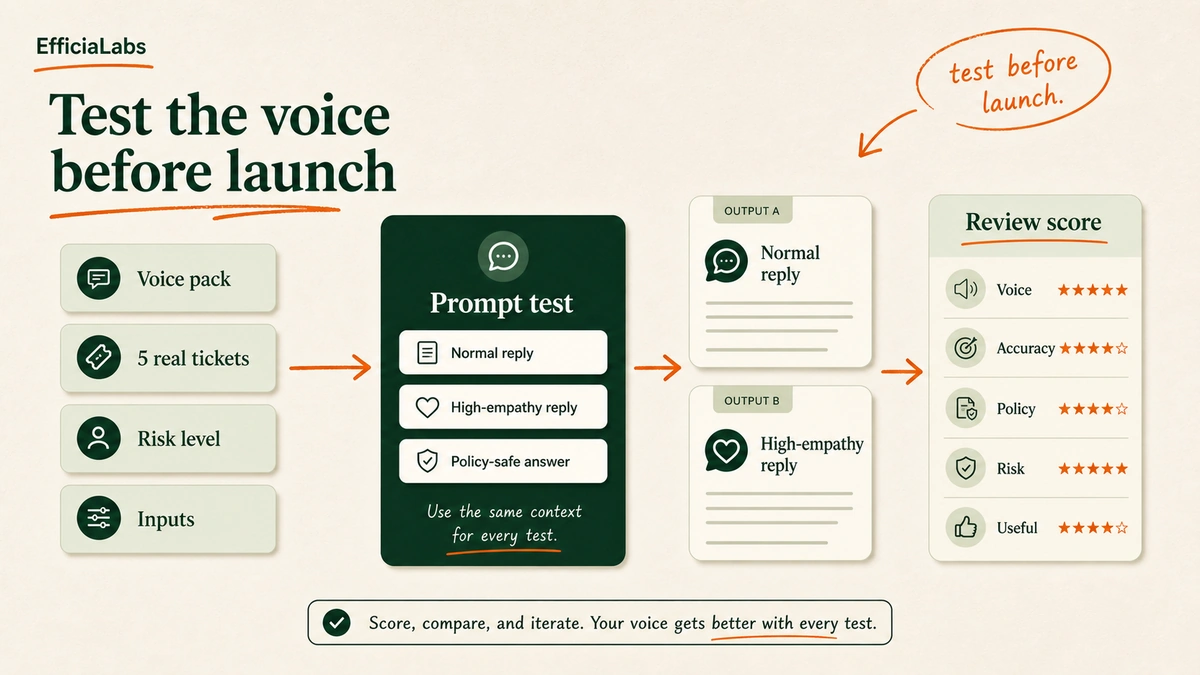
Pick 5 real tickets:
- A delayed order with a fixed customer deadline.
- A refund request outside policy.
- A sizing question from a first-time customer.
- A damaged item with a photo attached.
- A frustrated subscription customer asking to cancel.
Then ask the AI for two drafts per ticket: normal and high-empathy. Score each one from 1-5 on voice, accuracy, policy fit, risk, and usefulness.
This is the same reason brands compare Claude for Shopify customer support against other models on nuanced tickets. Model choice matters. But the voice pack and review loop matter more.
Use this prompt:
You are drafting customer support replies for a Shopify brand.

Use the support voice pack below as your source of truth.

Support voice pack:
[PASTE BRAND VOICE RULES]
[PASTE PRODUCT FACTS]
[PASTE REFUND, SHIPPING, WARRANTY, DISCOUNT, AND CANCELLATION POLICIES]
[PASTE 10-20 EXAMPLE REPLIES]
[PASTE BANNED WORDS AND CLAIMS]
[PASTE ESCALATION RULES]

Task:
Draft replies to the 5 customer tickets below.

For each ticket, give:
1. Normal reply
2. High-empathy reply
3. Risk level: Low, Medium, or High
4. Handoff recommendation: AI can answer, human should review, or human must answer
5. One sentence explaining which brand voice rule you used

Constraints:
- Lead with the customer's actual issue.
- Do not invent policy exceptions.
- Do not promise refunds, replacements, discounts, timelines, or outcomes unless the policy text allows it.
- Do not use banned words or risky claims.
- Keep each reply under 90 words unless the ticket requires more detail.

Tickets:
[PASTE 5 REAL TICKETS]
After the test, do not rewrite everything.
Look for patterns:
- Too long? Add a length rule.
- Too fake-warm? Add banned phrases.
- Too casual on complaints? Add risk-based tone rules.
- Too many policy guesses? Tighten the source of truth.
- Missed escalations? Add handoff triggers.
Better replies today. Fewer edits tomorrow.
Set escalation rules so on-brand does not become risky
An AI reply can sound perfect and still be the wrong reply.
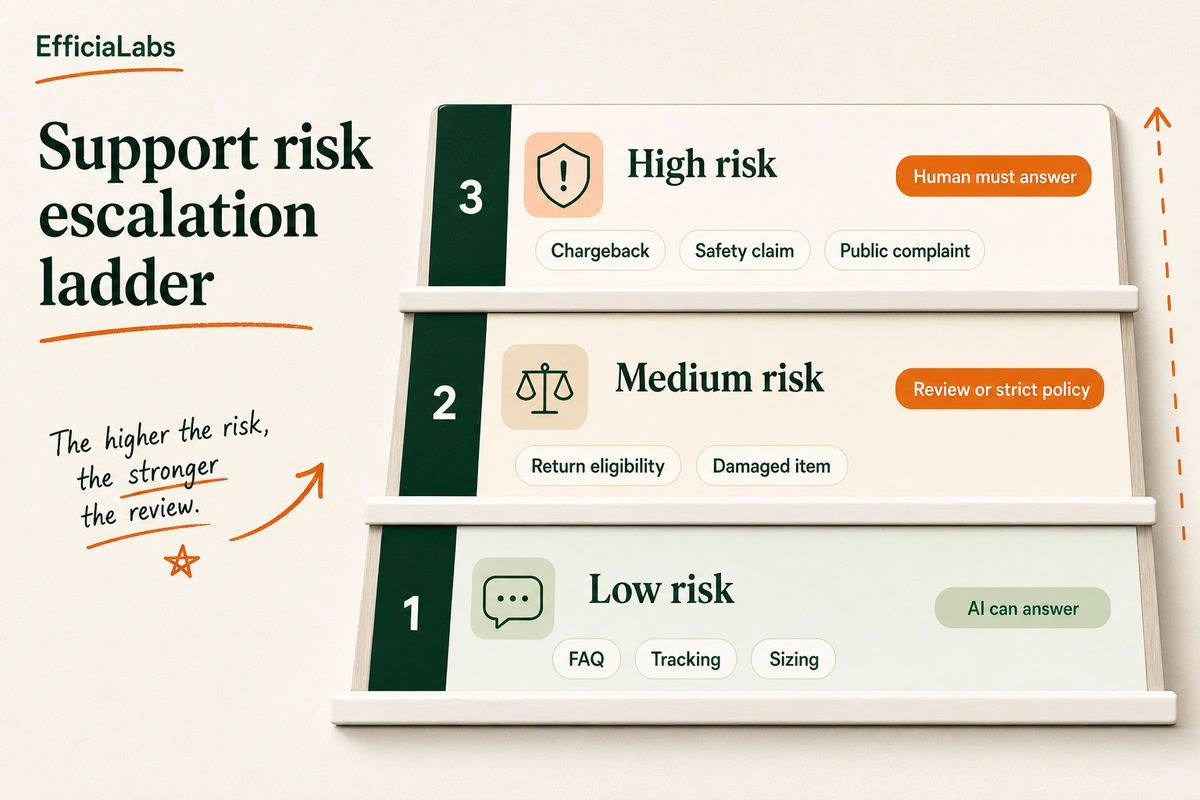
This is where most brand voice articles stay too soft. They talk about tone. They do not talk enough about risk.
For Shopify support, the AI needs a ladder:
| Risk level | AI can do | Examples | Rule |
|---|---|---|---|
| Low | Answer directly | FAQ, order tracking, sizing, care instructions | Use approved facts and standard tone. |
| Medium | Draft for review or answer with strict policy | Return eligibility, damaged item, discount exception | Stay inside policy. Ask for missing facts. |
| High | Hand off | Chargeback, legal claim, safety issue, public complaint, VIP issue | Do not resolve. Route to human. |
Important note: If the ticket can change money, trust, safety, or public reputation, the AI should slow down or hand off.
Brand voice includes knowing when not to answer.
A playful answer on a sizing question is fine. A playful answer on a chargeback threat is a mess.
A premium answer can be concise. But if it skips empathy on a damaged wedding-week order, it feels cold.
A generous answer sounds lovely until the AI gives away a refund your policy does not allow.
So write hard handoff rules. Use them inside Gorgias, Zendesk, Tidio, Intercom, ChatGPT projects, Claude projects, or a custom workflow. The platform is not the point. The operating rule is.
For tooling context, the ceiling shows up fast in off-the-shelf comparisons like Gorgias vs Tidio vs Manychat vs Chatfuel for ecommerce. The more your support depends on Shopify order state, product nuance, customer history, and policy exceptions, the more the AI needs to be wired to your actual business.
Review AI replies weekly like a CX lead, not a prompt hobbyist
The first version will miss.
Good.
That is how you find the real rules.
In our work with AI customer care systems, we have seen the same pattern: the first prompt reveals the obvious fixes, but the weekly review reveals the business fixes. The AI did not know the holiday shipping exception. The AI used an old bundle name. The AI apologized too much. The AI answered a complaint that should have gone to a founder.
We tested this review habit because prompt edits alone hide the real problem: stale support context.
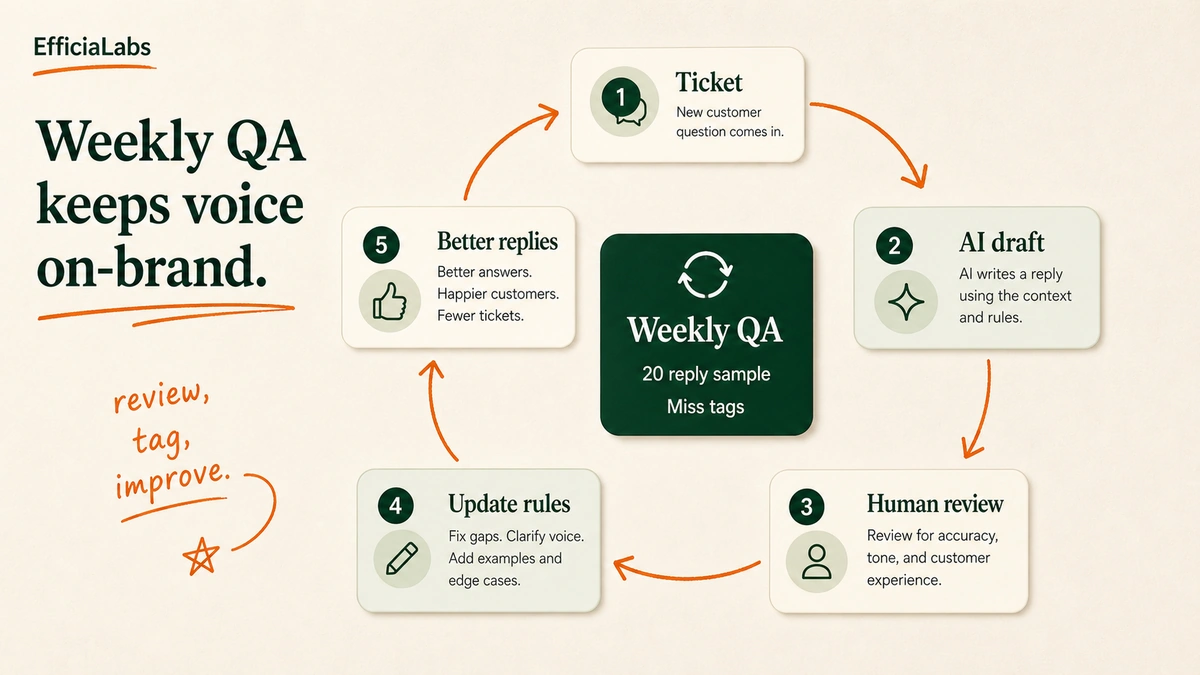
Set a weekly review rhythm:
- Sample 20 AI replies.
- Tag each miss: wrong tone, wrong policy, too long, too robotic, missed handoff, weak answer.
- Pull 3 good replies into the example library.
- Update help docs, macros, policy snippets, and voice rules.
- Retest the same 5-ticket set before changing more.
Note: Do not review only the replies customers liked. Review the misses. That is where the next rule lives.
One owner should run this. CX lead. Founder. COO. Ops lead. Not “everyone.”
Everyone means nobody.
This is where EfficiaLabs fits if the system needs more than a nice prompt. We build custom AI customer care for Shopify stores making $1-25M annually, especially when the support workflow needs order data, policy logic, macros, handoff rules, and QA in one place.
Not magic.
Just context, rules, and review.
AI Agent has really picked up on our brand’s voice. – Lynsay Schrader
FAQs about matching AI voice to your brand voice in customer support
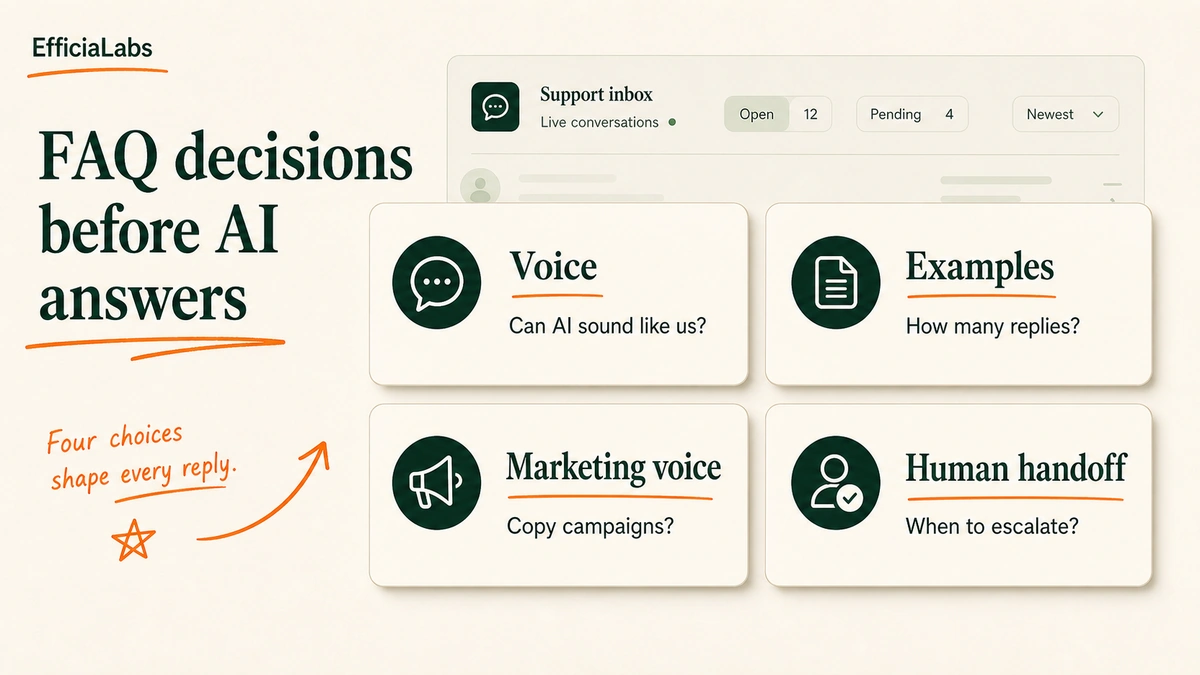
Can AI really sound like my brand in customer support?
Yes, if it has enough brand-specific context and a review loop. The AI needs examples of strong support replies, product facts, policies, banned phrases, and escalation rules.
It will sound generic when it only gets adjectives. It gets closer when it sees what your team actually says in real support moments.
How many examples does AI need to learn our support voice?
Start with 10-20 strong replies. That is enough to show pattern, rhythm, phrasing, and judgment without burying the AI in noise.
Add more only when the examples cover new ticket types: refund exceptions, damaged items, subscriptions, VIP customers, international shipping, or product safety questions.
Should AI copy our marketing voice exactly?
No. Your support voice should come from the same brand personality, but it should not copy campaign language blindly.
Support is more sensitive. A phrase that works in a launch email can feel glib when a customer is missing an order. Keep the personality. Change the tone by risk and mood.
What should AI never handle without a human?
AI should not independently resolve chargebacks, legal threats, safety claims, medical claims, harassment, public complaint threats, VIP issues, or refund exceptions outside policy.
It can summarize, classify, and draft for review. It should not make the call.
Related Articles
- How to build a customer service AI chatbot for Shopify
- Using Claude for Shopify customer support
- Using ChatGPT for Shopify customer support
- Gorgias vs Tidio vs Manychat vs Chatfuel for ecommerce
- AI in DTC statistics for 2026
- How Shopify stores use AI to improve profitability
- AI in B2B commerce use cases for lean DTC teams
See you in the next one – Vai
Sources
- Gorgias: How to Perfect Your AI Brand Voice for Customer Service
- Contentstack: How do we maintain our unique brand voice when using AI?
- Reddit r/ecommerce: Can AI really speak in your brand’s tone?
- LinkedIn: How to Match Your Brand Voice with AI Responses
- Gleap: Customizing AI Chatbots to Match Your Brand Voice
- Smallest.ai: How AI Agents Adapt Brand Voice for Communication Strategies

No comment yet, add your voice below!