

Gorgias Customer Support AI vs Custom AI is not a tool comparison. It is an operating decision. Gorgias AI is usually better for low-volume Shopify support. Custom AI is better when you want complete deflection, tighter brand voice, cross-system actions, and lower cost per resolved ticket.
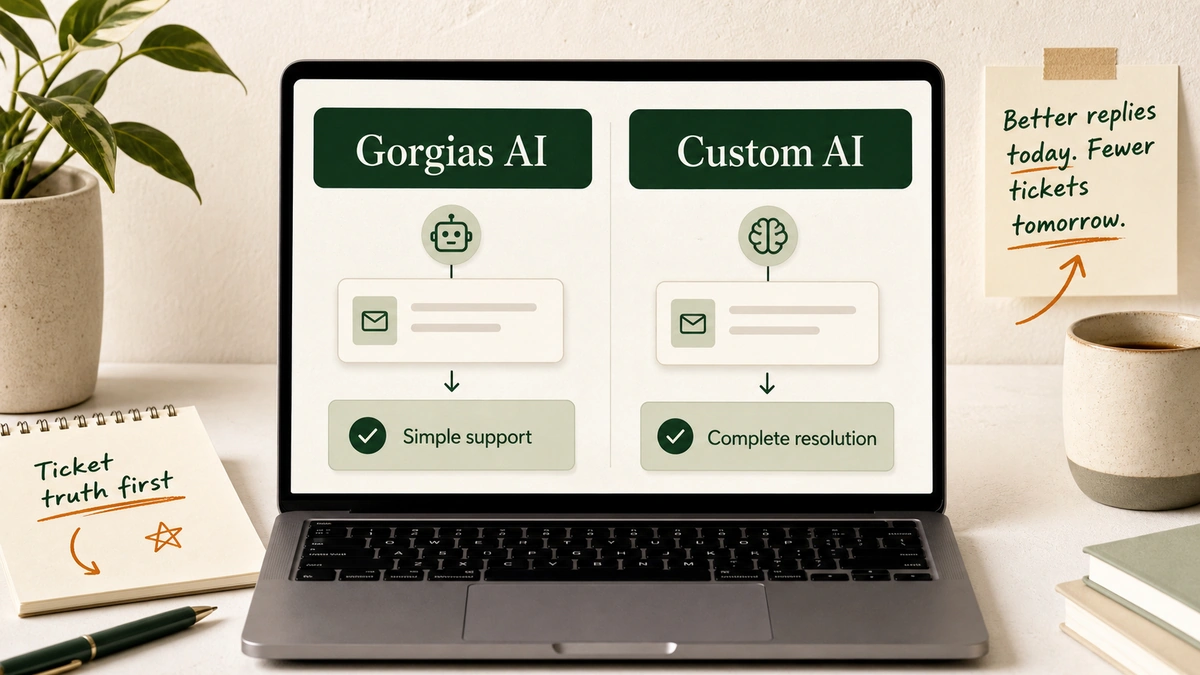
I like Gorgias.
That is the first thing to say.
It is a serious helpdesk for ecommerce. Shopify context. Social DMs. Email. Chat. One inbox. Useful.
The mistake is treating its AI as the only possible answer.
Some stores need a clean default. Some need a machine built around their weird policies, angry edge cases, founder-approved tone, and 17 tabs of operational context.
Two different problems.
Two different answers.
Table of Contents
- TL;DR: choose Gorgias AI for simple support, custom AI for complete resolution
- What is Gorgias AI Agent?
- What is a custom customer support AI?
- Gorgias AI vs. custom AI: the practical comparison
- When Gorgias AI is probably the better choice
- When custom AI is probably the better choice
- The 1,000-ticket/month test before choosing either option
- Cost example: how to compare price per resolution
- My recommendation for a 5-50 person DTC brand
- Frequently asked questions about Gorgias AI vs. custom customer support AI
TL;DR: choose Gorgias AI for simple support, custom AI for complete resolution
If your store gets fewer than 500 tickets a month, makes less than $1M a year, and most questions are standard Shopify support, start with Gorgias AI.
If the founder, or Head of Ops or CX wants complete deflection, a custom AI is the better long-term bet.
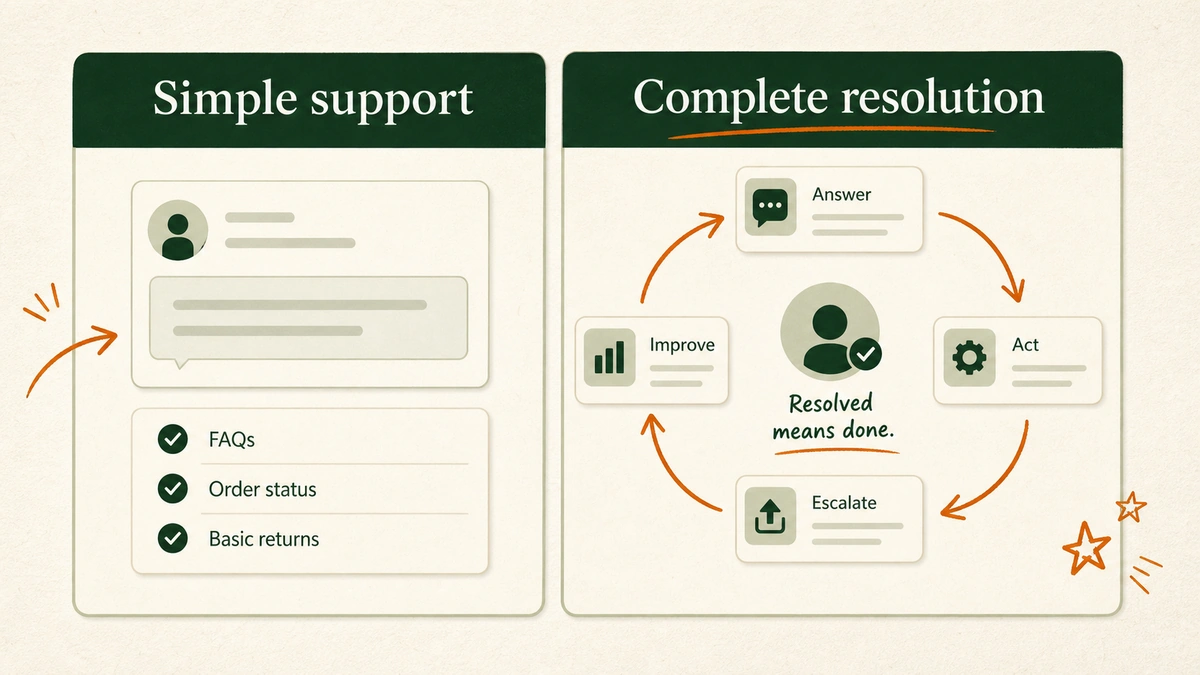
Here is the short version:
| Situation | Better first choice | Why |
|---|---|---|
| Fewer than 500 monthly tickets | Gorgias AI | The setup cost and operational weight of custom AI may not be justified yet. |
| Less than $1M annual revenue | Gorgias AI | The business may need simple automation before a full support system. |
| Mostly WISMO, returns, FAQs, sizing, and discount codes | Gorgias AI | These are the exact repetitive patterns helpdesk-native AI can handle well. |
| Multiple systems decide the answer | Custom AI | The AI needs to reason across policies, order tools, subscriptions, returns, warehouse rules, and exceptions. |
| Founder wants complete deflection | Custom AI | The system is built only for that store instead of starting generic and trying to customize backward. |
| Brand voice is a non-negotiable | Custom AI | The reply logic, tone, examples, and review criteria can be built from the brand’s actual voice. |
| Cost per ticket matters at scale | Custom AI | A custom system can be optimized around model cost, routing, and deflection economics. |
Note: This is not “Gorgias bad, custom good.”
Lazy comparison. Useless.
The better question is:
What job are you hiring the AI to do?
If the job is “answer common questions inside Gorgias,” Gorgias AI makes sense.
If the job is “resolve as many tickets as safely possible, in our voice, across our stack, without my team babysitting it,” custom AI starts to look very different.
What is Gorgias AI Agent?
Gorgias AI Agent is the AI layer inside Gorgias for ecommerce support and sales. It is trained on brand policies, website content, help center articles, documents, custom guidance, and Shopify data. Gorgias describes it as an AI Agent that can analyze, train, test, and deploy from inside the helpdesk.
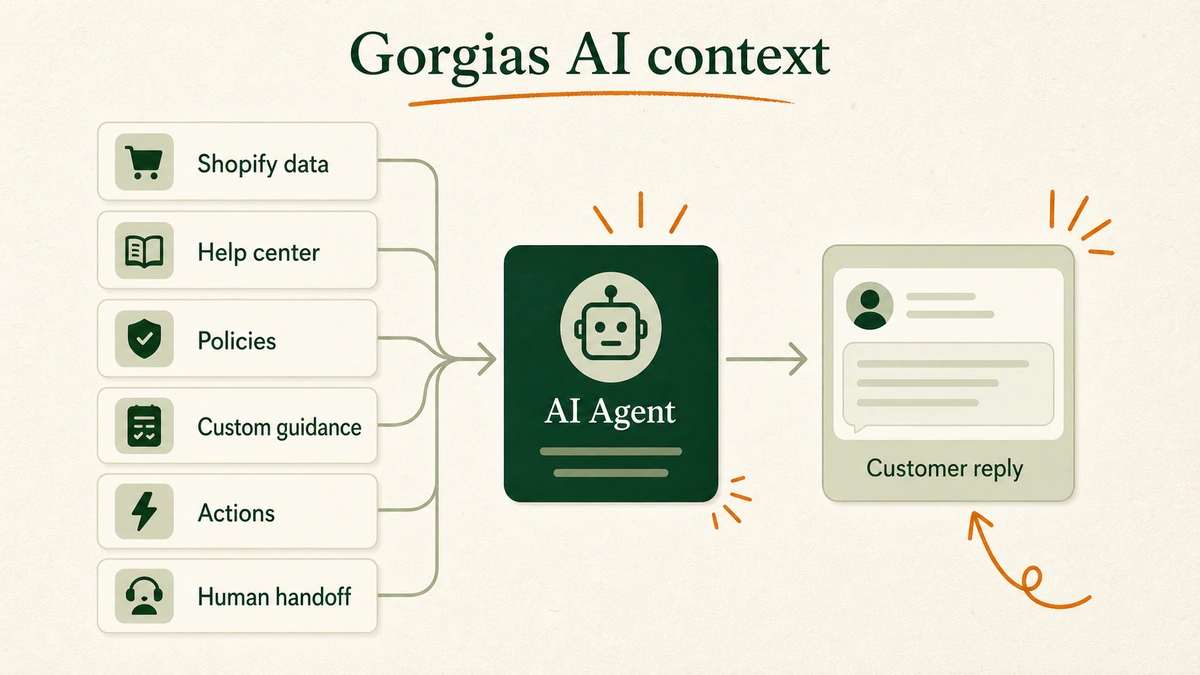
Gorgias’ current AI Agent docs say AI Agent has two skillsets:
- Shopping Assistant: Handles pre-purchase questions, recommendations, upsells, and discounts.
- Support Agent: Handles post-purchase issues like order tracking, edits, returns, and subscription management.
It can also use Actions. The current Gorgias Shopify Actions docs list order actions such as canceling orders, editing shipping addresses, removing order items, replacing an item, reshipping an order, and adding order notes.
That is real capability.
Not just “AI writes a reply.”
But the details matter.
Those Shopify Action docs also list limitations. For example, some Shopify order changes do not automatically pass to every 3PL or fulfillment tool. Some multi-item replacement cases hand over to the team. Some price-change cases need a human when additional payment is required.
That is normal. Support has landmines.
As of June 2026, the same Gorgias Shopify Actions page lists 6 available Shopify action types and a separate limitations section.
AI that edits orders should have boundaries.
Good fit: A Shopify-first brand that already runs support in Gorgias, has clean help docs, wants faster coverage, and mainly needs repetitive ecommerce tickets resolved.
Weak fit: A brand where the real answer depends on five systems, founder-level judgment, or store-specific rules that are not neatly documented.
For a broader setup walkthrough, see our guide on how to build a customer service AI chatbot for Shopify. If the team is still deciding which model belongs in the workflow, the guides to Claude for Shopify customer support and ChatGPT for Shopify customer support cover that earlier layer.
What is a custom customer support AI?
A custom customer support AI is not a chatbot widget.
It is a support system built around one store.
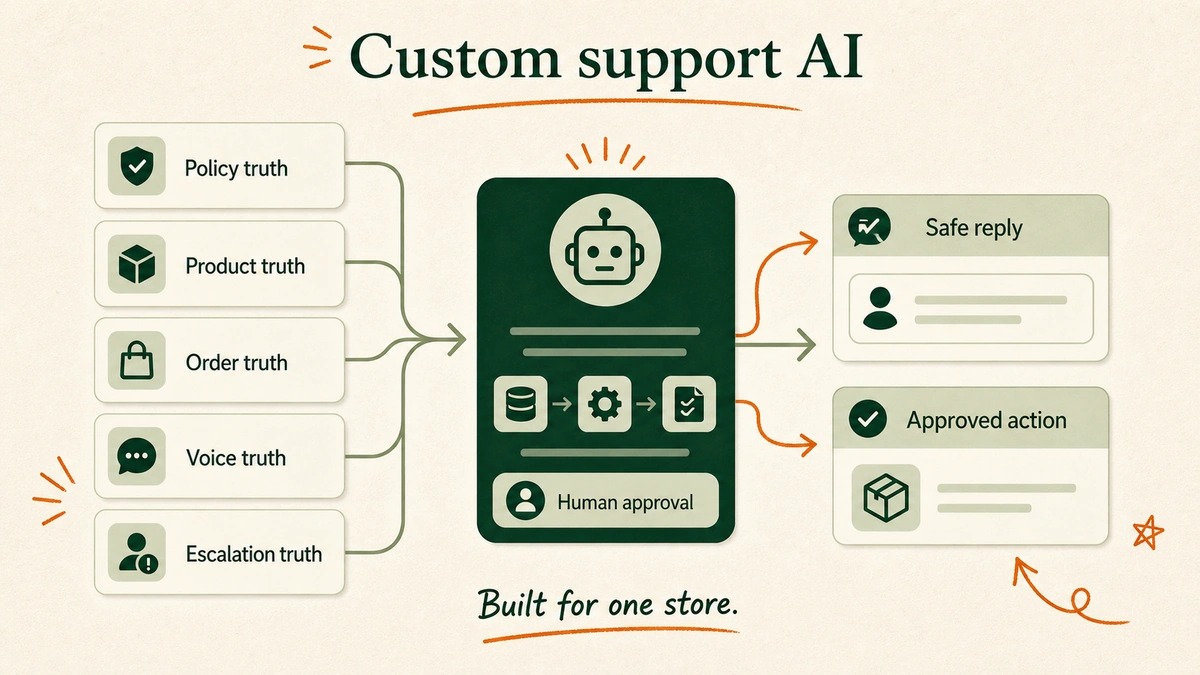
It can work inside Gorgias, Zendesk, Freshdesk, Gmail, or another support inbox. The helpdesk is the surface. The custom AI is the V8 engine underneath it.
The difference is where the system starts.
Most SaaS AI starts generic:
- Here is the product.
- Connect your store.
- Add your help center.
- Configure the tone.
- Create rules.
- Test.
Custom AI starts with the store:
- What are your top ticket types?
- Which tickets should never be automated?
- Which policies are hard rules?
- Which policies need judgment?
- Which systems contain the truth?
- What does a good reply sound like?
- What does a bad reply sound like?
- Can I upsell any product to this customer?
- What should happen after the reply?
That last question is the one people miss.
Support is not just answering.
Support is checking, deciding, acting, logging, escalating, refunding, updating, preventing.
If a customer asks, “Can I change the address on the order I placed 42 minutes ago?”, the AI may need to:
- Confirm the order exists.
- Check fulfillment status.
- Check the shipping window.
- Validate the new address.
- Decide whether a warehouse or 3PL update is required.
- Update the order or hand off.
- Write the reply.
- Add a note.
- Flag the pattern if it happens often.
That is not a prettier macro.
That is an operations workflow.
In our customer support builds, voice is usually the second problem.
Accuracy comes first.
This is why matching AI voice to your brand voice is only one layer. The reply must sound right. It also has to be right.
Gorgias AI vs. custom AI: the practical comparison
The easiest way to compare these options is to stop asking “Which AI is smarter?”
Ask who owns the system.
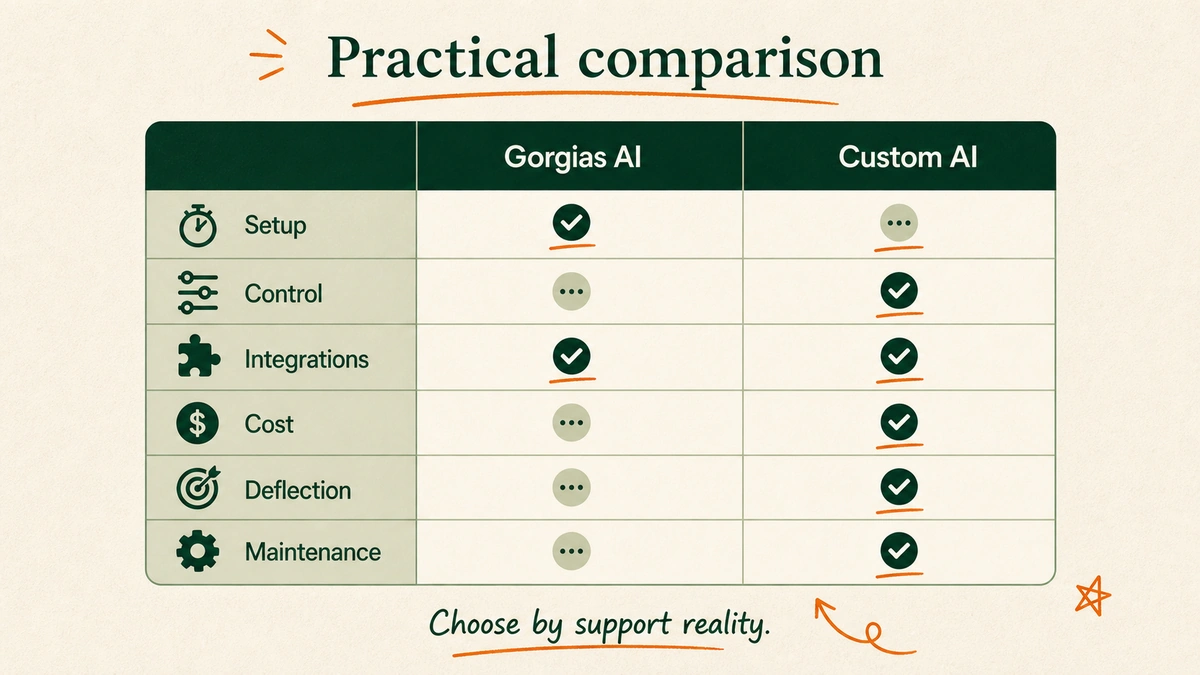
| Category | Gorgias AI | Custom customer support AI |
|---|---|---|
| Setup speed | Faster if you already use Gorgias and Shopify | Slower upfront because the system is built around your support reality |
| Best use case | Common ecommerce questions and standard Shopify workflows | Full-ticket resolution across custom policies, tools, and edge cases |
| Brand voice | Configurable tone and guidance | Built from examples, approvals, reviews, and store-specific voice rules |
| Integrations | Strong inside the Gorgias ecosystem and ecommerce integrations | Built around whatever systems the store actually uses |
| Deflection goal | Automate the tickets it can confidently handle | Push toward complete safe deflection across the store’s repeatable support work |
| Maintenance | Your team monitors, trains, and tunes inside the product | EfficiaLabs can build, deploy, monitor, and improve the system for the store |
| Cost model | Gorgias says most plans price AI Agent at $0.90 per resolved interaction, with starter plans beginning at $1 | EfficiaLabs systems can run as low as about $0.01 per ticket in model cost, depending on complexity and setup |
That last row needs care.
Gorgias prices a product. EfficiaLabs builds a system. Those are not identical commercial models.
“AI Agent that powers the entire customer journey.”
– Romain Lapeyre, CEO of Gorgias
Cc: Gorgias Conversational AI launch post.
Gorgias’ AI Agent pricing page, updated May 28, 2026, says AI Agent is priced per resolved interaction, with most plans at $0.90 per resolved conversation and starter plans beginning at $1. It also says AI Agent is an add-on to Gorgias Helpdesk.
Gorgias’ billing docs add another important detail: when AI Agent fully resolves a ticket without human handoff, an automation fee can apply, and the helpdesk ticket fee can also apply to the same ticket.
So do not compare only “AI price.”
Compare full cost per resolved support issue.
Pro tip: If the vendor price page makes your spreadsheet messy, your real support costs will probably be messy too.
When Gorgias AI is probably the better choice
Gorgias AI is probably the better first move when your support operation is still simple.
Simple is not an insult.
Simple is good.
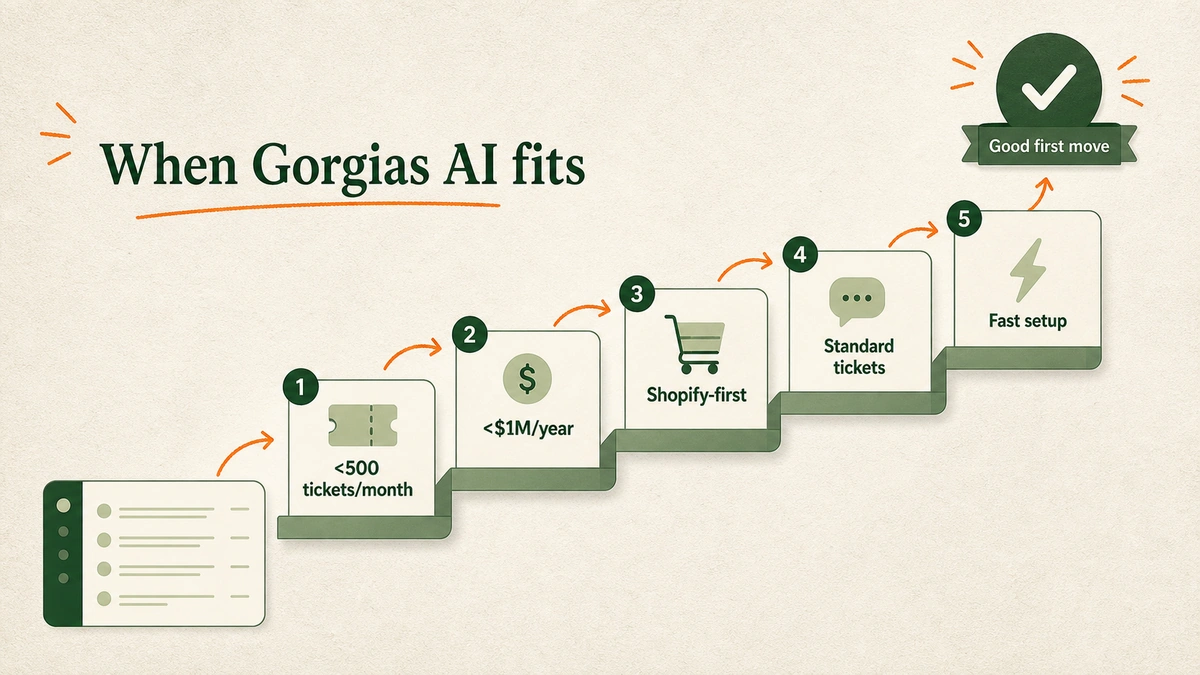
Choose Gorgias AI first when:
- You receive fewer than 500 support tickets per month.
- The store makes less than $1M in annual revenue.
- Your support stack is mostly Shopify plus standard ecommerce apps.
- Your top tickets are WISMO, returns, FAQs, discount codes, sizing, and simple order edits.
- You already use Gorgias and the team likes the inbox.
- You want faster setup more than complete control.
- You are still learning which tickets should be automated.
At this stage, the biggest risk is buying a system before you understand the support pattern.
I have seen founders try to automate chaos.
Doesn’t work.
The AI becomes a mirror. Messy policies in. Messy replies out.
If you have 300 tickets a month, your first win is not complete AI support architecture. It is categorizing the tickets, cleaning the policies, fixing repeated product-page confusion, and letting the helpdesk AI handle the obvious stuff.
For the same reason, stores should read the broader AI opportunity carefully before buying tools. Our AI in DTC statistics guide is a useful sanity check before the budget gets emotional.
Gorgias AI is also attractive when the founder wants one vendor and one surface.
One login. One bill. One inbox.
Lovely.
For a lean team, that matters.
When custom AI is probably the better choice
Custom AI becomes interesting when the founder or Head of ops or CX wants complete deflection.
Not “AI drafts some replies.”
Not “AI handles FAQs.”
Complete deflection.
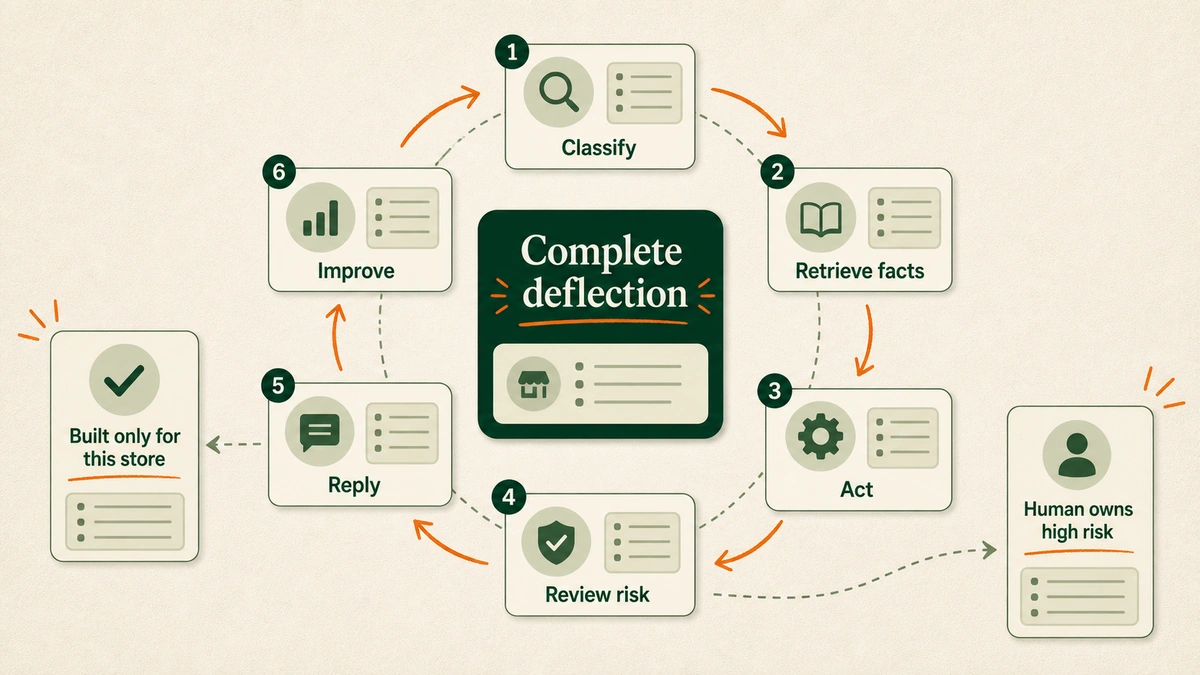
Choose custom AI when:
- The founder or Head of ops/CX wants complete deflection/resolution, not partial automation.
- Tickets require store-specific logic, edge-case policies, or cross-tool actions.
- The AI needs to answer in a voice that feels built for the store.
- The brand does not want a generic system customized afterward.
- Cost per ticket matters.
- The company wants the AI built, deployed, and maintained for them.
- Want to use powerful AI models like Gemini, Claude, ChatGPT.
Here is the key difference:
Generic AI starts broad, then narrows.
Custom AI starts narrow, then deepens.
It is built for the store’s exact support reality:
- The return rule that changes for sale items.
- The subscription rule that changes by product line.
- The VIP policy that only applies over a certain lifetime value.
- The warehouse cutoff that changes by 3PL.
- The founder’s “never say this phrase” rule.
- The escalation logic for chargeback threats.
- The voice examples that make replies sound human.
In our work, this is why custom AI can be better at resolving tickets.
Not because it has magic.
Because it has fewer generic assumptions.
It knows the store.
If you are choosing between SaaS tools, our Gorgias vs Tidio vs Manychat vs Chatfuel comparison is useful. But custom AI is a different category. It is not one more app in the drawer.
It is the support operating system.
That same pattern shows up outside support too. When a messy workflow is costing the team time every week, AI works best as a system layer, not a shiny widget. The inventory version is in our guide to eliminating Shopify inventory Excel chaos with AI.
The 1,000-ticket/month test before choosing either option
Before you buy a heavier AI support setup, run the 1,000-ticket/month test.
This does not mean you must manually read exactly 1,000 tickets.
It means monthly ticket volume should drive the decision.
Start simple.
Count the work.
Then choose the tool.
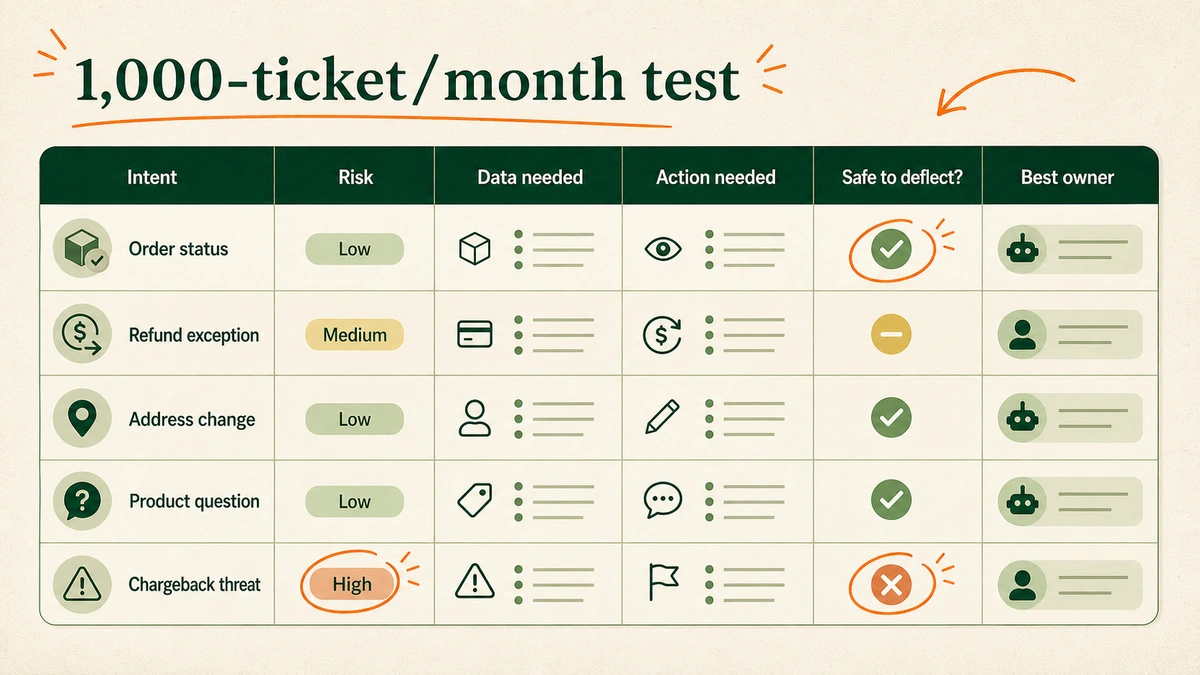
If you are under 1,000 tickets a month, audit the monthly ticket mix before committing to custom AI. If you are above 1,000, audit a representative sample from the last 30 to 60 days.
Tag each ticket with:
| Field | What to capture | Example |
|---|---|---|
| Intent | What the customer wanted | “Where is my order?” |
| Risk | How bad a wrong answer would be | Low, medium, high |
| Data needed | What facts the AI needs | Order status, policy, product info |
| Action needed | Whether the AI must do something | Reply only, cancel, refund, edit address |
| Safe to deflect? | Whether a human can be skipped | Yes, no, review first |
| Better owner | Which system should handle it | Gorgias AI, custom AI, human |
You are looking for buckets.
Not vibes.
In our audits, this step is where the sales demo fantasy dies.
We test the ticket mix before we trust any automation claim.
No guesswork.
No shiny demo math.
After the audit, you should know:
- What percentage of tickets are simple enough for Gorgias AI.
- What percentage need human judgment.
- What percentage are repeatable but too custom for a generic setup.
- Which policies need cleanup before any AI goes live.
- Which integrations determine real resolution.
Important note: Do not count “AI answered” as success.
Count resolved.
A ticket is resolved when the customer gets the right answer, the right action happens, the brand is protected, and the customer does not come back asking the same thing again.
That is the standard.
Cost example: how to compare price per resolution
Do not compare monthly subscription prices.
Compare cost per resolved support issue.
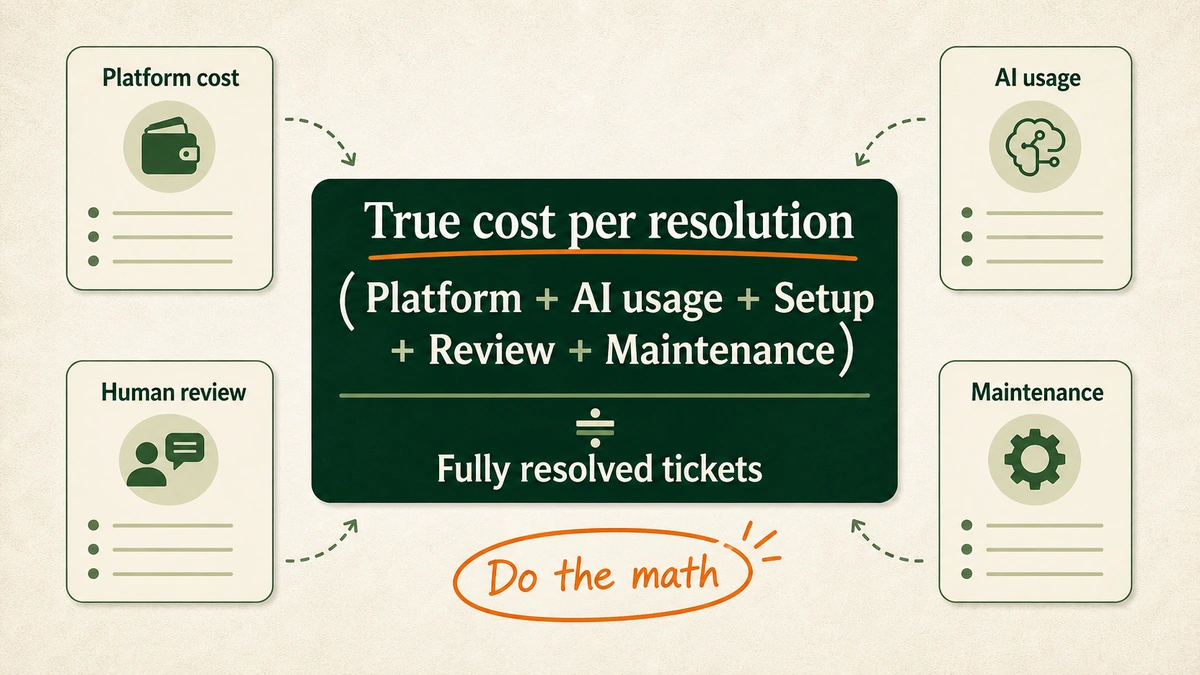
Use this formula:
True cost per resolution =
(platform cost + AI usage cost + setup cost + human review cost + maintenance cost)
/ fully resolved tickets
A few examples:
| Cost item | Why it matters |
|---|---|
| Platform cost | The base helpdesk or AI subscription. |
| AI usage cost | Per-resolution, per-ticket, or model usage fees. |
| Human review cost | Time spent checking, editing, and fixing AI output. |
| Setup cost | Documentation, workflows, integrations, and testing. |
| Maintenance cost | Policy updates, QA, prompt changes, and edge-case fixes. |
Gorgias’ public pricing page says most AI Agent plans price resolved interactions at $0.90, with starter plans beginning at $1. It also says plans include monthly automated interaction allotments from 90 to 2,500+.
EfficiaLabs custom support systems can often run at about $0.01 – $0.05 per ticket in model cost once built.
“Within six days, Fin is successfully resolving 42% of conversations.”
– Dane Burgess, Customer Support Director at Linktree
But model cost is not the whole cost.
In our work, we measure the support system by resolved tickets, not generated replies.
I do not want to play spreadsheet games.
The honest comparison is:
- What does each resolved ticket cost all-in?
- How many tickets are fully resolved without human labor?
- How many wrong replies create extra work?
- How much founder or CX lead time does setup consume?
- How often does the system need maintenance?
Simple math first.
Tool choice second.
That is why low-volume stores should be careful.
If you have 250 tickets a month, saving $0.80 per ticket is not the main game.
If you have 5,000 tickets a month and a messy support stack, it can be.
Support cost also connects to profit. If the founder is looking at AI from a margin lens, our guide on how Shopify stores use AI to improve profitability is the adjacent read.
My recommendation for a 5-50 person DTC brand
If I ran a DTC brand with 5-50 people, I would not start with the tool.
I would start with ticket truth.
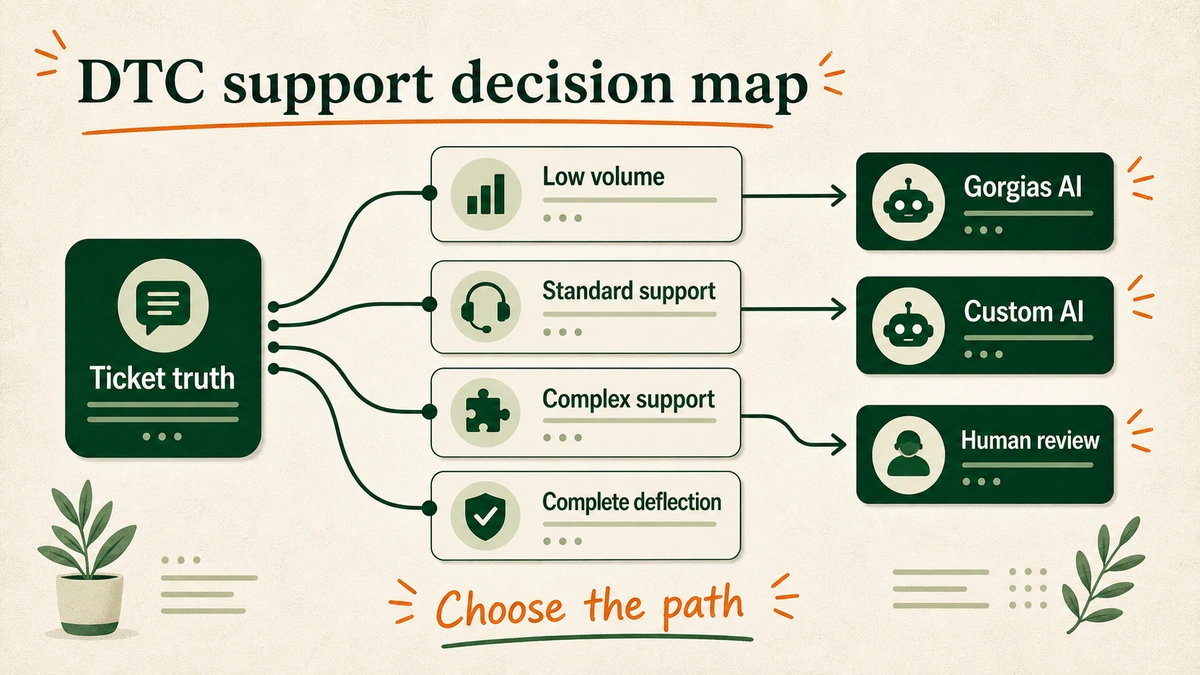
Here is the path I would follow:
- If you have fewer than 500 tickets/month or less than $1M annual revenue, start with Gorgias AI or simple helpdesk automation.
- If you are near 1,000 tickets/month, audit the ticket mix before changing systems.
- If most tickets are standard Shopify support, use Gorgias AI and measure true resolution.
- If the same complex ticket appears every week, document it and make it automatable.
- If the founder or Head of CX wants complete deflection, build custom AI around the store.
For more examples of where this system-first thinking applies, see our breakdown of AI use cases for lean DTC teams and the comparison of the best ecommerce AI customer care companies.
Small caveat.
Complete deflection should not mean “never escalate.”
That is how brands get hurt.
Complete deflection means every ticket gets the right path:
- Resolve automatically when it is safe.
- Ask for more information when facts are missing.
- Escalate when judgment is required.
- Block automation when risk is high.
- Improve the system when repeated confusion appears.
That is the real prize.
Better replies today. Fewer tickets tomorrow.
This is also why the service model matters. EfficiaLabs builds, deploys, and maintains the custom support AI. The store mainly grants access, reviews the important rules, and gives feedback when the system needs to learn a nuance.
Founders already have enough tabs open.
I want to close a few.
Frequently asked questions about Gorgias AI vs. custom customer support AI
Is Gorgias AI good for small ecommerce stores?
Yes, if the support volume is modest and the ticket types are standard. For stores under 500 monthly tickets or under $1M annual revenue, Gorgias AI is usually a more sensible first move than a custom system.
The caveat is ticket complexity. A small store with unusual products, regulated claims, subscription rules, or fragile brand voice may still need a more controlled setup.
Is custom AI better than Gorgias AI?
Custom AI is better when the goal is complete safe deflection, not just faster replies.
Because it is built only for the store, it can reflect the store’s policies, product nuances, escalation rules, and brand voice more deeply. That does not mean every store should build custom AI first. It means the ceiling is higher when the support operation is complex enough to justify it.
What ticket volume justifies custom customer support AI?
Start looking seriously around 1,000 tickets per month.
Below that, audit the ticket mix first. If the monthly volume is low and most issues are repetitive, simpler automation may be enough. If the volume is high or the same complex issues keep repeating, custom AI becomes more attractive.
Can custom AI work inside Gorgias?
Yes. A custom support AI can use Gorgias as the inbox while adding store-specific logic outside the default product layer.
That means the team can keep familiar workflows while the custom AI handles classification, context retrieval, action logic, and reply generation behind the scenes.
How should a DTC brand test Gorgias AI against custom AI?
Run a ticket audit first.
Label each ticket by intent, risk, required data, required action, and safe deflection. Then estimate which tickets Gorgias AI can resolve, which need humans, and which could be fully resolved by a custom system. The winner is not the one with the best demo. It is the one that resolves your actual tickets.
What should never be fully automated?
High-risk tickets should keep a human owner.
That usually includes legal threats, chargeback threats, abuse, safety issues, privacy questions, unusual refund exceptions, and anything where the brand cannot tolerate a wrong answer. AI may summarize or prepare context. A human should decide.
What is the biggest mistake stores make with AI customer support?
They automate before cleaning the support system.
Bad policies, vague docs, missing product facts, and messy escalation rules do not become better because an AI reads them. They become faster. Fix the source. Then automate.
Catch you in the next one.
Vai

No comment yet, add your voice below!