

The best company for ecommerce AI customer care depends on how your support operation works. Shopify brands usually start with Gorgias, Yuma, Tidio, or Intercom Fin. Larger teams may prefer Zendesk, Freshworks, or Ada. Brands with unusual workflows, private data needs, or no internal AI owner should consider a custom partner like EfficiaLabs.
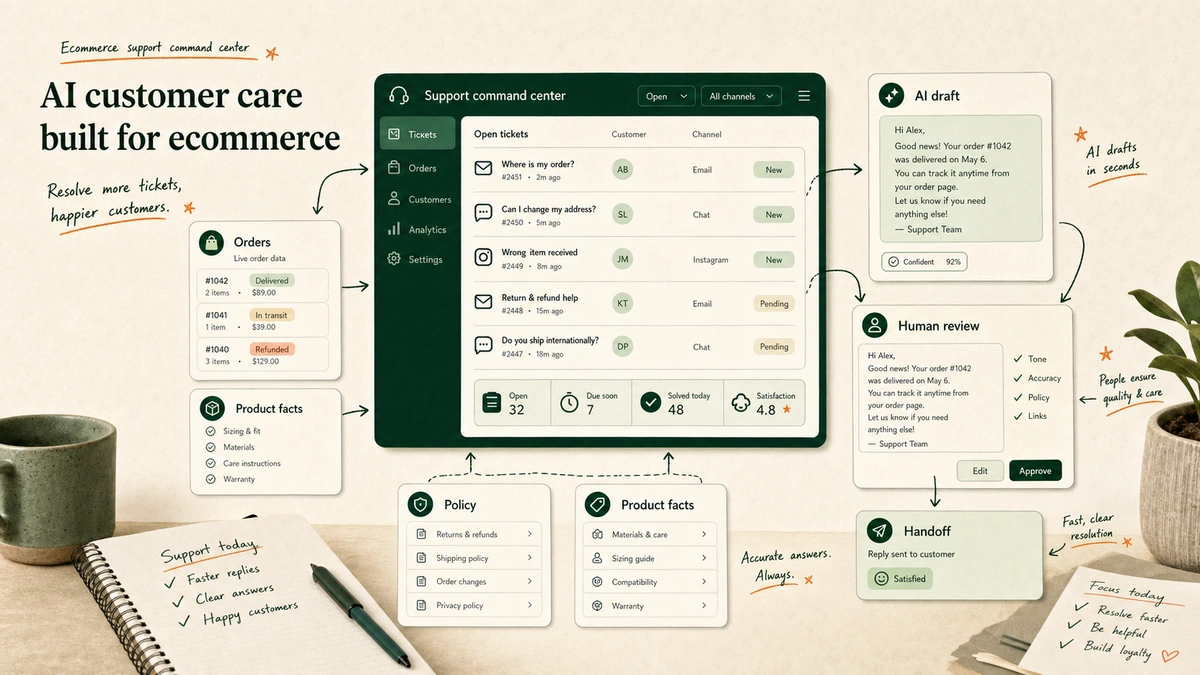
The demo is easy.
The hard part is the second refund edge case. The customer bought with store credit, used a bundle discount, returned one item, and is now angry because the exchange app and Shopify do not agree.
That is where most “AI support” decisions become real.
A polished bot can answer “where is my order?”
A useful AI support system can read the order. Check the rules. Know if it can act. Hand off when it should. Leave the team with less mess.
Key Takeaways
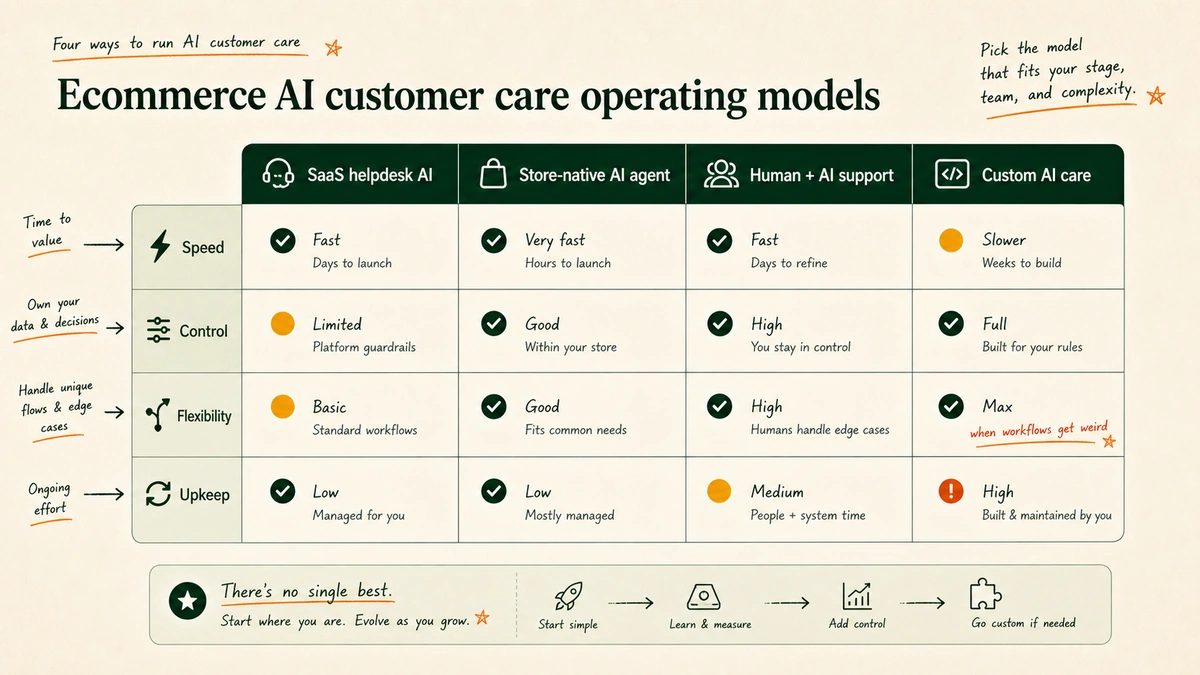
- Start with your support operating model, not the vendor demo: helpdesk AI, ecommerce-native AI agent, outsourced human plus AI, or custom AI customer care.
- In our work with DTC support systems, the break point is rarely FAQ accuracy. It is policy authority, handoff quality, and who maintains the system after launch.
- As of 2026-06-04, Gorgias lists plans from $10/mo for 50 tickets/mo and AI Agent interactions from $1.00 per resolved conversation on its pricing page.
- As of 2026-06-04, Fin lists $0.99 per outcome, a 50-outcome monthly minimum, and $29 per helpdesk seat for Fin plus Intercom on its pricing page.
- As of 2026-06-04, Tidio lists Lyro AI Agent from $32.50/mo for 50 Lyro AI conversations and says Lyro can solve up to 67% of customer problems on its pricing page.
Two customer quotes shaped how I wrote this list:
“without losing that special human touch”
- Katy Eriks, Director of Customer Experience at SuitShop, from Gorgias customer stories
“a partner that’s just really trying”
- Gabe Walker, CX Manager at Clove, from Yuma case studies
Table of contents
- What “best company for ecommerce AI customer care” really means
- Quick comparison: AI support vendors
- 9 best AI support companies for online stores
- When a custom AI customer care company beats SaaS
- How to choose the right ecommerce AI customer care company
- FAQs about ecommerce AI customer care companies
- My take: buy the tool until the tool becomes the ceiling
What “best company for ecommerce AI customer care” really means
A $600K Shopify store with two people answering tickets needs a different system than a $12M DTC brand with subscriptions, returns, VIP customers, chargebacks, marketplace orders, and Black Friday ticket spikes.
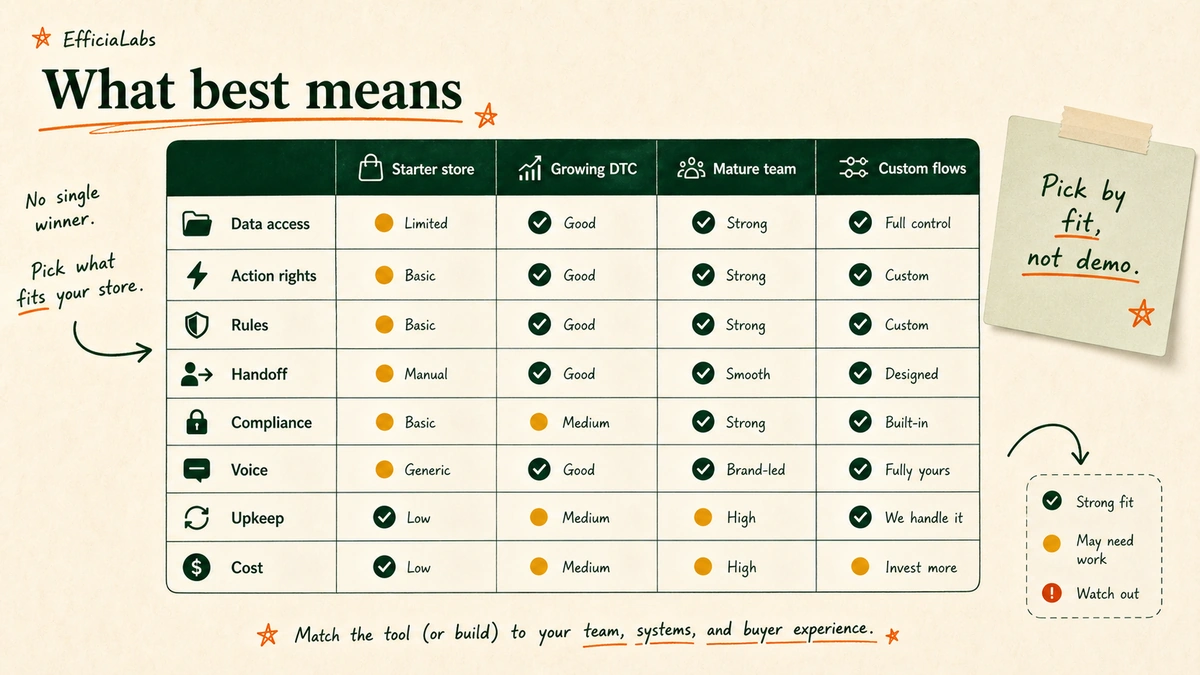
So before picking a vendor, define “best” by operating fit:
- Ecommerce data access: Can the system read orders, customers, fulfillment status, subscriptions, returns, product data, and support history?
- Order-action authority: Can it only answer questions, or can it cancel, refund, exchange, apply credit, edit an address, or trigger a workflow?
- Policy guardrails: Can it follow your actual rules for damaged items, late orders, VIP exceptions, fraud risk, final-sale products, and partial refunds?
- Human handoff: Does the handoff include context, attempted steps, customer emotion, and the exact reason the AI stopped?
- Compliance posture: Does the vendor publish security, privacy, and compliance information that matches your risk tolerance and markets?
- Brand voice control: Can it sound like your brand without inventing policy or becoming weirdly cheerful during complaints?
- Maintenance burden: Who updates the system when products, policies, apps, shipping zones, or promotions change?
- Loaded cost: What is the real cost after seats, usage, add-ons, implementation, QA, maintenance, and human review?
If you are still building the basics, read this guide to building a customer service AI chatbot for Shopify first. If you already have tickets, apps, macros, and policies scattered everywhere, the company choice matters more.
Quick comparison: AI support vendors
Use this as a shortlist, not a verdict.
The right fit depends on your helpdesk, Shopify setup, ticket load, team skill, and need for custom work.
| Vendor | Best fit | Setup | Watch-out |
|---|---|---|---|
| Gorgias. | Shopify teams that want AI in the helpdesk. | SaaS. | Best if you want to run on Gorgias. |
| Yuma AI. | Shopify Plus teams with returns and plans. | SaaS AI agent. | Still needs rules, QA, and stop points. |
| Intercom Fin. | Brands already on Intercom. | SaaS agent. | Store actions need a real pilot. |
| Zendesk AI. | Mature teams on Zendesk. | SaaS suite. | Heavy for a lean DTC team. |
| Freshdesk / Freddy AI. | Freshworks users. | SaaS suite. | Broad support tool, not DTC-first. |
| Tidio Lyro. | Smaller stores. | Chat plus AI. | Can hit limits as rules get hard. |
| Ada. | Large global teams. | AI platform. | More than many DTC teams need. |
| SupportYourApp. | Teams that need coverage. | Managed service. | You still own the process. |
| EfficiaLabs. | $1M+ DTC brands with custom flows. | Done-for-you build. | Not for simple FAQ bots. |
9 best AI support companies for online stores
1. Gorgias: best for Shopify brands that want AI inside their helpdesk
Best for: Shopify brands that want helpdesk, rules, macros, and AI support in one store-focused tool.
Pricing: Gorgias publishes plan and add-on pricing on its pricing page. Check the current page because tickets, AI interactions, add-ons, and billing cycle change the total.
What I like: Gorgias is one of the clearest store-native support tools. It is built around Shopify, AI Agent, order work, and sales-aware chats.
The best use case is not “answer FAQs.” It is support work where agents already live: order status, returns, shipping, product questions, and repeat tickets.
If you are comparing chat-first tools, this older EfficiaLabs breakdown of Gorgias vs Tidio vs ManyChat vs Chatfuel is a useful adjacent read.
Watch out for: Gorgias is strongest when you want the Gorgias work model. If data lives across many apps, you still need to design the process.
You might need it if: You use Shopify and want to reduce repetitive tickets inside Gorgias.
2. Yuma AI: best for Shopify Plus brands with subscription and returns workflows
Best for: Shopify and Shopify Plus brands that want a store-native AI agent instead of a generic site bot.
Pricing: Yuma lists plan info on its pricing page. Review tiers, order volume, and feature limits before you compare.
What I like: Yuma is built around store support: order questions, plans, refunds, returns, discounts, shipping, and post-purchase pain. “Cancel my order” and “cancel my plan” need different actions.
Watch out for: Store-native does not mean hands-off. You still need clean rules, action rights, audits, and stop points.
You might need it if: You are on Shopify Plus and mostly run standard ecommerce workflows.
3. Intercom Fin: best for brands already using Intercom
Best for: Brands already using Intercom for support, buyer chat, or help center content.
Pricing: Fin has its own pricing page. Compare loaded cost, not only the headline entry point.
What I like: If your help center is strong and your team uses Intercom, Fin can answer repeat questions without a tool move.
Watch out for: Intercom is not store-native in the same way Gorgias or Yuma are. If the AI needs to act on orders, test the apps and action paths.
This is where a small test matters. Use real tickets, not a clean demo script. For Shopify-specific language model workflows, compare the constraints in ChatGPT for Shopify customer support and Claude for Shopify customer support.
You might need it if: You already use Intercom and want AI resolution inside that platform.
4. Zendesk AI: best for mature support teams already on Zendesk
Best for: Larger teams already using Zendesk for routing, agent help, QA, knowledge, work flows, and reports.
Pricing: Zendesk publishes AI and suite information on its AI customer service pages, but larger plans are often sales-led. Confirm which AI capabilities are included versus add-ons.
What I like: Zendesk is built for scale. It can tag tickets, route work, help agents, find knowledge, and improve service flows.
Watch out for: Zendesk can be too much system for a lean DTC brand whose flows change each month.
You might need it if: Your team already runs on Zendesk and needs AI to improve that machine.
5. Freshdesk / Freddy AI: best for teams already in the Freshworks ecosystem
Best for: Store teams already using Freshdesk or other Freshworks products.
Pricing: Freshworks lists Freshdesk plans and AI info on its customer support AI pages and plan pages.
What I like: Freshdesk is broad and known. Freddy AI can help agents, self-serve answers, ticket handling, and support work inside Freshworks. If your team works well there, improve it before you move.
Watch out for: This is broad support, not DTC-first store support. Test Shopify, returns, product data, plans, and discount edge cases.
You might need it if: You already use Freshworks and want AI inside that stack.
6. Tidio Lyro: best starter option for smaller ecommerce stores
Best for: Smaller stores that want live chat, AI flows, and fast answers.
Pricing: Tidio lists plans on its pricing page. Check AI chat limits, live seats, Shopify features, and channel limits.
What I like: Tidio is a good start for lean store teams: common questions, lead capture, shopper help, and simple repeat chats.
Watch out for: Starter tools hit limits when support depends on hard rules, refunds, plans, loyalty, and regional edge cases.
You might need it if: You are early, budget-sensitive, and need a practical support/chat tool.
7. Ada: best for enterprise multilingual support
Best for: Larger brands that need enterprise AI, global support, controls, data views, and formal setup.
Pricing: Ada is sales-led from its official site. Budget for the tool, setup, apps, QA, and ongoing work.
What I like: Ada is not a small Shopify bot. It fits teams that need AI service at scale, many languages, app links, controls, reports, and steady quality.
Watch out for: For a 10-person DTC team, Ada can be more platform than you need. Complexity has a cost.
You might need it if: You have high volume, multilingual needs, and a mature service organization.
8. SupportYourApp: best for outsourced human plus AI support coverage
Best for: Brands that need coverage, staff, global agents, or managed support instead of software alone.
Pricing: SupportYourApp is sales-led. Its store outsourcing and AI chatbot for customer support pages explain the model, but you need a scoped quote.
What I like: This belongs in the list because AI support is not always a software problem. The pinch can be hiring, training, hours, QA, lead work, or peak volume.
Watch out for: Outside support does not remove process ownership. You still need clear rules, brand voice, handoff rules, refund rights, and reports.
You might need it if: Your biggest support problem is coverage and staffing, especially during seasonal spikes or when the founder is still too involved in support.
9. EfficiaLabs: best for $1M+ DTC brands that want custom AI customer care built, deployed, and maintained
Best for: $1M+ DTC brands with messy flows or no team to design, ship, watch, and maintain AI support.
Pricing: Custom scope based on ticket load, channels, systems, rules, apps, AI depth, review flow, and upkeep.
What I like: I run EfficiaLabs, so do not treat this as a neutral vendor ranking. Treat it as a fit call.
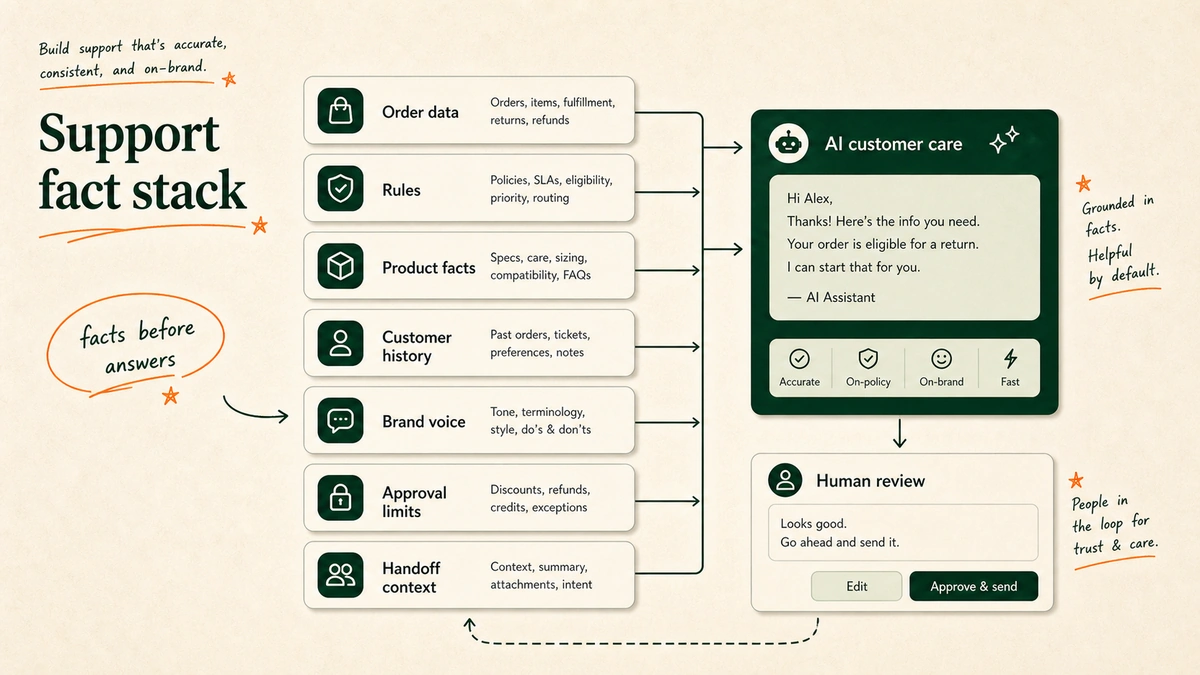
In our work with store support stacks, the hard part is not the first bot launch. It is keeping rules, product facts, apps, and sign-off logic current after launch.
A custom build can be designed around the way your brand actually operates:
- Shopify, plans, returns, helpdesk, loyalty, warehouse flows, product catalog, and inventory cleanup.
- Refund, replacement, warranty, VIP, fraud, and escalation rules.
- Brand voice, complaint-handling tone, and approval thresholds.
- The split between automation, drafts, agent assist, and human approval.
- Data-control needs, including builds where sensitive support data can stay in systems you control.
That upkeep matters. Rules change. Products launch. Promos break assumptions. Buyers find edge cases you did not write down.
Watch out for: Custom is not the first move for every store. If you only need FAQs, WISMO, or basic chat, buy SaaS first. Custom work earns its keep when tool limits, manual edge cases, risk, or upkeep cost more than a build.
For teams thinking through tone and guardrails, the work starts with matching AI support to your brand voice, not with picking a model.
You might need it if: You are a $1M+ DTC brand and want a partner to build and maintain the AI customer care layer.
When a custom AI customer care company beats SaaS
SaaS should be the first answer.
It is faster. It is cheaper to try. It gives you a working baseline. It forces you to see which tickets are repetitive and which are not.
Custom starts to win when the support system becomes too specific for generic tooling.
That happens in five situations.
First, you need private or controlled design. Sensitive support data can stay in systems you control, with strict rules for what leaves your helpdesk, store platform, or database.
Second, your flows are odd. Generic AI can handle basic returns, then fail on partial bundle returns, loyalty credit, plan pauses, B2B support cases, warranty rules, or regional shipping.
Third, your apps are custom. Shopify is only one part of the stack. Many DTC brands also use return portals, plan tools, ERPs, warehouse tools, review tools, loyalty tools, email/SMS, fraud tools, and old sheets.
Fourth, you need local-law-aware guardrails. Do not let AI make legal, refund, warranty, health, safety, or regulated-product claims unless the rules and review flow are built for each market.
Fifth, you do not have an AI owner. Buying a tool does not create one. Someone still needs to update facts, test bad cases, inspect replies, watch drift, and fix the system when the brand changes.
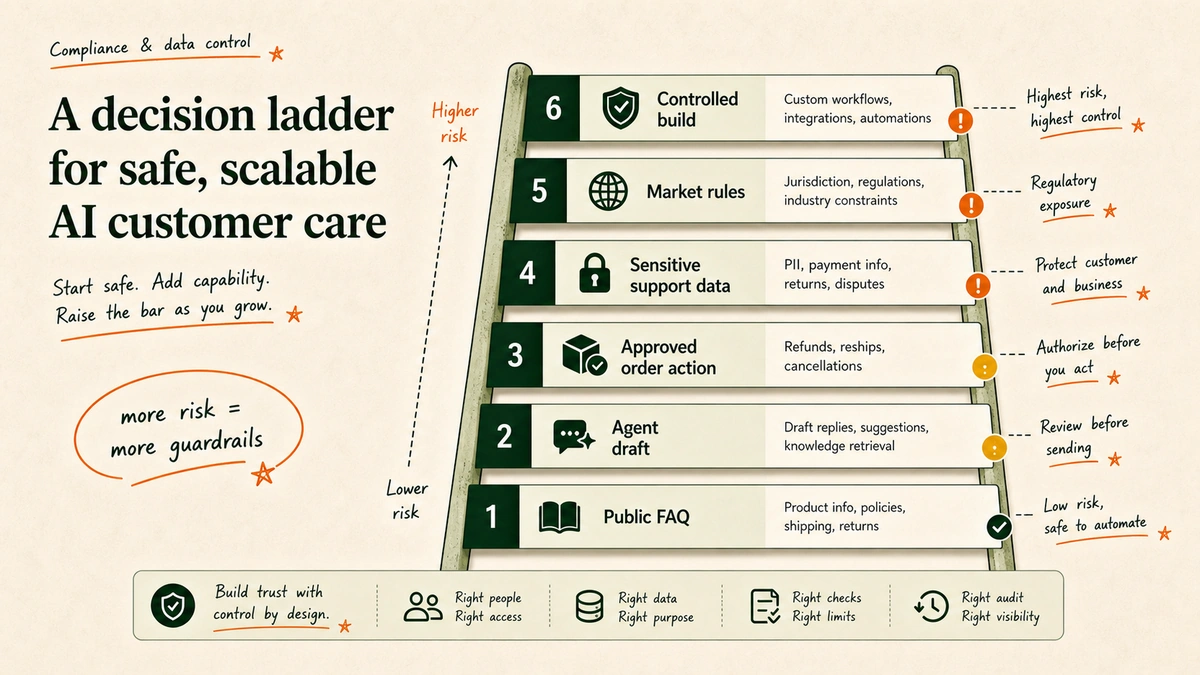
The clean way to think about it:
- Buy SaaS when your support workflows are standard and your team can own setup.
- Use outsourced support when staffing and coverage are the constraint.
- Build custom when workflows, data control, integrations, or maintenance ownership are the real problem.
This is also why industry statistics only get you so far. A broad trend report, like our AI in DTC statistics article, can show momentum. It cannot tell you whether your refund approval path is ready for automation.
How to choose the right ecommerce AI customer care company
Do not choose from a vendor demo. Choose from your tickets.
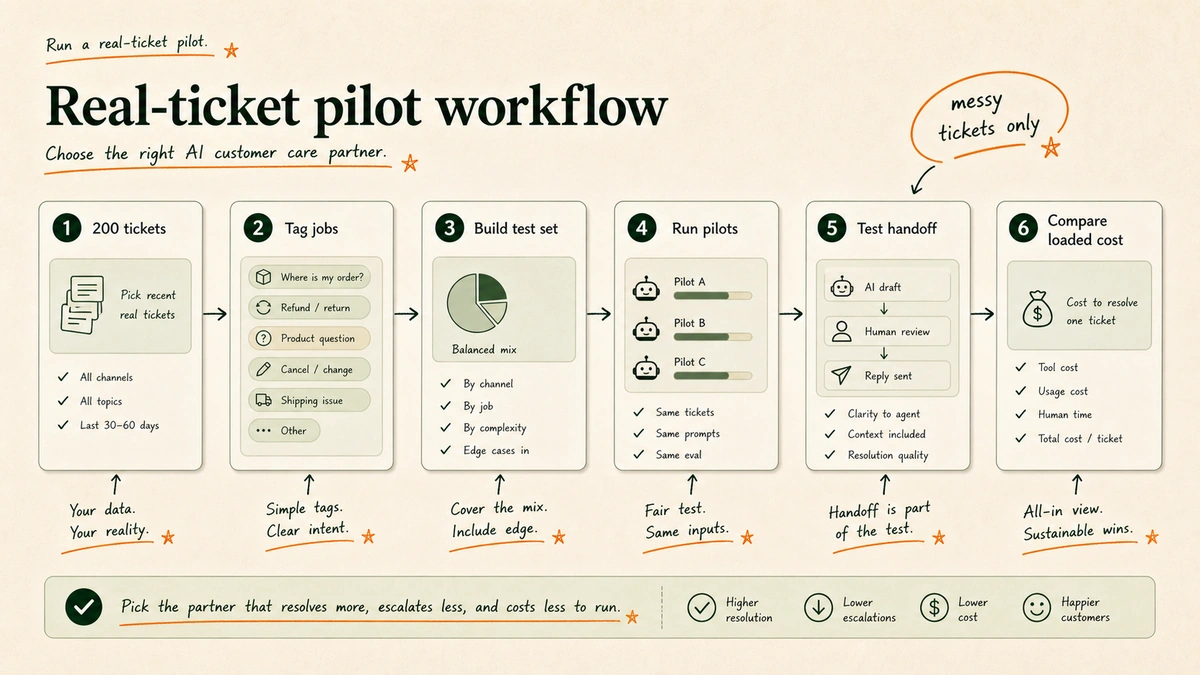
1. Pull 200 real tickets
Use real chats from the last 30 to 90 days: happy questions, angry notes, odd cases, refunds, damaged items, shipping delays, plan problems, and pre-purchase questions.
Do not clean them up too much. Messy tickets are the point.
2. Tag the work
Tag each ticket by job:
- WISMO and tracking.
- Returns and exchanges.
- Refund requests.
- Product questions.
- Subscription changes.
- Discount and promo issues.
- Damaged, missing, or wrong items.
- Complaints and escalations.
- VIP or exception handling.
This shows what AI should handle first. It also keeps you from buying the best demo instead of fixing the worst support load.
3. Run a pilot on real questions
Ask each short-listed vendor to work against real tickets. We tested this pattern because polished demos hide the messy cases. You can mask private data at first. Keep real rules, product facts, and order context.
For each response, score:
- Did it answer the customer’s actual question?
- Did it follow policy?
- Did it avoid inventing facts?
- Did it know when to hand off?
- Did it preserve brand voice?
- Did it reduce agent work, or just create review work?
4. Test handoff and failure cases
A good AI support system is not the one that answers everything.
It knows when not to answer.
Test situations where the AI should stop:
- Refunds above a threshold.
- Fraud or chargeback risk.
- Legal threats.
- Health, safety, or regulated-product questions.
- Angry repeat customers.
- Unclear warranty claims.
- Requests outside documented policy.
- High-value customers where retention judgment matters.
If the vendor cannot show a clean handoff path, do not let the AI take action.
5. Compare loaded cost, not sticker price
Sticker price is not the cost.
Loaded cost includes:
- Platform fee.
- Seats.
- AI usage or resolution fees.
- Implementation.
- Integrations.
- Internal admin time.
- QA and testing.
- Human review.
- Maintenance.
- Cost of wrong answers.
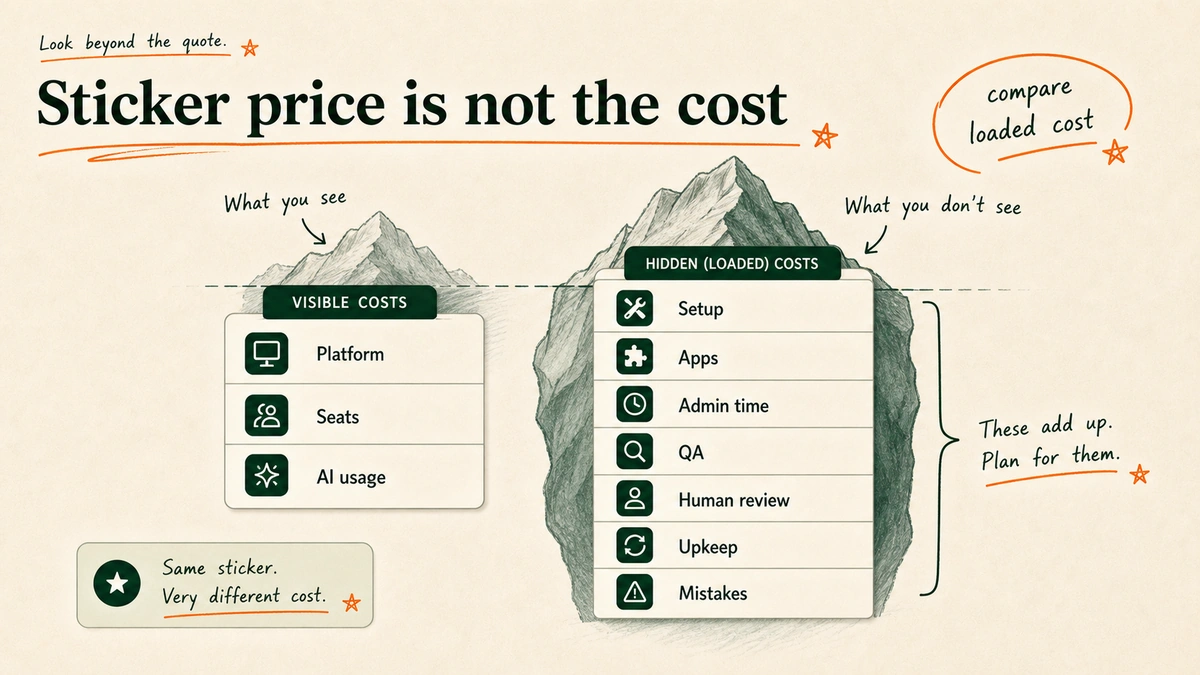
This is where smaller brands get the math wrong. A cheap tool that needs constant founder attention is not cheap.
For profitability thinking beyond support, see how Shopify stores use AI to improve profitability.
FAQs about ecommerce AI customer care companies
What is the best company for ecommerce AI customer care?
The best company for ecommerce AI customer care depends on your operating model. Shopify brands that want AI inside the helpdesk should look at Gorgias. Shopify Plus brands with ecommerce-specific automation needs should evaluate Yuma. Intercom, Zendesk, Freshworks, Tidio, Ada, and SupportYourApp fit different maturity levels. EfficiaLabs fits $1M+ DTC brands that need custom AI customer care built and maintained around their workflows.
Should a DTC brand buy SaaS AI support or build custom?
Buy SaaS first if your workflows are standard, your team can maintain the system, and the main goal is to reduce repetitive tickets. Build custom when your workflows are unusual, your integrations are fragmented, your data-control requirements are stricter, or no internal person can own the AI system after launch.
What tickets should ecommerce AI handle first?
Start with high-volume, low-risk tickets: order status, tracking, shipping timelines, return-policy questions, product FAQs, size or fit guidance, and simple post-purchase updates. Move slowly into refunds, replacements, cancellations, subscriptions, and exception handling because those require stronger policy guardrails and approval rules.
What should AI customer care never automate without approval?
Be careful with large refunds, legal threats, health or safety questions, regulated-product claims, fraud risk, chargebacks, warranty exceptions, angry repeat buyers, VIP saves, and anything outside policy. AI can draft, sum up, tag, or suggest. It should not act without human sign-off.
My take: buy the tool until the tool becomes the ceiling
Most DTC brands should not start with a custom build. Start with the tool that matches your current support stack. Clean up the help center. Fix broken macros. Tag your tickets. Automate the obvious questions. Measure what improves. If you are still early, start with Shopify support automation before you price a full build.
Then watch for the ceiling.
The ceiling shows up when AI cannot follow your real flows. Data lives in too many places. Edge cases need judgment. No one on the team can keep the system current.
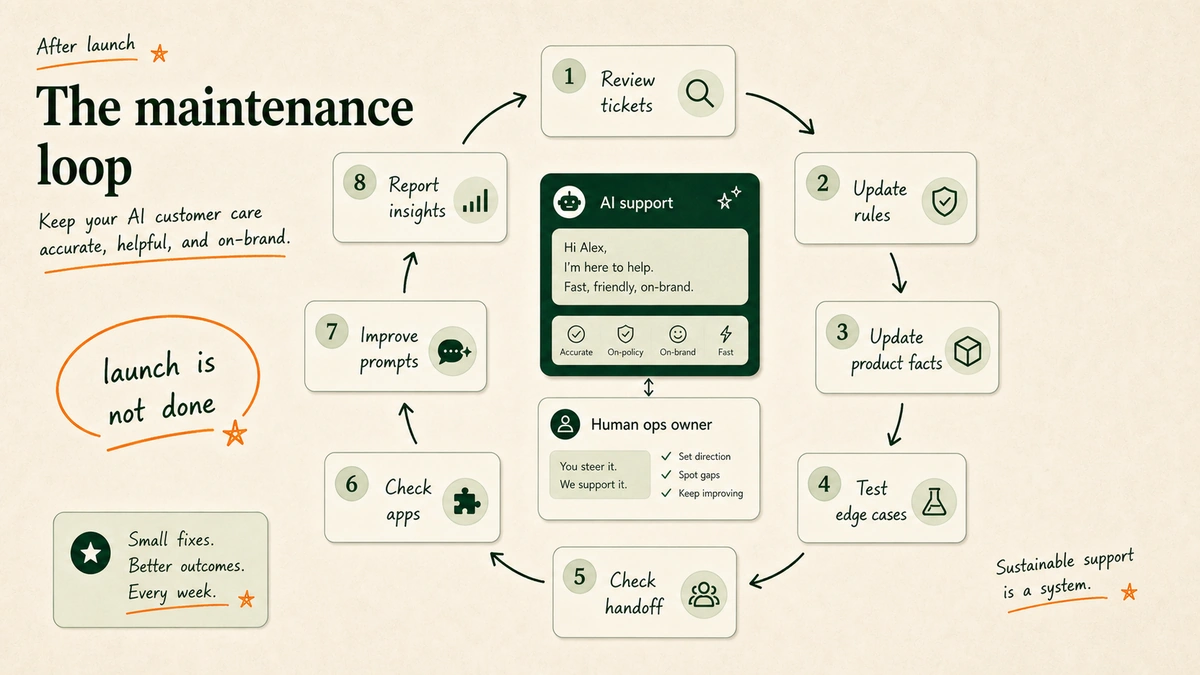
For $1M+ DTC brands, the question is less “which chatbot?” and more “who owns the support system when policies, products, and customer expectations change?”
That owner might be your helpdesk vendor. It might be an outsourced support partner. It might be an internal ops lead. Or it might be a custom AI customer care company.
Choose the company that matches the work you actually need owned.

No comment yet, add your voice below!