

I got a message last Tuesday. A founder. $2M Shopify brand. Three months on Rep AI, loved the setup speed, and now the monthly bill had become very hard to ignore. The rep AI vs custom AI for customer service question had arrived, the way it usually does. Quietly, then all at once.
“Vai, is this what everyone pays?”
$750 a month. For 1,000 email conversations.
With a custom-built AI customer service, it’s usually $50 to $100 for the same volume. That gap is why this comparison exists.
Custom-built. Maintained by us. No SaaS subscription ticking up every month. No CS manager whose job is to expand your contract. $650 to $700 every single month. Gone.
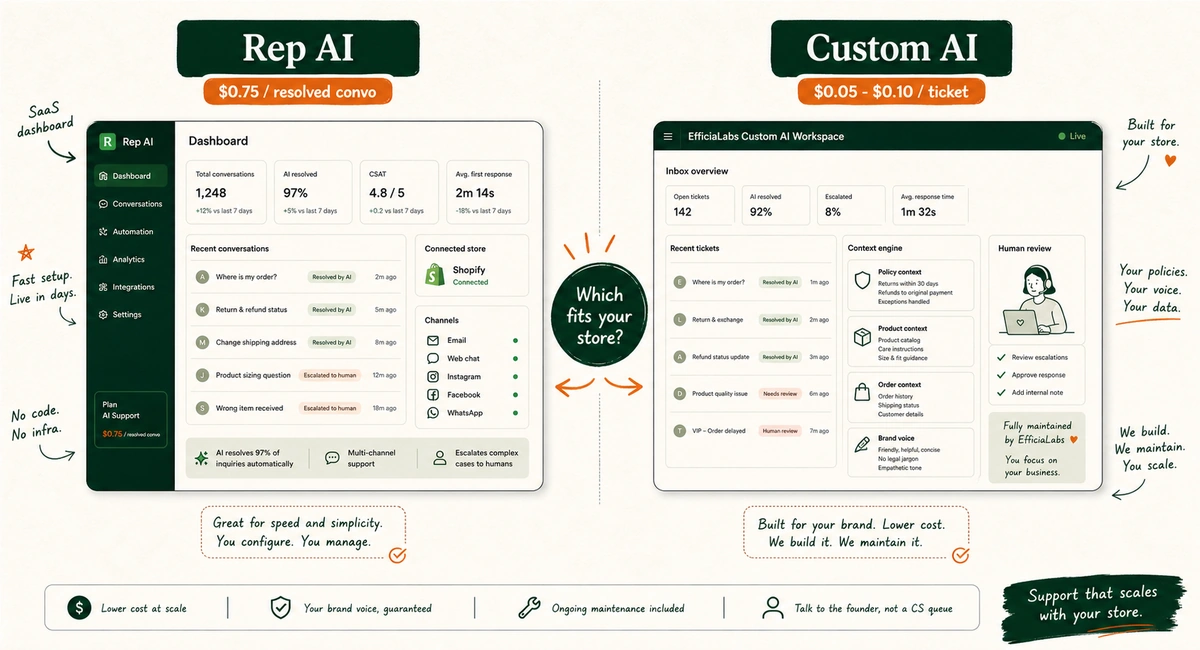
Rep AI is a legitimate product. Real Shopify integrations. Fast setup. Good multi-channel coverage. If you need something live this week and cost is not your primary concern, it is a reasonable option. This post is not a takedown.
It is a comparison. With actual numbers.
Key Takeaways
- Rep AI costs $0.75 per AI-resolved conversation; custom AI (EfficiaLabs) costs $0.05–$0.10 per ticket
- At 1,000 tickets/month, the monthly gap is $650–$700 ($7,800–$8,400/year)
- Rep AI wins on speed to launch: live in days, no technical partnership needed
- Custom AI wins on cost, brand voice guarantee, and long-term maintenance optional
- Most $1M+ Shopify brands handling 500+ tickets/month find custom AI cheaper within 60 days
Table of Contents
– What is Rep AI, and what does it actually cost?
– What is a custom AI customer support system?
– Rep AI vs. custom AI for customer service: the direct comparison
– Where does Rep AI make sense?
– Why do most $1M+ Shopify brands choose custom AI?
– How do you decide between Rep AI and custom AI?
– Frequently Asked Questions About Rep AI vs. Custom AI
– The Right Call for Your Store
What is Rep AI, and what does it actually cost?
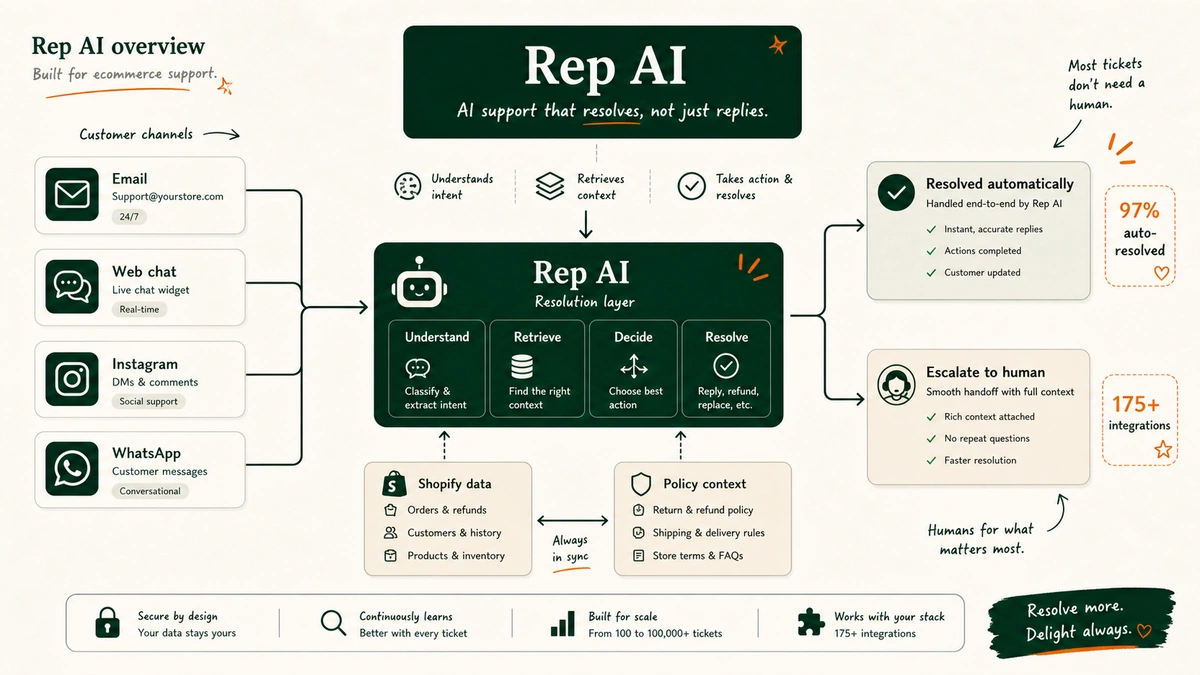
Rep AI (hellorep.ai) is an AI customer support tool built for ecommerce. It resolves support conversations across email, web chat, Instagram, Facebook, and WhatsApp. It connects to Shopify, reads your product catalog and order data, and handles the common requests: order tracking, return initiation, refund status, address changes, subscription edits.
Their headline claims: 97% of inquiries resolved automatically. 50–70% reduction in support tickets. 5× ROI within 30 days. “Live in 6 clicks.” For context, 61% of customers cite faster response as their primary reason for preferring AI-handled interactions for routine requests (Kustomer, 2024) — speed is where SaaS AI tools earn their keep, and Rep AI is no exception.
That last one is roughly accurate. The setup is genuinely fast for basic configuration.
Pricing: $0.75 per AI-resolved conversation (as of 2026). Their AI Support plan starts at $149/month. At 1,000 email conversations per month, that is $750/month. Add Instagram and Facebook volume and the number climbs — 1,750 conversations across three channels runs $1,313/month.
They have 175+ integrations including Shopify, Klaviyo, Gorgias, Loop Returns, and Recharge.
One useful piece of context: Rep AI positions itself against Gorgias, not against custom AI. Their pricing page says “25% cheaper than Gorgias.” If you want to see how Gorgias, Tidio, Manychat, and Chatfuel compare for ecommerce before settling on any tool, that comparison covers the ticketing-platform landscape.
Custom-built AI solutions are not in Rep AI’s competitive frame at all. That is not a criticism. Their product was designed for a different set of trade-offs than what we are comparing here.
What is a custom AI customer support system?
Custom AI is not a SaaS product. There is no monthly subscription, no settings panel to log into, no dashboard to monitor. It is a system built for your store specifically, using your policies, your product catalog, your brand voice, and your specific workflows.
What the build process looks like with EfficiaLabs: we connect to your Shopify store, your ticketing platform (Gorgias, Zendesk, Freshdesk, or Gmail), your product catalog, your return and refund policy, and your brand voice guide. We study your best support replies. Then we build the system from the ground up for your specific setup, deploy it, and maintain it going forward.
The ecommerce store does two things: grants us access to the relevant portals, and tells us how the brand sounds. That is it. For a sense of what “fully custom” means in practice using different AI models, using Claude for Shopify customer support walks through how nuanced ticket handling gets built.
What comes out the other side:
– Ongoing cost of $0.05–$0.10 per ticket — compute cost only, no SaaS markup
– Replies that match your brand voice closely enough that customers do not realize they are reading AI
– No ongoing maintenance burden: when your policies change or a new product line launches, that is our problem to handle
– One guarantee: if the replies sound like AI, you do not pay
That last point is not a marketing line. It is written into how we work with clients.
In my work building custom AI support for DTC brands, I have seen the same pattern repeat: a store launches with a SaaS tool, tickets get handled, costs feel manageable, and then six months later the founder is logging into a dashboard every week to tweak instructions, update policies, and investigate why resolution rate dropped after a product change. That is the hidden cost SaaS pricing does not show you.
I have spoken with DTC founders who tried two or three SaaS AI tools before moving to something custom. The pattern is consistent: the SaaS tool resolves tickets fine at first, but as the brand grows, edge cases multiply, and the flat monthly bill keeps rising while the tool’s ability to handle complexity plateaus.
We tested this firsthand with brands that came to us after running SaaS AI tools for 6–18 months. The resolution rates were fine, but the maintenance burden was real. Learn more about how to build a customer service AI chatbot for Shopify.
Rep AI vs. custom AI for customer service: the direct comparison
Both tools solve the same core problem: answering support tickets at scale without a room full of human agents. The difference is in cost structure, flexibility, and who is responsible for quality over time.
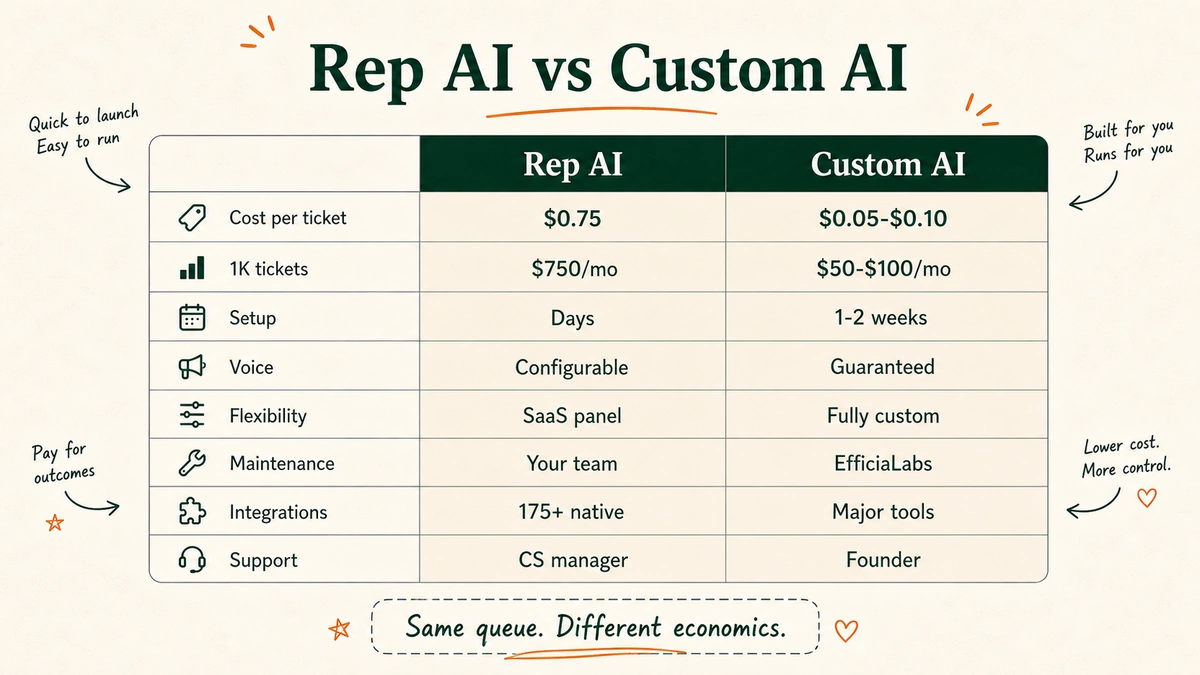
| Dimension | Rep AI | Custom AI (EfficiaLabs) |
|---|---|---|
| Cost per ticket | $0.75 | $0.05–$0.10 |
| Monthly cost (1,000 tickets) | ~$750 | $50–$100 |
| Monthly cost (5,000 tickets) | ~$3,750 | $250–$500 |
| Setup time | Days (“6 clicks”) | 1–2 weeks |
| Brand voice fidelity | Configurable (you tune it) | Guaranteed (or you don’t pay) |
| Flexibility | SaaS settings panel | Fully custom — anything is possible |
| Maintenance | Your team manages ongoing | EfficiaLabs handles everything |
| Integrations | 175+ native | All major: Gorgias, Zendesk, Freshdesk, Gmail |
| Who you talk to | Customer success manager | Vaibhav (founder) |
The cost column is the story. Everything else is a tie or a judgment call. Cost is not.
Where does Rep AI make sense?
Rep AI is the right call in three specific situations.
You handle fewer than ~200 tickets/month. At that volume, the per-ticket cost difference between $0.75 and $0.05–$0.10 adds up to roughly $130–$140/month. That is real money, but it may not justify the time investment of a custom build. Rep AI’s base plan is a reasonable fit here.
You need something live this week. If your support queue is burning and you cannot wait ten days for a custom system, Rep AI’s speed is a genuine advantage. “Live in 6 clicks” is close to accurate for basic configuration. The 30-day free trial with no credit card makes the first month essentially risk-free.
You want to test AI support before committing. If you have never run AI on your ticket queue and want to see what resolution rate looks like before investing in something custom, Rep AI’s trial is a legitimate experiment. Run it for 30 days. See how many tickets resolve automatically.
If the number is 80%+, that tells you your ticket mix is simple enough for AI to handle well. A custom build would deliver the same results at a fraction of the cost.
Pro tip: If Rep AI’s trial resolves 90%+ of your tickets, do not renew at $0.75/conversation. That resolution rate tells you custom AI is viable — and custom AI will cost 7.5–15× less per ticket at any meaningful volume. Some stores bridge the gap first with ChatGPT for Shopify customer support before moving to a fully bespoke build.
Why do most $1M+ Shopify brands choose custom AI?
Three reasons. The math, the voice, and the workload.
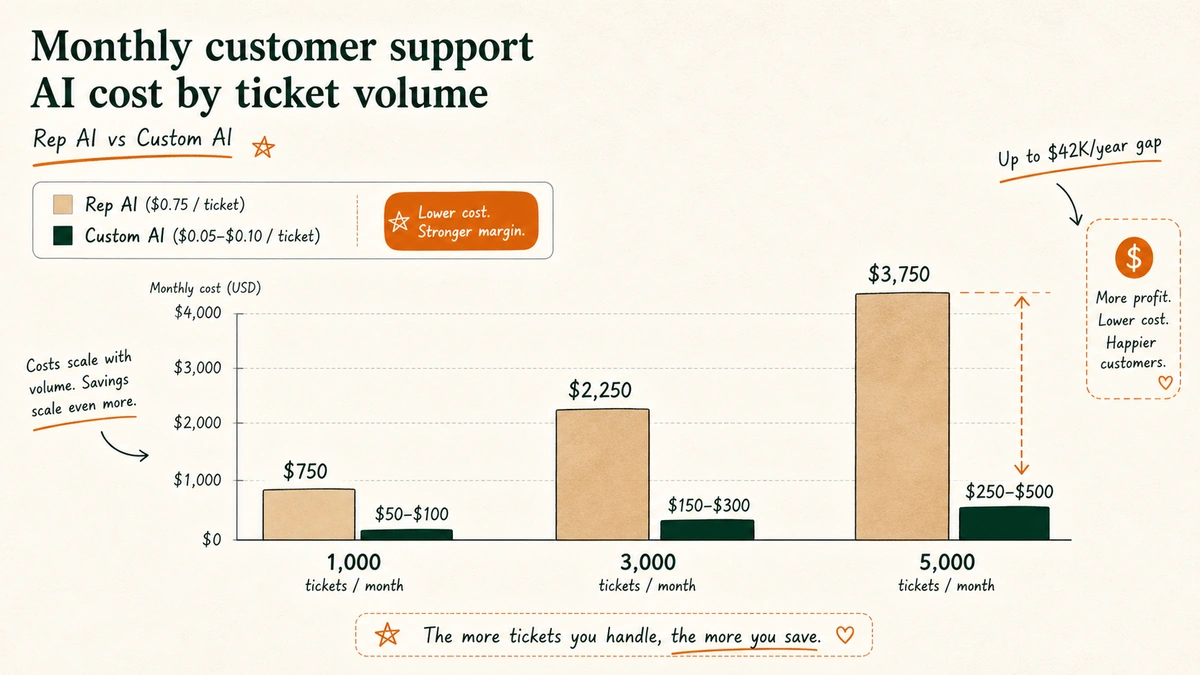
The cost math, done plainly.
Rep AI: $0.75 per AI-resolved conversation.
EfficiaLabs custom AI: $0.05–$0.10 per ticket.
At 1,000 tickets/month: Rep AI = $750. EfficiaLabs = $50–100. Monthly savings: $650–700.
At 3,000 tickets/month: Rep AI = $2,250. EfficiaLabs = $150–300. Monthly savings: $1,950–2,100.
At 5,000 tickets/month: Rep AI = $3,750. EfficiaLabs = $250–500. Annual gap: $39,000–42,000.
Same tickets answered. Very different bill. For the broader picture of how Shopify stores use AI to improve profitability, support cost is consistently one of the highest-leverage levers — and this is exactly why.
Brand voice is not a settings panel problem.
We built and deployed custom AI support systems for DTC Shopify brands across apparel, supplements, home goods, and beauty. The single most consistent piece of feedback from founders who switched from a SaaS tool: “It finally sounds like us.”
Rep AI lets you configure tone. You write instructions: be friendly, avoid legal language, don’t mention competitor brands. That is real control, and it works well enough for most stores.
But it is SaaS control. You are working within a UI that another company designed, with configuration options that another company decided to give you.
Custom AI starts from your actual emails. Your brand guidelines. Your support history. The 200 best replies your team ever wrote. We build the voice from the ground up until the replies are indistinguishable from your best support agent on their best day.
“If it sounds like AI, you don’t pay.” That is the guarantee.
For a deeper look at what that process involves: how to match AI voice to your brand voice in customer support.
“The founders I work with are not looking for another subscription to manage. They want support that sounds like their brand. And then to never think about it again.”
— Vaibhav Sharan, Founder, EfficiaLabs
The maintenance question nobody asks before they sign up.
In our work with Shopify brands across apparel, supplements, and beauty, the question that comes up most after switching from a SaaS AI tool is not “does it work?” They already knew it would work. The question is always some version of: why didn’t anyone tell me I’d be maintaining this thing myself?
Your return policy changes. Who updates the AI?
You launch a new product line with different care instructions. Who teaches the AI the answers?
A supplier issue affects three SKUs and customers start asking questions you have never been asked before. Who trains the AI on what to say?
With Rep AI, those updates are your team’s job. Log in, update the instructions, test, push live. Every time, for as long as you use the tool.
With EfficiaLabs, they are our responsibility. Policy changes, seasonal promotions, new product launches: we handle the updates. Most stores go years without touching the system themselves after the initial build.
Ecommerce founders are already running full companies. A support system should run quietly in the background, not become another SaaS subscription that needs babysitting.
Founder attention vs. a customer success manager.
Large SaaS companies assign you a CS manager. Their job is to help you get value and to grow your account. It is how SaaS works.
EfficiaLabs is not a large SaaS company. I personally listen to every client. When something is not right, I fix it.
There is no escalation chain. The clients who work with us tend to stay for years, not because of a contract lock-in, but because the system works and someone they trust is accountable for it.
See how we compare across the wider market: best company for ecommerce AI customer care in 2026.
How do you decide between Rep AI and custom AI?
Three questions. Honest answers to each settle it.
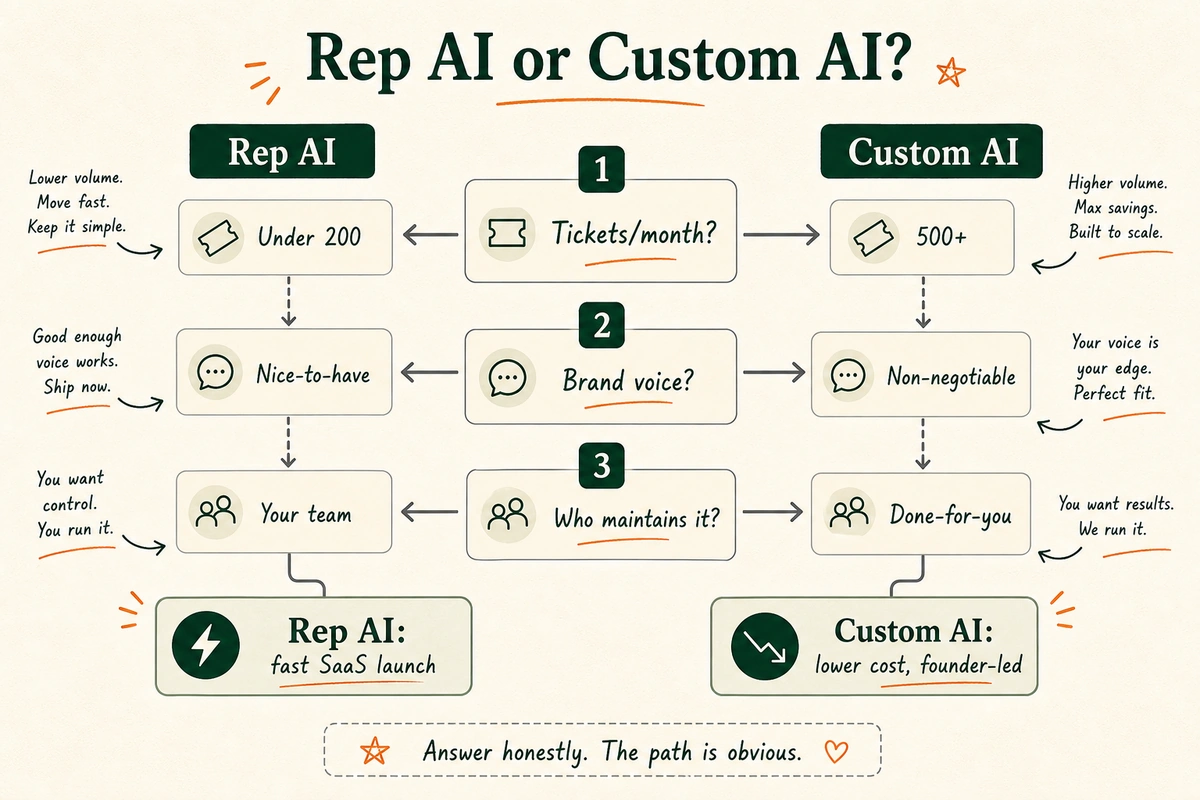
Question 1: How many support tickets do you handle per month?
Under 200: Rep AI’s base plan probably makes sense. The cost difference is small enough that it may not justify the time investment of a custom build.
200–500: The math starts favoring custom. At 300 tickets/month you are paying ~$225 to Rep AI versus $15–30 for custom. The break-even on a custom build is fast.
500+: Custom AI is almost certainly cheaper on a per-ticket basis. At 500 tickets, you are paying $375/month to Rep AI versus $25–50 for custom. The gap is no longer marginal. It is the kind of gap that funds a product launch.
Question 2: How important is brand voice to your customer experience?
Nice-to-have: Rep AI’s tone configuration is probably sufficient. It is flexible within its own system and works well for brands where support replies are functional rather than brand-defining.
Non-negotiable: If your brand voice is a genuine differentiator — if customers recognize your tone, if your support copy has been carefully crafted over years, if “sounds like a bot” is reputationally costly — you want a guarantee, not a settings panel.
Question 3: Do you have bandwidth to manage a SaaS tool long-term?
Your team can: Rep AI gives you full control. Tune instructions, monitor resolution rates, update the system when your business changes. If you have ops capacity for that, it is a valid model.
You want hands-off: Custom AI is built for founders who want to configure it once and not think about it again. Once deployed, most stores run for years with no intervention from anyone on their team.
The honest answer to these three questions usually lands in the same place. Most founders who reach out to EfficiaLabs have already been through the SaaS maintenance loop. They paid for the tool and became the unpaid maintainer.
Also worth reading before you decide: the same framework applied to two other platforms — Gorgias Customer Support AI vs. custom AI and Zendesk AI vs. custom customer support AI.
Frequently Asked Questions About Rep AI vs. Custom AI
Is Rep AI worth it for Shopify stores?
Rep AI is worth it for stores that need AI support live quickly and handle fewer than 200–300 tickets/month. At higher volumes, the $0.75 per AI-resolved conversation cost makes it significantly more expensive than a custom-built alternative. It is a solid product — the question is whether you are paying 7.5–15× more than necessary at your specific volume.
How much does custom AI cost compared to Rep AI?
Rep AI charges $0.75 per AI-resolved conversation. EfficiaLabs custom AI runs $0.05–$0.10 per ticket in compute costs. At 1,000 tickets/month, that is roughly $750/month vs. $50–100/month. At 5,000 tickets/month, the annual cost difference reaches $39,000–$42,000. There is a one-time build investment for custom AI, but for most stores handling 500+ tickets/month, that is recovered within 60–90 days of live operation.
How long does it take to set up custom AI?
Typically 1–2 weeks from first conversation to live deployment. The ecommerce store’s involvement in that timeline is minimal — grant access to Shopify and your ticketing platform, share brand guidelines, and answer a few questions about edge cases. EfficiaLabs handles the build, integration, testing, and deployment.
Can custom AI handle returns, exchanges, and order lookups like Rep AI?
Yes. Order tracking, return initiation, exchange workflows, address changes, refund status, subscription edits — all standard in a custom build. Because the system is built against your specific return policy and Shopify setup, it often handles edge cases more accurately than a general-purpose SaaS tool trained across many different brands’ workflows.
What happens when my return policy changes — who updates the AI?
With Rep AI, your team updates the AI. Log in, revise the instructions, test the new behavior, push live. With EfficiaLabs custom AI, that is our responsibility. Policy changes, new product lines, seasonal promotions, shipping rule updates — we handle the updates. Most EfficiaLabs clients run their systems for years without needing to touch the AI themselves.
Do I need technical skills to work with EfficiaLabs?
No. Onboarding requires two things: access grants to the relevant platforms (Shopify, ticketing tool) and a conversation about your brand voice. EfficiaLabs handles everything technical from there. The ecommerce founder’s job is to describe what good looks like — our job is to build it.
The Right Call for Your Store
That founder I mentioned at the start? She moved to a custom build three weeks after that message. In our work building her system, the entire setup took nine days from first call to live tickets being resolved.
First full month after launch: $73 in compute costs on 890 resolved tickets. Down from $668 the previous month on Rep AI.
She spent those savings on inventory for the next product drop.
That is what this decision is actually about. Not AI. Not technology. Whether you are paying what the infrastructure actually costs, or paying for a company’s growth margin on top of it.
Rep AI works. For the right store, at the right volume, it is a fast and reasonable way to start. But for most $1M+ Shopify brands handling real support volume, the math leads somewhere else.
The AI in DTC statistics for 2026 show adoption is accelerating. The question is no longer whether to use AI, but which AI costs what it should.
If you want to see what that looks like for your store specifically, reach out.
— Vai
Sources
- Rep AI pricing and product claims: hellorep.ai and hellorep.ai/platform/ai-support (pricing confirmed 2026)
- EfficiaLabs per-ticket cost of $0.05–$0.10: internal compute cost data, EfficiaLabs
- Cost calculations at 1,000 / 3,000 / 5,000 tickets/month: derived from Rep AI’s $0.75/conversation rate and EfficiaLabs’ $0.05–$0.10/ticket rate

No comment yet, add your voice below!