

Meta spend is getting less efficient. Contribution margins are shrinking. In the brands we work with, contribution margins that were sitting above 25% in 2023 have dropped to 20–22% in 2026. Every new tool you add has to earn its place against a P&L that is already under pressure.
A founder called me last quarter. Eight-person brand, somewhere in Texas. Meta CAC up 40% year-over-year. She had just come off a Siena AI demo. $750 a month, 90 cents per automated ticket. She wanted to know: when it comes to Siena AI customer support vs. custom AI, which one actually makes sense for a brand her size?
That question keeps coming up. So here is the honest answer.
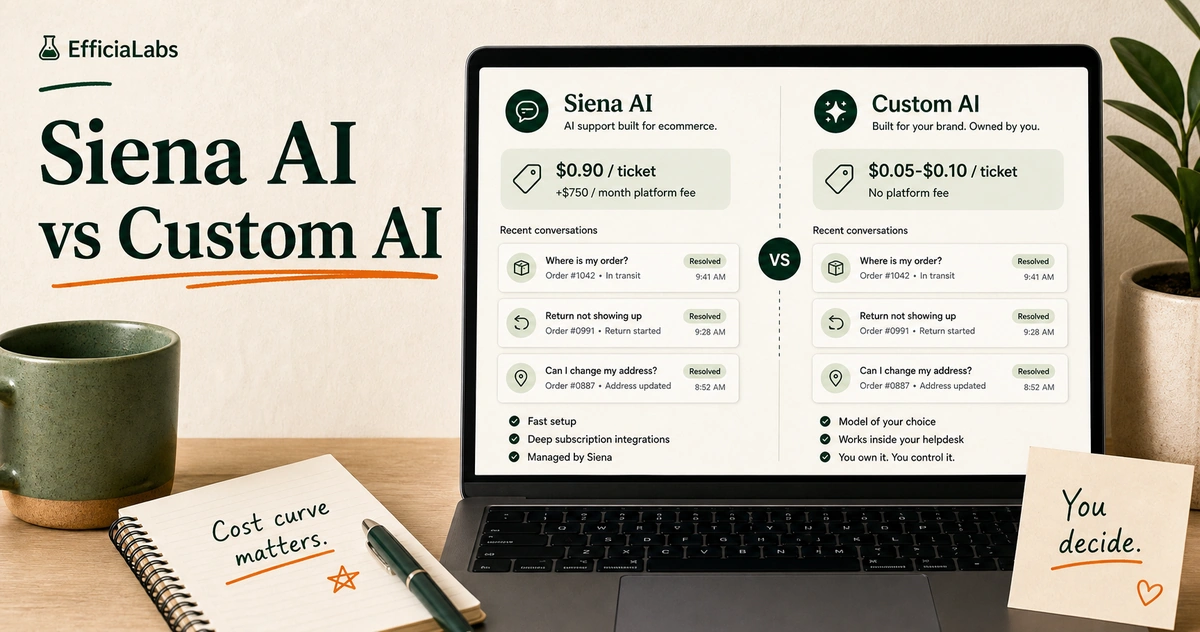
Siena AI costs $750/month plus $0.90 per automated ticket. A custom AI build costs $0.05–$0.10 per ticket to run. At 1,000 tickets/month, the gap is over $1,550 every month. Whether that gap matters depends on your ticket volume, how much control you want over the system, and how much margin you have left to give.
Key Takeaways
- Siena’s cost scales with your ticket volume. The more you grow, the more you pay.
- Custom AI costs stay flat. $0.05–$0.10/ticket whether you are fielding 500 tickets or 5,000.
- Siena is not a standalone helpdesk. You keep paying for Gorgias, Zendesk, or whatever you already run.
- Custom AI takes 30 days to set up properly. After that, you own it and self-maintain or walk away.
- Under 300 tickets/month: Siena is reasonable. Over 500: the math changes fast.
Table of Contents
- Key Takeaways
- What is Siena AI?
- How much does Siena AI actually cost?
- What does “custom AI customer support” actually mean?
- Siena AI vs. custom AI: side by side
- The cost math at real DTC volumes
- When does Siena AI make sense?
- When does custom AI win?
- How does brand voice actually work?
- What does the cost math look like in practice?
- Which one is right for you?
- FAQs about Siena AI vs. custom AI customer support
- The answer
What is Siena AI?
Siena is an AI customer support platform built specifically for DTC ecommerce. It handles support tickets, post-purchase queries, and returns across chat, email, and social. Siena’s own 2025 data claims automation of up to 80% of daily customer interactions. h/t Siena.cx For broader context on AI adoption rates and benchmarks across DTC ecommerce in 2026, the data is worth reviewing before committing to any AI platform.
The headline feature is “AI Personas” — configurable brand voices you can tune differently across different channels. The results are real. Spanx: 50% of conversations automated, 90%+ CSAT, handle time cut in half, as cited by Siena in 2025. h/t Siena.cx
What Siena does well
Empathic, on-brand replies. Agentic actions: refunds, address edits, order updates. Not just canned answers. Deep subscription integrations: Recharge, Skio, Smartrr, Ordergroove, Prive. h/t Alhena AI
What Siena does not do
Chat only. No voice channel. And it is not a standalone helpdesk. It sits on top of Gorgias, Zendesk, Kustomer, Intercom, or Dixa. You keep paying for those. Siena is the AI layer, not the whole system. That distinction matters for the cost math.
How much does Siena AI actually cost?
$750/month platform fee. $0.90 per automated ticket. h/t Yuma AI, 2025
Here is what that means at real DTC volumes.
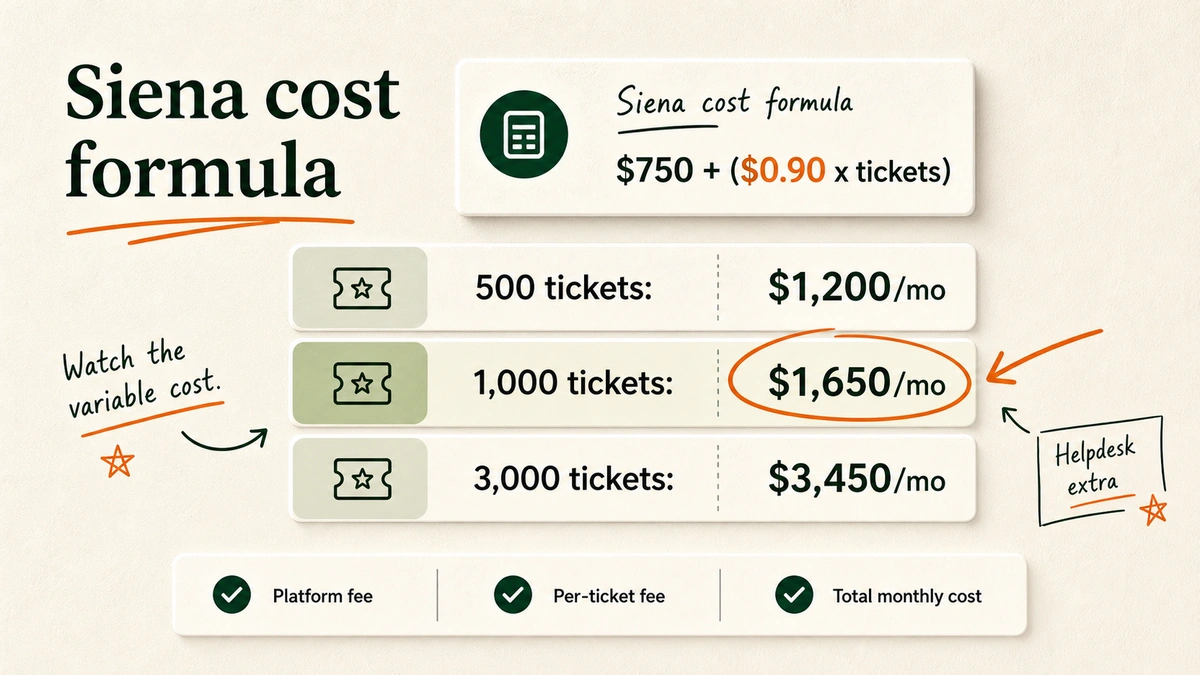
| Monthly tickets | Platform fee | Per-ticket cost | Total Siena cost |
|---|---|---|---|
| 500 | $750 | $450 | $1,200/mo |
| 1,000 | $750 | $900 | $1,650/mo |
| 3,000 | $750 | $2,700 | $3,450/mo |
None of those totals include your helpdesk. Add Gorgias, Zendesk, or Freshdesk on top.
Pro tip: Run the full 12-month math before signing. Include your helpdesk cost on both sides. Siena adds a new invoice on top of what you already pay; custom AI adds only model API costs.
Here is what bothers me about per-ticket pricing: it penalizes your growth. The better your store performs, the more support volume you generate, the more you pay. When contribution margins are sitting in the 20–25% range and Meta ad costs keep climbing, a cost line that scales with your revenue is the opposite of what you need.
“Most DTC founders I work with are not looking for more tools. They are looking for fewer invoices.”
— Vai S., founder, EfficiaLabs
What does “custom AI customer support” actually mean?
Not what most people assume.
It does not mean hiring a developer and spending six months building something from scratch. It means a team builds it, deploys it inside your existing helpdesk, coordinates with you for 30 days to make sure every output is right, fine-tunes the responses, and hands it over.
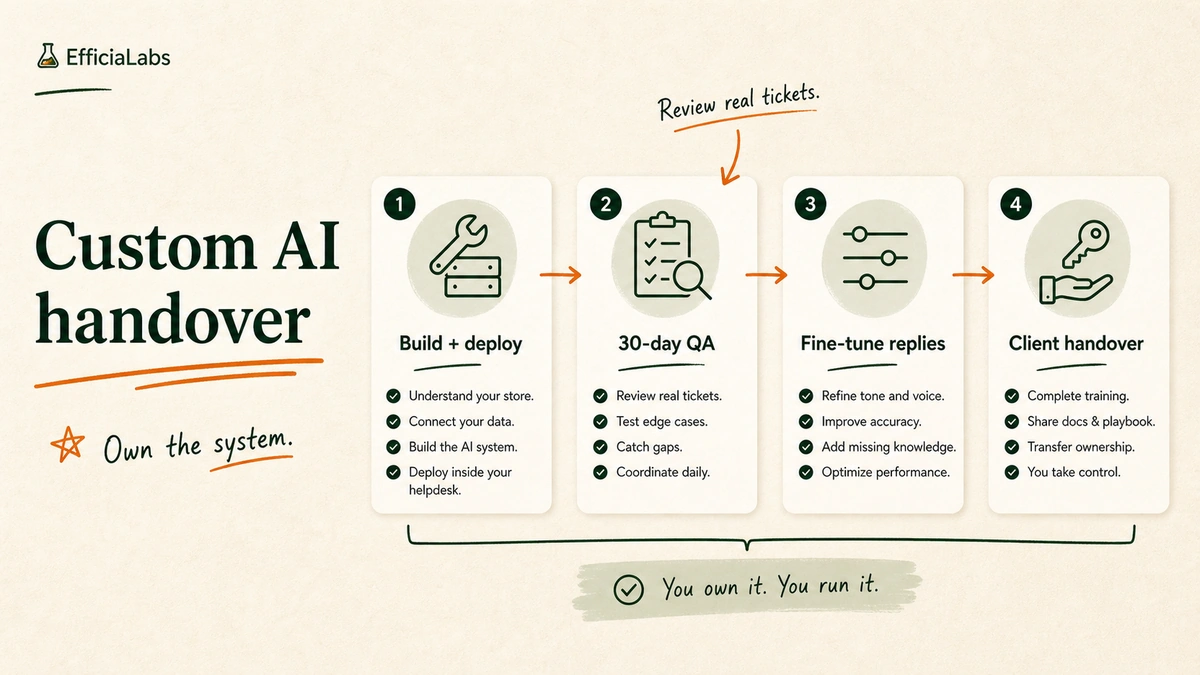
In our work with DTC brands across the US, UK, and Australia, the 30-day coordination period is the most valuable part of every build. That is where we compare real outputs against the brand’s own emails, catch anything that sounds robotic, and build the QA patterns that make the system reliable long-term. We have tested this process across brands ranging from 300 to 5,000 tickets a month — the formula holds at every volume.
Four things worth knowing:
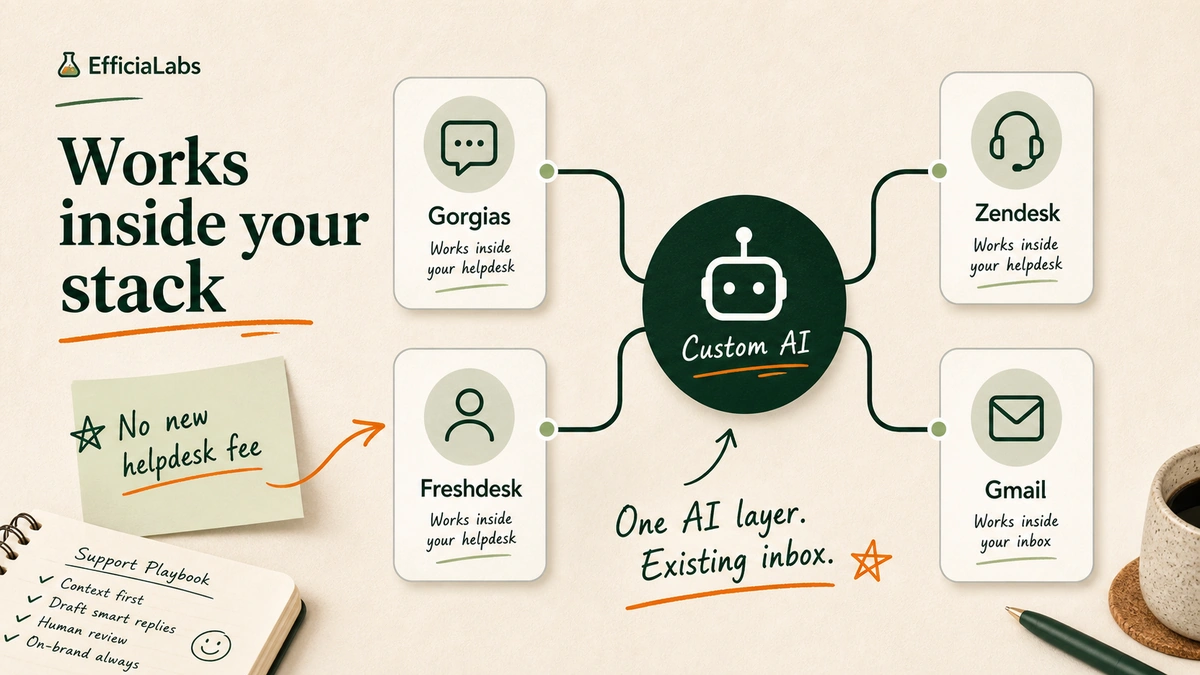
- Works inside what you already have. Gorgias, Zendesk, Freshdesk, Gmail — custom AI plugs in. No new platform fee. No ripping out your current stack.
- Model is your choice. Claude, GPT-4, Gemini — whichever performs best for your brand’s specific support patterns and budget. You are not locked into a vendor’s model decision.
- Cost does not scale with volume. You pay model API costs: $0.05–$0.10 per ticket whether you handle 500 tickets or 5,000. Flat line.
- Maintenance is optional. After handover, most clients self-maintain. Update the knowledge base document when your return policy changes. Done.
Siena AI vs. custom AI: side by side
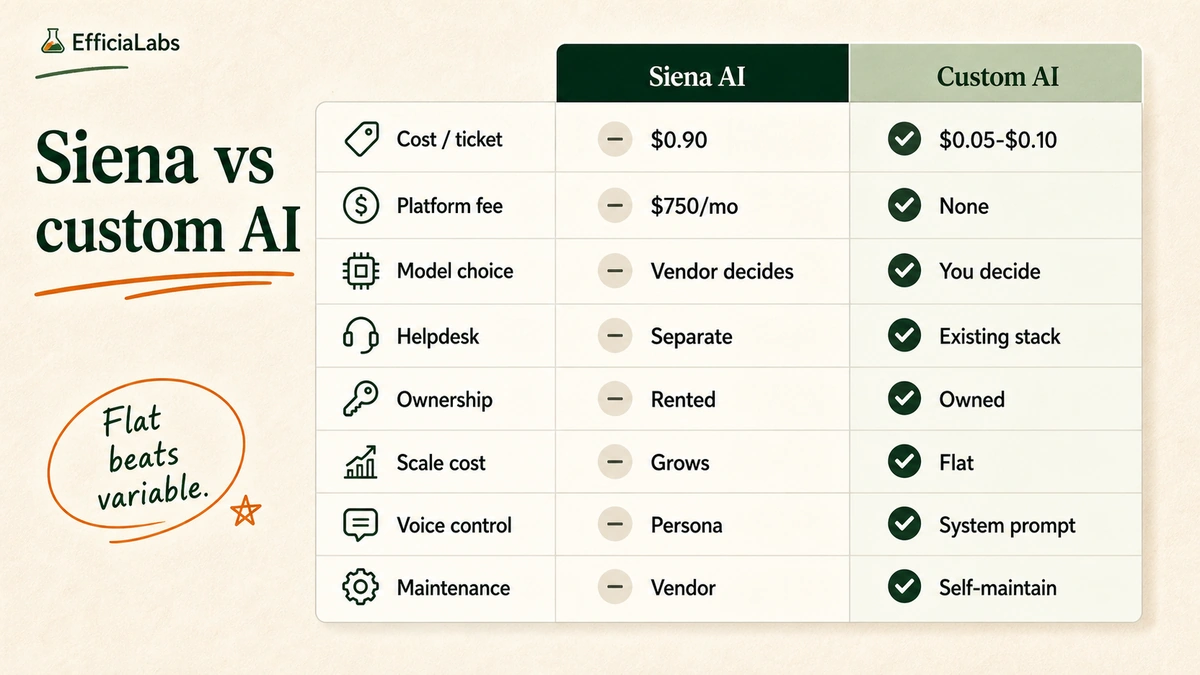
| Siena AI | Custom AI (EfficiaLabs) | |
|---|---|---|
| Cost per ticket | $0.90 | $0.05–$0.10 |
| Monthly platform fee | $750/mo | None |
| Model choice | Siena decides | Claude, GPT-4, Gemini — you decide |
| Brand voice control | AI Personas (in-platform) | System prompt + full knowledge base |
| Helpdesk dependency | Yes, billed separately | Works inside yours |
| Maintenance after launch | Vendor manages | Self-maintain or optional support |
| Ownership | Rented | You own it |
| Cost as you scale | Grows with every ticket | Stays flat |
Pricing: h/t Yuma AI, 2025. Custom AI figures = model API costs only.
The cost math at real DTC volumes
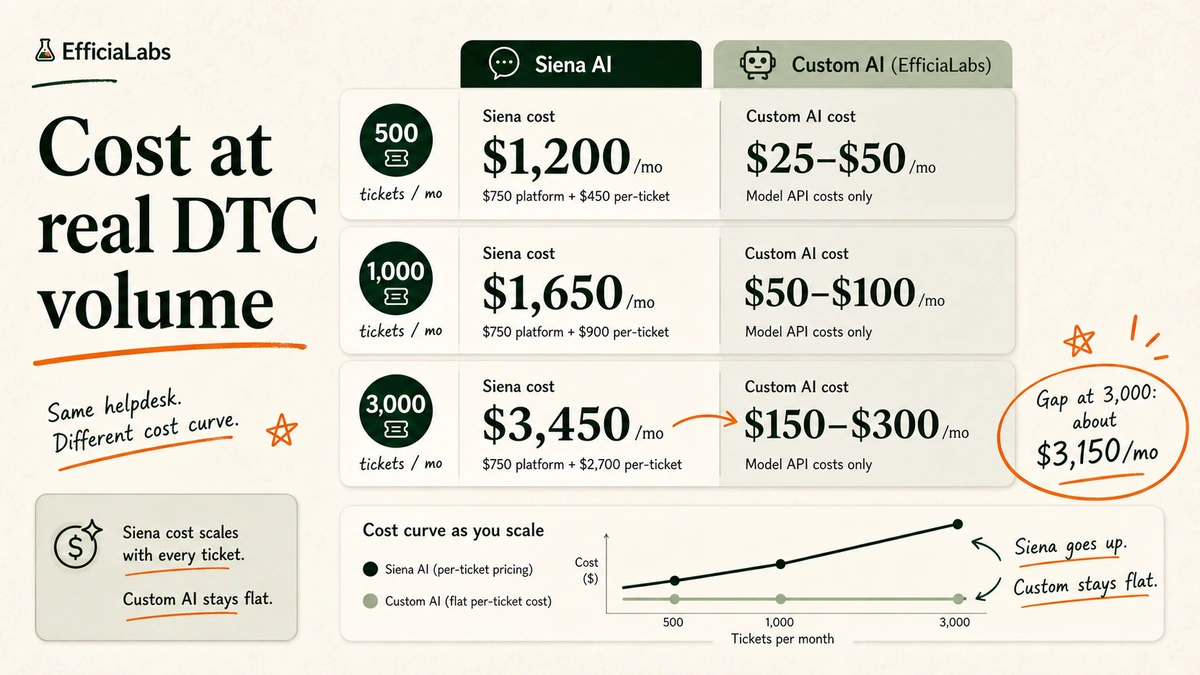
At 500 tickets/month:
Siena: $1,200. Custom AI: roughly $25–$50 in model costs.
At 1,000 tickets/month:
Siena: $1,650. Custom AI: roughly $50–$100.
At 3,000 tickets/month:
Siena: $3,450. Custom AI: roughly $150–$300. A gap of $3,150 every single month. $37,800 a year.
I have watched founders run this calculation and sit with the number for a minute. At 3,000 tickets, $37,800 a year is a retention campaign. It is three months of paid social. It is a full-time support hire in certain markets. Real money.
The crossover point sits around 300–500 tickets/month, where custom AI wins on a 12-month view. Below that, Siena’s fast launch and zero technical lift may justify the premium. Above it, the math is hard to argue with.
When does Siena AI make sense?
Siena is good software. There are scenarios where it is genuinely the right call.
Under 300 tickets/month. The monthly cost is manageable. You get a vendor with a support team, a polished UI, and something live in days, not weeks.
Subscription-heavy brands. Recharge, Skio, Smartrr, Ordergroove — Siena has them all connected out of the box. If subscription logic drives most of your support volume, Siena has a real launch-speed advantage.
Zero bandwidth for onboarding. Your team has no capacity to review outputs and give feedback for 30 days. Siena handles everything from day one.
Testing AI for the first time. Want to see what support automation looks like before committing to a custom build? Siena is a reasonable place to start.
Important note: One thing to ask in any Siena demo. h/t Gorgias (a direct competitor — read with appropriate weight) noted that Siena’s AI continues responding to tickets even after a human agent picks them up. If accurate, that creates CSAT damage at the exact moment a customer needs a human. Get clarity on this before signing.
When does custom AI win?
500+ tickets/month. The math. Every month. No exceptions.
You want model choice. We have seen this matter more than most brands expect. Claude handles emotionally complex, nuanced tickets differently than GPT-4. Gemini runs cheaper at very high volume. Being locked into a vendor’s LLM means you cannot optimize for your brand’s specific support patterns or your cost structure. You are flying blind on model performance.
Non-standard integrations. A custom loyalty system. A bespoke returns portal. An internal ops tool. Custom AI connects to anything with an API. Siena connects to Siena’s list.
You want ownership, not a subscription. Flat costs. Full control. No invoice growing every time your brand does.
This is what matters most in 2026. Every SaaS line you add is a commitment your margin has to honor every single month, indefinitely. When ad efficiency is declining and contribution margins are under real pressure, a cost structure that grows with ticket volume is a structural problem. Not just a budget line item.
“When implementing Siena AI, the key is controlling exactly what you feed it. Train on historical tickets and it learns to repeat promotions that no longer exist. Intentional, real-time training is what keeps the AI honest.”
— Lisa Popovici, VP Customer Experience, Simple Modern h/t LinkedIn
How does brand voice actually work?
Siena uses “AI Personas.” You configure tone, vocabulary, and escalation rules inside their platform. It works. The Spanx numbers are proof.
Custom AI works differently. The brand voice lives in the system prompt — a document we write together that defines tone, language style, what the AI should and should not say. It is paired with a knowledge base: your product catalog, return policy, FAQs, and shipping SLAs.
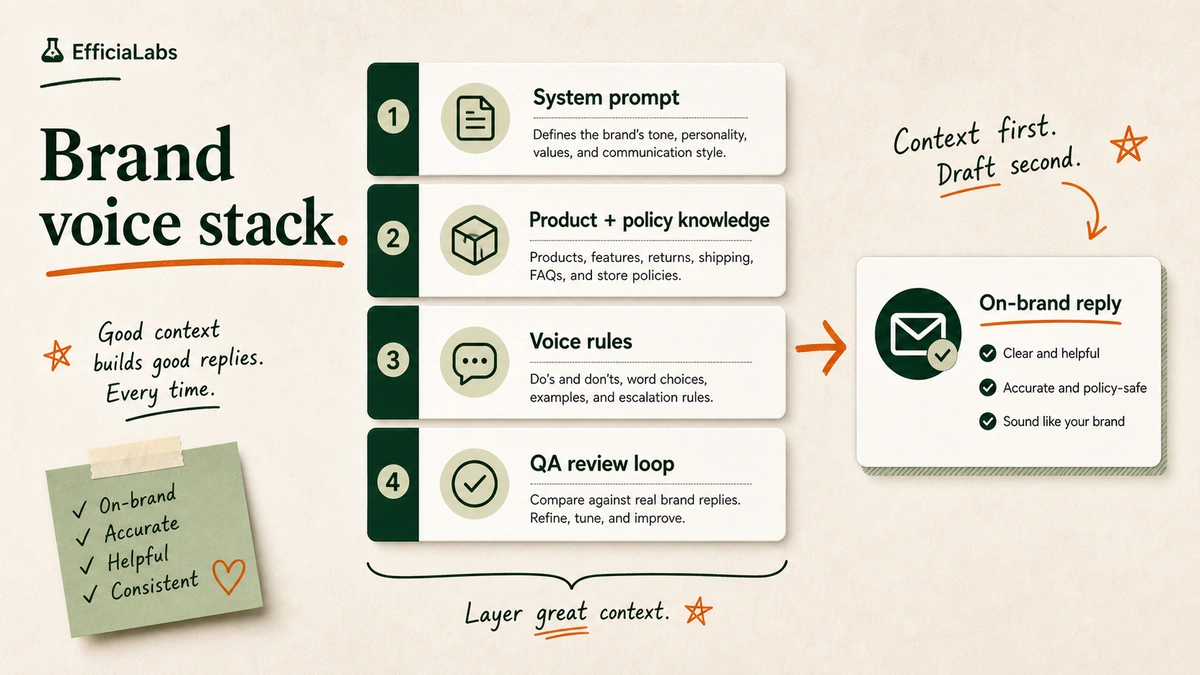
Note: Update the knowledge base and the AI reflects it within minutes. No ticket to a vendor. No platform release cycle. No stale replies about a promotion that ended last Tuesday.
We have run this process for brands across the US, UK, and Australia. In our work with these teams, I measured reply quality against the brand’s own pre-AI emails — tone, word choice, escalation behavior — and the gap closes significantly by week three. The pattern is consistent: by the end of 30 days, the replies sound like the founder wrote them. The difference is not the AI model. It is the quality of the context you feed it. A Siena persona builder and a well-written system prompt can produce the same output quality. The difference is who controls the inputs and how fast you can update them.
For the full mechanics, how to match AI voice to your brand voice in customer support covers the approach in depth.
What does the cost math look like in practice?
Take a brand handling 1,200 tickets a month — common for a DTC brand doing $2–5M in annual revenue. At Siena’s 2025 pricing: $750 + (1,200 × $0.90) = $1,830/month. Plus whatever they already pay for Gorgias or Zendesk.
With custom AI at $0.08/ticket: $96/month in model API costs. Same helpdesk. No additional platform fee.
The $1,734 monthly gap pays back a typical build inside two months. After that, every month is $1,734 saved — or reinvested into the acquisition spend that is already under pressure.
That is the math at 1,200 tickets. At 3,000 tickets, it is $3,150 a month. The curve only goes one direction.
Which one is right for you?
Three questions. Honest answers.
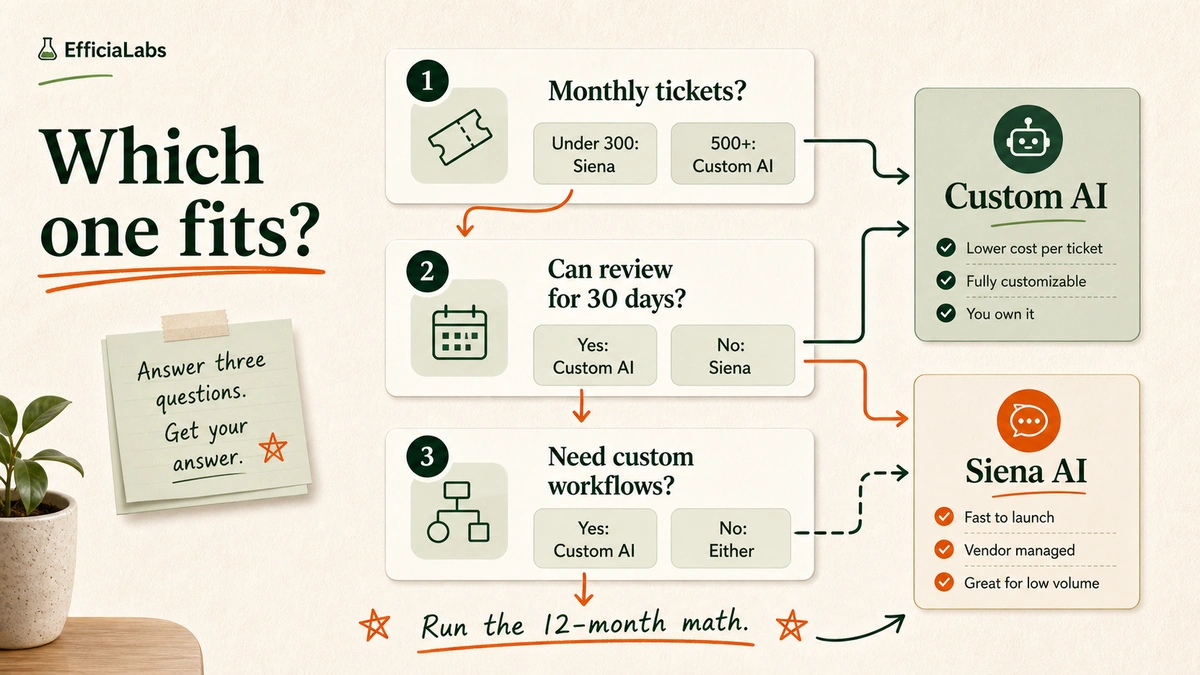
Question 1: How many support tickets do you handle per month?
– Under 300: Siena is a reasonable call.
– 300–500: Run the 12-month math. If margin is already tight, custom AI likely wins here too.
– 500+: Custom AI wins on cost. Full stop.
Question 2: Does your team have bandwidth for a 30-day coordination process?
– Yes — someone can review outputs and give feedback for 30 days: custom AI is viable.
– No bandwidth right now: Siena launches faster with less lift from your team.
Question 3: Do you need a specific AI model or a workflow Siena does not support?
– Yes: custom AI is the only real option.
– No: either works.
If you are comparing other platforms with the same framework — Gorgias Customer Support AI vs. Custom AI, Zendesk AI vs. custom customer support AI, and Rep AI vs. Custom AI for Customer Service — each runs the same cost analysis for its platform.
FAQs about Siena AI vs. custom AI customer support
How much does Siena AI cost per month?
Siena charges $750/month as a platform fee plus $0.90 per automated ticket. At 1,000 tickets/month, that is $1,650/month before any helpdesk costs. Siena does not publish pricing publicly on their website; this figure is h/t Yuma AI, 2025. Your actual costs will depend on the volume of tickets Siena successfully automates.
Does custom AI customer support require ongoing maintenance?
Not necessarily. After the 30-day coordination and fine-tuning period, the client receives a full handover. Most clients self-maintain from that point: updating a knowledge base document when return policies, products, or promotions change. Ongoing support from EfficiaLabs is available but entirely optional — most clients do not need it after the first 30 days.
How long does it take to set up custom AI for customer support?
Build and deployment takes roughly a week. The 30-day coordination period follows — outputs are reviewed against the brand’s real emails, responses are tuned to match the brand’s voice, and edge cases are handled. By day 31, the system runs reliably and the client takes ownership.
Can custom AI match Siena’s brand voice quality?
Yes. The mechanism is different — a system prompt plus a structured knowledge base rather than an in-platform persona builder — but the output quality is comparable. The 30-day coordination period is specifically focused on making every reply sound like the brand, not like a chatbot. The key variable is how thoroughly you define the voice in the system prompt.
What helpdesks does Siena AI integrate with?
Siena integrates with Gorgias, Zendesk, Kustomer, Intercom, Dixa, Recharge, Skio, Klaviyo, Loop Returns, and others, as documented by h/t Alhena AI. Custom AI integrates with Gorgias, Zendesk, Freshdesk, Gmail, and any platform with an API — working inside your existing stack rather than adding a new subscription on top.
The answer
Ad spend getting more expensive. Margins getting thinner. Every platform you subscribe to is a bet your business can carry that cost indefinitely.
Siena AI is good software. Under 300 tickets/month, the fast launch and zero technical lift might justify the premium. Their brand voice results are real and their subscription integrations are genuinely strong.
Above 500 tickets/month, the per-ticket math stops working in Siena’s favor. $1,650/month at 1,000 tickets. $3,450/month at 3,000. Costs that grow every time your brand grows.
Custom AI runs at $0.05–$0.10/ticket. Flat. You own it. You maintain it. The cost curve does not move.
For a broader view of who builds AI customer support well for DTC brands, the best companies for ecommerce AI customer care in 2026 has the full list.
— Vai
Sources
- Siena AI homepage — siena.cx (Spanx case study, 80% automation claim, AI Personas overview — cited 2025)
- Siena AI pricing — h/t Yuma AI ($750/month + $0.90/ticket; Siena does not publish pricing publicly)
- Siena integration list — h/t Alhena AI (most comprehensive third-party source found)
- Post-escalation routing behavior — h/t Gorgias (direct competitor; one data point, not independently confirmed)
- EfficiaLabs custom AI cost range: $0.05–$0.10/ticket (model API costs, 2026; varies by model and volume)

No comment yet, add your voice below!