

It’s 11pm, and a customer in Utah just asked your brewery why their hazy IPA hasn’t shipped. It hasn’t, and it legally can’t, which is the one thing most guides skip. Knowing that before the AI drafts a word is how you use AI customer service for brewery ecommerce stores without a fine in your inbox.
Beer is not soap. Beer is not a phone case.
Half your support questions touch a law. The wrong cheerful auto-reply isn’t a bad customer experience. It’s a compliance problem.
Last updated: 2026-06-18.
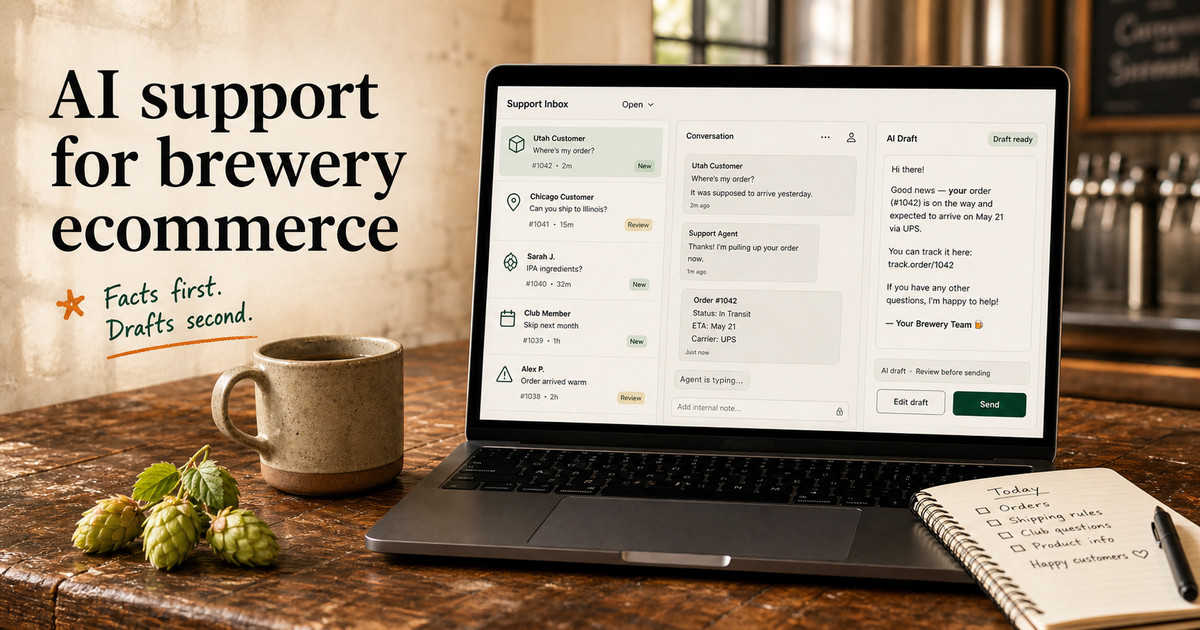
In our work with regulated DTC brands, breweries are the trickiest vertical we touch. Here’s how to do it right, on the same custom Shopify support stack we build for other stores.
In a sentence
Put AI on the tickets that are safe and repetitive. Gate everything that touches alcohol law or age behind a human. Feed it your real policies, and you can launch the whole thing in about a week.
Table of Contents
- Why is brewery customer service different from other ecommerce?
- Which brewery tickets should AI answer, and which should it never touch?
- What context does an AI need before it answers a beer question?
- How do you make AI sound like your taproom, not a bot?
- How to use AI customer service for brewery ecommerce stores in 7 days
- What does AI customer service cost for a brewery ecommerce store?
- Frequently asked questions
Why is brewery customer service different from other ecommerce?
Because most of your inbox is about something you’re not always allowed to do.
Direct-to-consumer beer shipping is legal in only 11 states plus Washington, D.C. as of 2026, per Sovos ShipCompliant. Wine ships to 48. Beer ships to a dozen.
So “can you send a case to my place?” has a different answer depending on which side of a state line your customer’s couch is on.
It gets more specific. Avalara’s state-by-state guide lists hard per-person caps: Kentucky allows 10 cases a month, Virginia allows two, Washington, D.C. allows one.
Every legal shipment needs an adult 21-or-over signature at the door. The carrier cannot leave beer on a porch.
Now stack the demand on top. 69% of regular craft beer drinkers say they’d subscribe to a DTC beer club, and 77% say they’d buy more craft beer if direct shipping were available (Sovos, 2026).
The orders are coming. The questions come with them.
So a brewery’s support inbox is really four inboxes wearing one hat:
- Shipping legality (“do you ship to Texas?”)
- Age and ID (“nobody was home to sign”)
- The beer itself (“is this gluten-free, what’s the ABV?”)
- The club (“pause my subscription, skip this month”)
A generic ecommerce chatbot answers all four the same confident way. That’s the trap.
The first two can get you fined. The second two are easy money for automation.
Pro tip: Before you automate anything, pull your last 200 tickets and tag each one by which of those four buckets it lands in. That ratio tells you exactly how much of your inbox is safe to hand to AI on day one.
Which brewery tickets should AI answer, and which should it never touch?
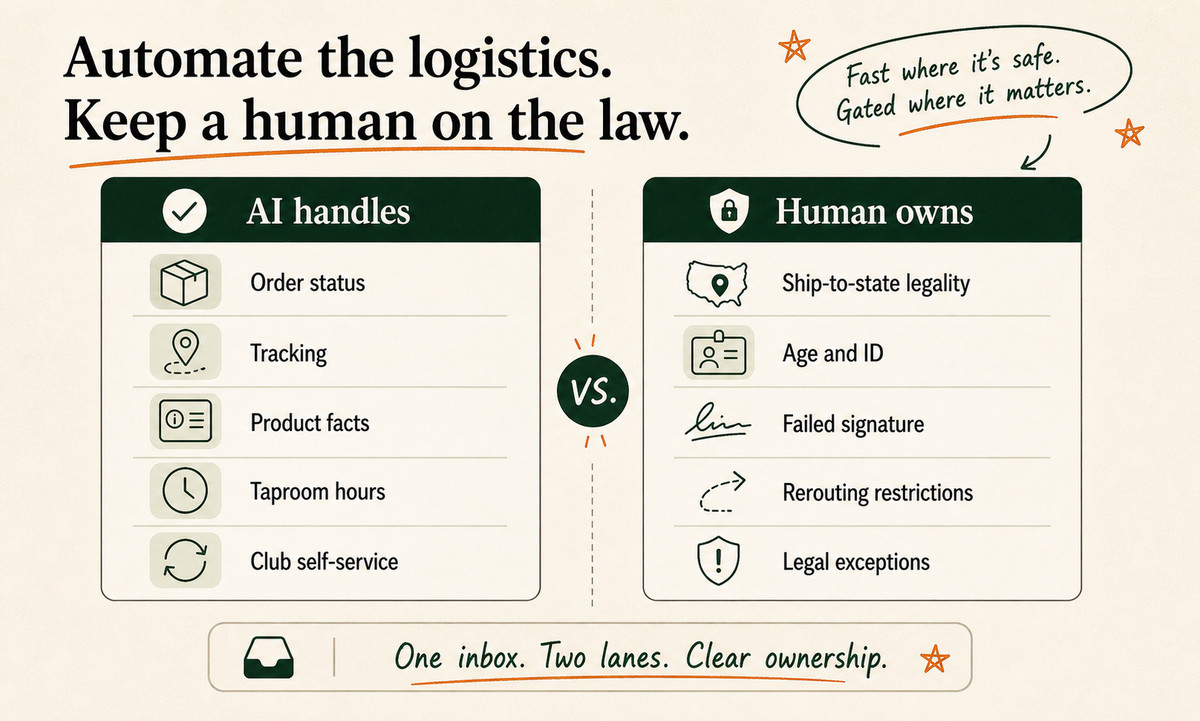
Sort every ticket by what happens if the AI gets it wrong. Low stakes, AI answers. Legal stakes, a human decides.
That’s the entire framework.
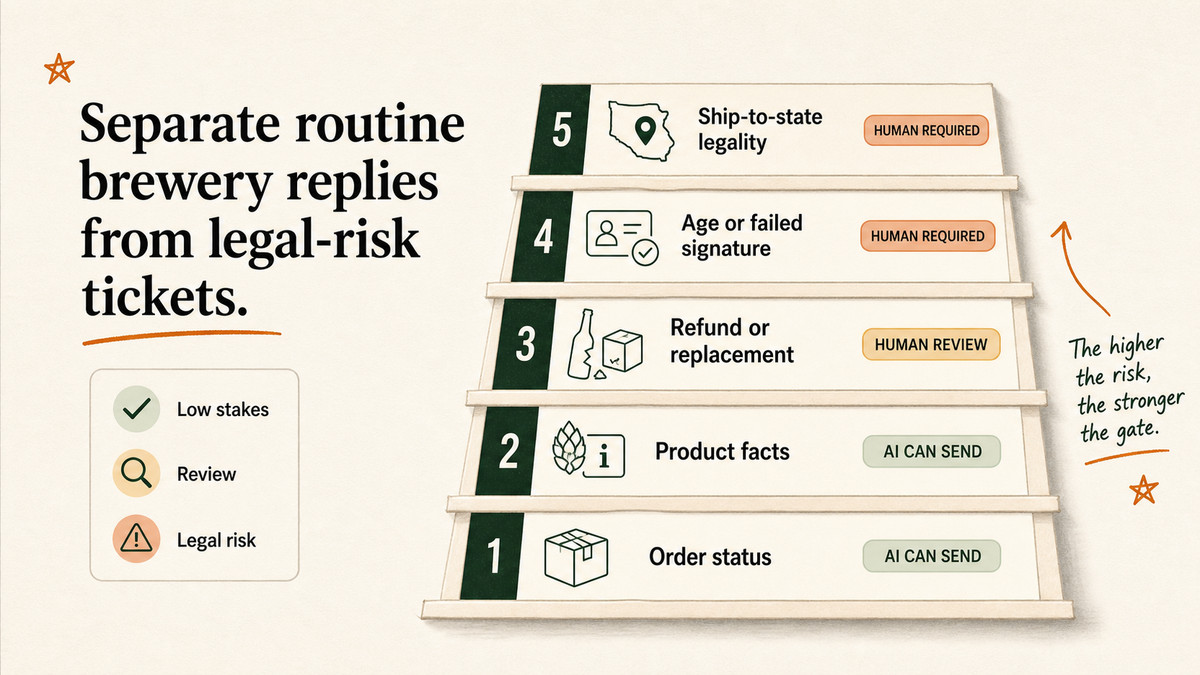
Roughly 80% of ecommerce tickets are the same nine questions asked over and over (eDesk, 2026). For a brewery, the safe, high-volume ones look like this.
Safe for AI to answer on its own:
- “Where’s my beer?” Order status, tracking, delivery windows.
- “What’s the ABV / IBU / is this gluten-reduced?” Straight from your product data.
- “When does the taproom open?” Hours, address, parking.
- “How do I pause or skip my club box?” Subscription self-service, once you’ve confirmed the rules.
Drafts only. A human confirms before send:
- Refunds and replacements for breakage or a flat keg.
- Club billing disputes.
- Address changes on an order already in motion.
Hard human gate. AI never sends these alone:
- “Can you ship to my state?” The answer is a legal one, and it changes by zip code.
- Anything about age, ID, or a failed signature delivery.
- A customer trying to reroute beer to a state you can’t ship to.
We’ve built this same gate for regulated verticals like supplements, where one wrong claim is an FTC problem. The build pattern is identical to the one in our protein supplements support guide: automate the boring 70%, gate the regulated 30%, never blur the two.
Beer is the only DTC category where a friendly auto-reply can technically break the law. So that’s the line we never let a bot cross.
— Vaibhav Sharan, founder, EfficiaLabs
Important note: “AI never sends these alone” doesn’t mean a human writes them from scratch. The AI drafts, pulls the order, and flags the risk. A person clicks approve.
You get the speed. You skip the liability.
What context does an AI need before it answers a beer question?
Facts. Layered, current, and yours.
An AI with no context is just a confident stranger guessing about your refund policy.
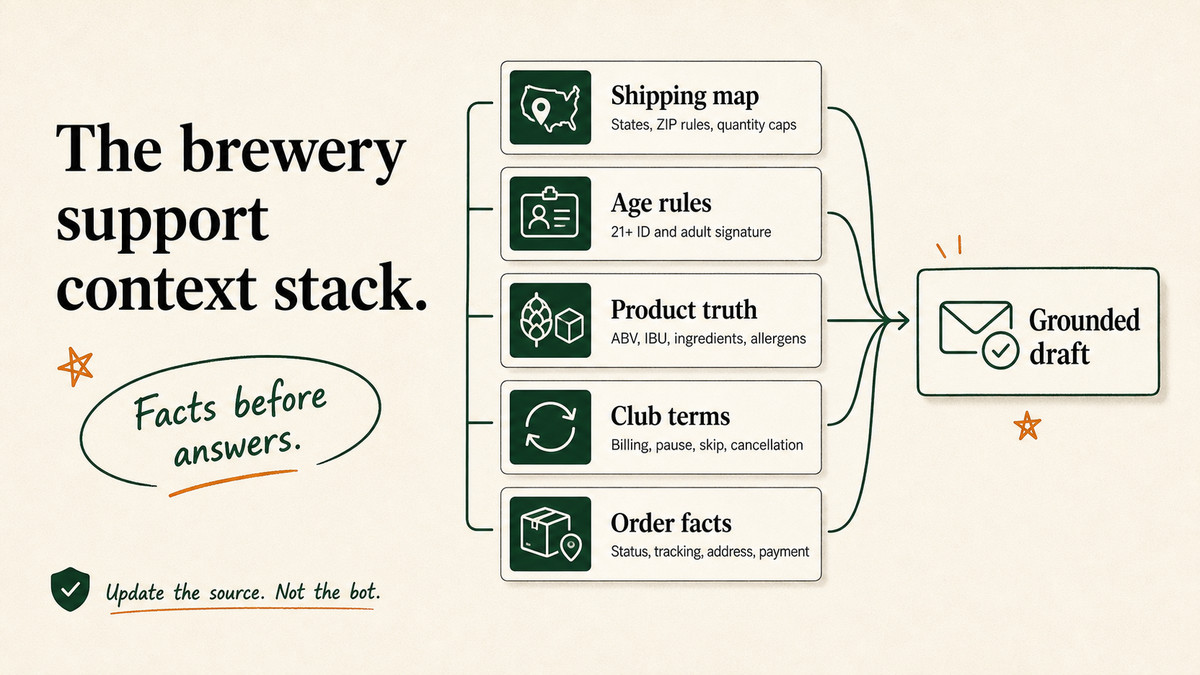
Here are the five layers we load before a brewery AI answers anything.
- Shipping-state map. The exact states and zip rules you can ship to, with per-person caps. This is the layer that keeps you out of trouble.
- Age and 21+ rule. ID and adult-signature requirements, plus what to tell a customer whose delivery failed.
- Product truth. ABV, IBU, ingredients, allergens, gluten, batch and seasonal availability.
- Club and subscription terms. Billing dates, pause and skip and swap rules, cancellation windows.
- Order facts. Live status, tracking, address, payment, pulled per ticket from your store.
When products or laws change, you change the source, not the bot. A new state opens up for DTC beer, you update one map. A seasonal sour sells out, you flip one flag.
The AI reads the latest version every time.
This is also where a custom build pulls away from an off-the-shelf widget. A generic tool knows shipping in the abstract.
It doesn’t know that you can ship to Ohio but not Pennsylvania, that your club bills on the 3rd, or that your west-coast IPA is brewed with wheat. That gap is the difference between a helpful reply and a fineable one.
How do you make AI sound like your taproom, not a bot?
You write the voice rules down. You give it real examples of your best replies. You test it against tickets before a single customer sees it.
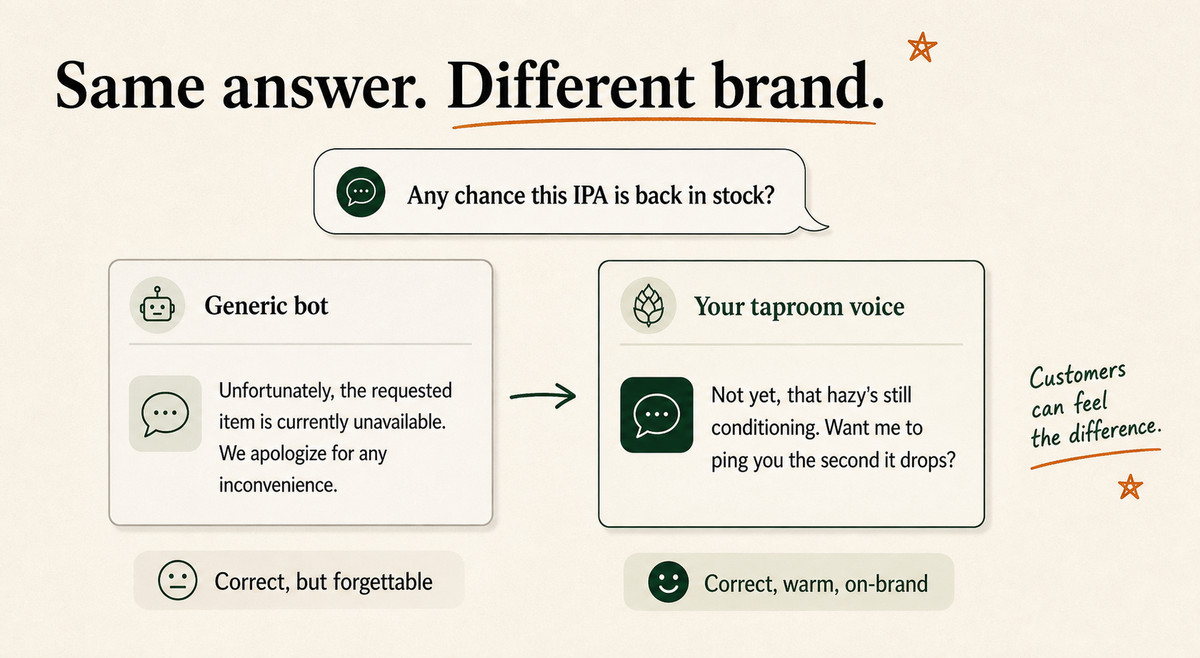
A customer asks: “Any chance this IPA is back in stock?”
A stock bot says: “Unfortunately, the requested item is currently unavailable. We apologize for any inconvenience.”
Your taproom says: “Not yet, that hazy’s still conditioning. Want me to ping you the second it drops?”
Same information. Completely different brand.
Craft beer customers can smell a corporate auto-reply from across the bar, and a flat one chips at the exact personality they bought into. We go deep on this in our guide to matching AI voice to your brand voice, but the short version is three rules.
- Feed it your real replies. Twenty of your best human answers teach tone better than any style guide.
- Ban the tells. No “we apologize for any inconvenience,” no “kindly,” no robotic stiffness. Write the banned list explicitly.
- Keep the human in the loop early. For the first weeks, you approve drafts. The AI learns your edits.
Here’s our actual promise on this: if the replies don’t sound like your brand, you don’t pay. We don’t ship a bot that embarrasses you.
If a reply doesn’t sound like it came from your taproom, it doesn’t go out. Brand voice isn’t a nice-to-have for a brewery. It’s the product.
— Vaibhav Sharan, founder, EfficiaLabs
That’s the line I give every brewery founder on the first call.
How to use AI customer service for brewery ecommerce stores in 7 days
You don’t build this. We do.
Your job is roughly one hour on day one and a review on day six. Here’s the actual schedule we run.
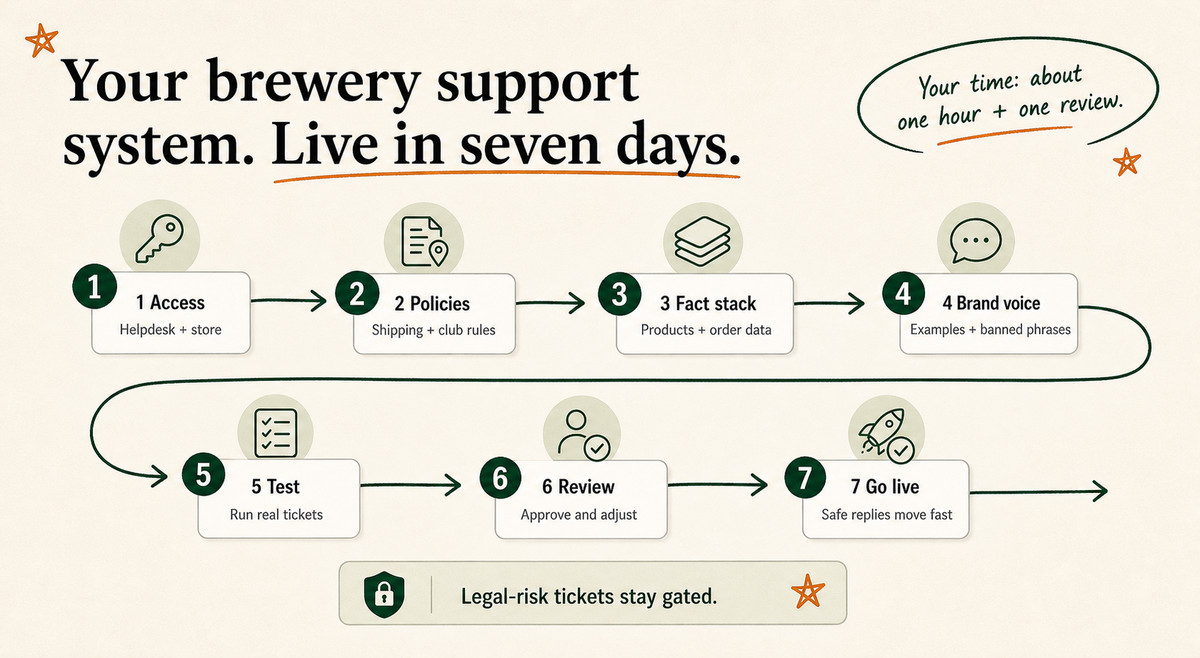
Day 1: You grant access
You give us read access to your helpdesk and store. Gorgias, Zendesk, Freshdesk, Gmail, Shopify, it doesn’t matter which. That’s the bulk of your effort, done.
This mirrors the kickoff in our skincare 7-day deployment guide, just with beer law layered in.
Day 2: We map your policies
We pull your shipping rules, club terms, and refund policy into a single source of truth. We flag every state you can and can’t ship to.
Day 3: We build the fact stack
We wire up the five context layers: shipping map, age rules, product data, club terms, live order lookups.
Day 4: We set the brand voice
We load your best replies, write the banned-phrase list, and tune tone until it reads like you.
Day 5: We test on real tickets
We run the AI against your last few hundred tickets and grade every draft. When we tested this on a brewery’s real inbox, we saw the safe buckets clear instantly while the gated ones lined up for review. The legal-gate tickets get checked hardest.
Day 6: You review drafts
You skim a batch of real drafts and tell us where it’s off. We adjust. This is your second and final time investment.
Day 7: Go live
The AI starts drafting in your helpdesk. Every reply that touches shipping legality or age waits for a human click. Everything safe goes out fast.
Note: “Go live” does not mean “walk away.” For the first two weeks the human-approval rate stays high on purpose. As the drafts prove themselves on the safe buckets, you let more of them auto-send.
The gated ones stay gated forever.
What does AI customer service cost for a brewery ecommerce store?
Less than you think. The pricing model matters more than the sticker.
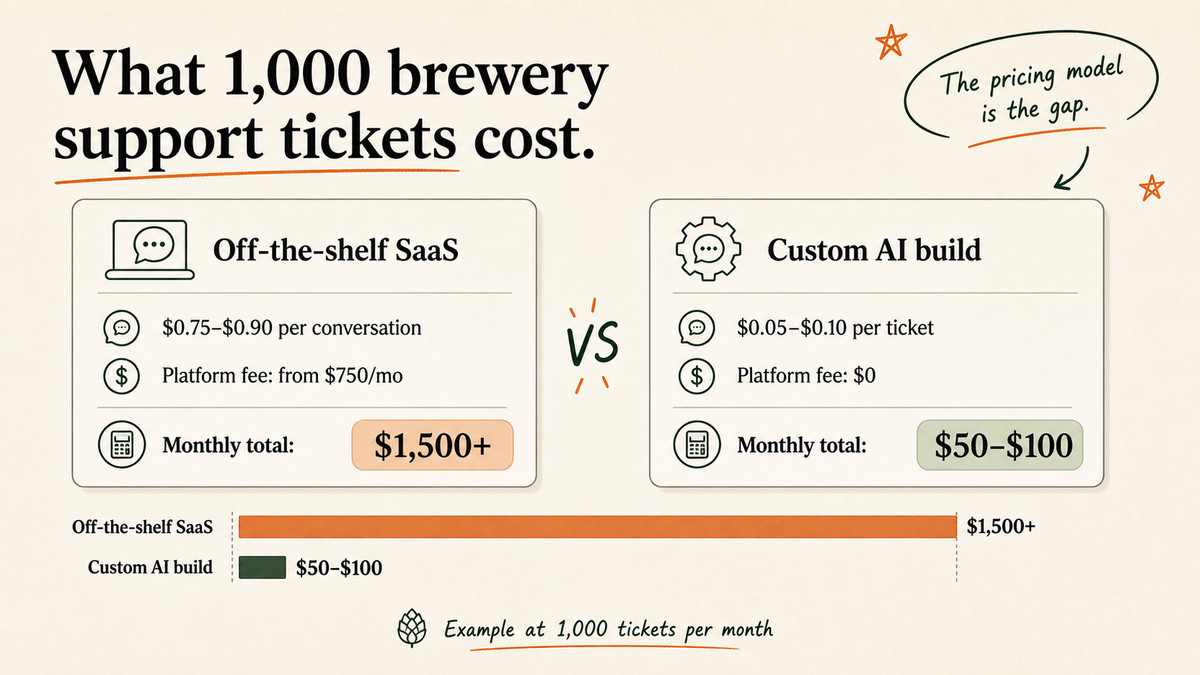
Most off-the-shelf AI support tools bill per conversation, and it adds up. Rep AI runs about $0.75 per conversation. Siena lists around $0.90 per ticket on top of a $750 monthly platform fee.
For a brewery doing real club volume, those numbers compound every Q4.
A custom build runs on raw model cost. We see $0.05 to $0.10 per ticket, with no platform fee. Here’s the gap on 1,000 tickets a month.
| Approach | Per ticket / conversation | Platform fee | 1,000 tickets / month |
|---|---|---|---|
| Off-the-shelf SaaS | $0.75-$0.90 | From $750/mo | $1,500+ |
| Custom AI (our builds) | $0.05-$0.10 | None | $50-$100 |
That’s not a typo.
The bigger saving is what you don’t see. Once a custom build is tuned, it usually runs for years with no real maintenance.
The AI customer service market is forecast to grow from $12.06 billion in 2024 to $47.82 billion by 2030 (MarketsandMarkets, 2025). The SaaS tools will keep adding seats and features and line items. A build you own doesn’t.
For the full picture on where AI moves the needle for a store, our 49 AI in DTC statistics roundup is a good gut-check. Read it before you spend a dollar.
Frequently asked questions
Can AI legally handle alcohol orders for my brewery?
Yes, for the parts that don’t decide a legal question. AI can answer order status, product specs, and club logistics all day.
It should not be the thing that decides whether a shipment to a given address is legal, or that clears an age or signature issue. Those stay behind a human gate.
The AI drafts and flags. A person approves.
Will AI accidentally tell a customer I ship to a state I can’t?
Not if it’s built right. The shipping-state map is loaded as hard context, and every “can you ship here?” ticket is gated for human approval rather than auto-sent.
That combination is exactly why a generic chatbot is risky for a brewery and a custom build isn’t. The guardrail is the whole point.
Which helpdesks does this work with?
All the common ones. Gorgias, Zendesk, Freshdesk, and Gmail are the usual setups for DTC brands, and a custom build sits on top of whichever you already use.
You don’t switch tools. We integrate with what’s there.
How is this different from the AI button inside Gorgias or Zendesk?
The built-in AI tools are generic and priced per conversation. They don’t know your shipping map, your club rules, or your taproom voice unless you spend weeks configuring them, and they still charge per ticket forever.
A custom build bakes your policies in once, runs at near-raw cost, and matches your brand. We break the trade-offs down by tool across our customer support comparisons.
What happens during a Black Friday or seasonal-release spike?
This is where AI earns its keep. Ticket volume jumps fast during peak season, and the safe buckets (“where’s my beer?”) are exactly the ones that spike hardest.
The AI absorbs those instantly while your team focuses on the gated, high-value tickets. You scale without hiring seasonal temps.
Right-size the work, then hand it off
A brewery inbox is half logistics and half law. The logistics half is begging to be automated. The law half needs a human who knows the rules.
Get that line right, and AI gives you back your evenings without putting your license anywhere near a chatbot’s confidence.
We do the whole build: the fact stack, the gates, the voice, the launch. You grant access and review once.
Seven days later your safe tickets answer themselves and the risky ones wait for you. That’s the version of AI support a brewery can actually run.
See you in the next one. — Vai
Sources
- Sovos ShipCompliant, DtC Beer Shipping Report, 2026: states allowing DTC beer shipping, consumer demand figures.
- Avalara, state-by-state guide for shipping beer DTC: per-person quantity caps and licensing.
- eDesk, AI customer service tools for high-volume ecommerce, 2026: ticket-volume and hybrid-support data.
- MarketsandMarkets, AI customer service market forecast, 2025: market size $12.06B (2024) to $47.82B (2030).

No comment yet, add your voice below!