

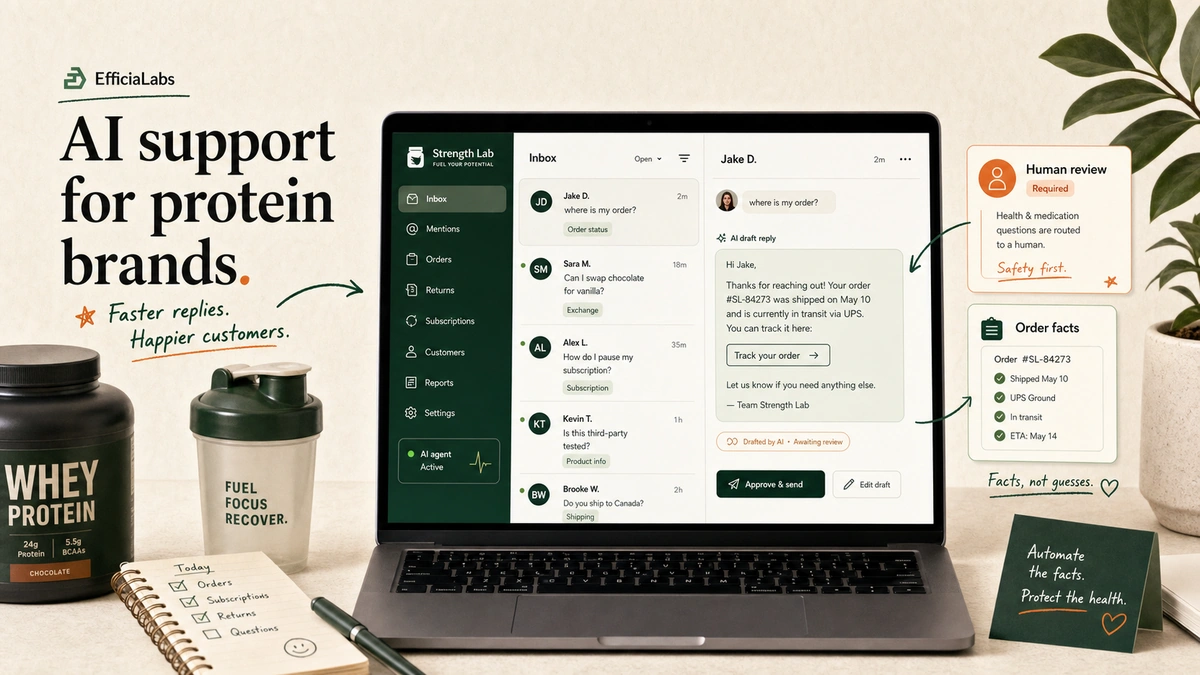
11:42pm. Two tickets land in the same minute. One: “where’s my order, it’s been 9 days.” Easy. The other: “can I take your pre-workout with my blood pressure meds?” Not easy. One belongs to a machine. One belongs to a human, fast.
Most supplement brands answer both the same way, slowly, the next morning. That is the whole problem in one screenshot.
To use AI customer service for a protein supplements brand, you put an AI agent on your existing helpdesk to draft replies to repetitive tickets, wire compliance guardrails so it never makes a disease claim, and keep a human review gate for anything touching health. Order status, flavor swaps, subscriptions: automated. “Is this safe with my medication”: routed to a person. You can have this live in about a week.
Table of Contents
- Key Takeaways
- What it means to use AI customer service for a protein supplements brand
- Which protein support tickets to automate first
- The compliance guardrails that keep you out of FTC trouble
- The human-review gate: a decision ladder for health-risk replies
- What AI customer service actually costs for a supplements brand
- How to launch in 7 days
- Frequently asked questions
- Live in 7 days, not 7 months
Key Takeaways
- Automate the facts (orders, flavors, subscriptions, “is it third-party tested”). Escalate the health.
- The FTC and FDA hold you liable for what your chatbot says. Guardrails are not optional for supplements.
- A human review gate is the difference between fast and reckless.
- Custom AI runs at roughly $0.05 to $0.10 per ticket. Per-resolution SaaS bots run 8 to 18 times that.
What it means to use AI customer service for a protein supplements brand
AI customer service is software that reads an incoming ticket, pulls the relevant facts (order record, product label, return policy), and drafts a reply in your brand voice. A person approves it or it sends on its own, depending on risk. It is not a generic chatbot widget bolted to your homepage. It lives inside the helpdesk you already use.
For a protein brand, the job splits cleanly. There are facts, and there are health questions. The facts are repetitive and safe to automate. “Where is my order.” “Can I swap chocolate for vanilla.” “Pause my subscription.” Same questions, every day, on a loop.
The health questions are different. “Will this help my joint pain.” “Is creatine safe for my kidneys.” Those carry regulatory and human risk, and they are where automation has to stop and a person has to step in.
In our work building these systems for Shopify brands, the pattern repeats across every protein account: when we measured the inbound, about 70% to 80% of tickets were pure logistics. That is the slice you automate first. The rest you protect.
The US protein supplements market hit roughly $10.88 billion in 2025 (Fortune Business Insights, 2025). More volume, more tickets, more “where’s my scoop.” Support is the tax you pay on growth, and the adoption numbers across DTC say most brands are already moving on it. AI is how you stop paying that tax twice.
Which protein support tickets to automate first
Start with the tickets that are high-volume and low-risk. A flavor swap cannot hurt anyone. A dosage-with-medication question can. Sort your inbox by that line, not by ticket count alone.
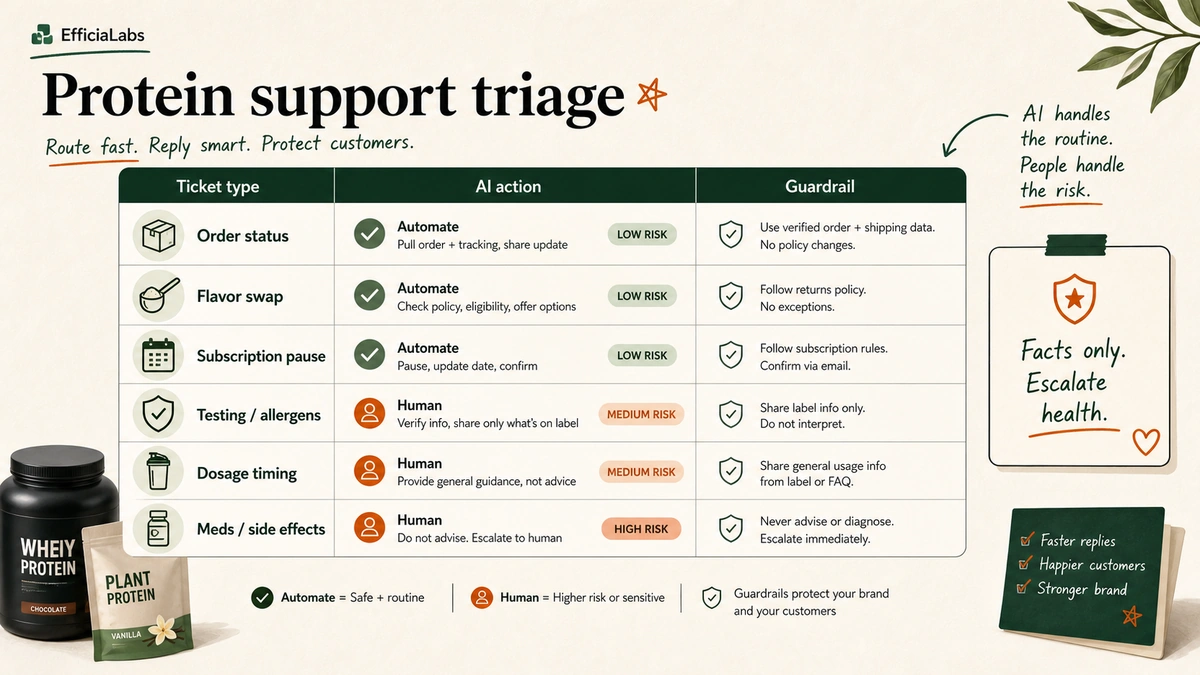
Here is the split we use on a new protein account:
| Ticket type | Automate now? | The guardrail |
|---|---|---|
| Where’s my order (WISMO) | Yes | Read order facts only, never guess a date |
| Flavor swap or exchange | Yes | Quote the real return policy |
| Subscription pause or skip | Yes | Confirm the change back to the customer |
| Blendability and mixing | Yes | Stick to label and FAQ guidance |
| “Is it third-party tested?” | Yes | Cite the actual certification, not a claim |
| Allergen or dairy check | Yes | Read the verified label, nothing more |
| Dosage timing | Yes | Label guidance only, no personalized advice |
| “Safe with my meds?” | No | Escalate to a human, never advise |
| Side effect or reaction | No | Human only, flag for follow-up |
Notice the pattern. The “yes” rows are facts your AI can look up and repeat. The “no” rows are judgment calls with a health consequence. h/t the Clootrack analysis of 10,000 protein reviews, the loudest customer pains are taste, blendability, and ingredient transparency. All three are safe to automate. Good news: that is most of your volume.
Pro tip: Automate the question, not the answer. The AI does not invent whether your whey is third-party tested. It reads the certificate you uploaded, names the program (Informed Sport, NSF Certified for Sport), and repeats what is true. Same with subscriptions: when a customer wants to skip a month, the AI reads your Recharge rules and confirms the change instead of guessing. Facts in, facts out.
This is also where a custom build pulls ahead of an off-the-shelf bot. Your flavors, your tubs, your subscription rules, your return window: all different. A generic widget guesses. A system trained on your catalog and policies does not. The same logic we use to build a customer service AI chatbot for Shopify applies here, with supplement guardrails layered on top.
The compliance guardrails that keep you out of FTC trouble
This is the part the generic chatbots skip, and it is the part that can cost you real money. Supplements are not t-shirts. What your AI says is regulated.
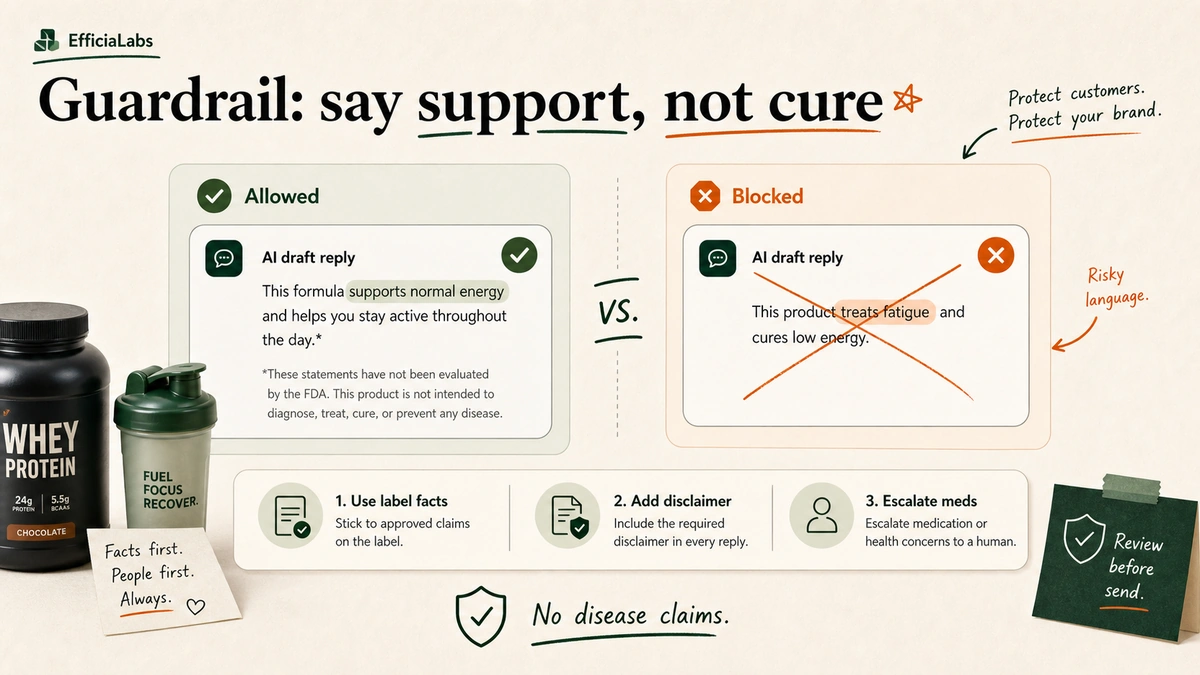
The FDA draws a hard line between two kinds of statement. A structure/function claim describes how an ingredient affects the normal body. “Supports normal energy metabolism.” That is allowed. A disease claim says the product can diagnose, treat, cure, or prevent a disease. “Treats fatigue.” “Prevents illness.” That is not allowed, and it does not matter whether a human or your chatbot typed it.
The FDA’s own mandatory language is the tell:
“This statement has not been evaluated by the Food and Drug Administration. This product is not intended to diagnose, treat, cure, or prevent any disease.”
- U.S. Food and Drug Administration
That sentence exists because the line is enforced. In September 2024 the FTC launched Operation AI Comply, a sweep against companies using AI to make deceptive claims.
“Using AI tools to trick, mislead, or defraud people is illegal.”
- Samuel Levine, FTC Bureau of Consumer Protection
Civil penalties run up to $53,088 per violation (FTC, 2025). One badly worded auto-reply, sent a thousand times, is not a typo. It is a thousand exposures. I saw a single template line cause a week of cleanup once, and that was a human who wrote it.
So you write the guardrails into the system before it goes live. Three rules cover most of it:
- Structure/function only. The AI may describe what an ingredient supports. It may never say the product treats, cures, or prevents anything.
- Auto-disclaimer. Any reply that touches health appends the FDA disclaimer, automatically, every time.
- Escalate medication and conditions. Any question about drugs, pregnancy, or a medical condition leaves the automation and goes to a person.
Important note: A generic model trained on the open web will happily tell a customer that magnesium “treats” their cramps, because it learned that from a thousand unvetted blogs. A custom system grounded in your verified labels will not, because you told it not to. That difference is the entire compliance story.
The human-review gate: a decision ladder for health-risk replies
Automation without a brake is not efficiency. It is liability at scale. The fix is a review gate that routes replies by risk, not by volume.
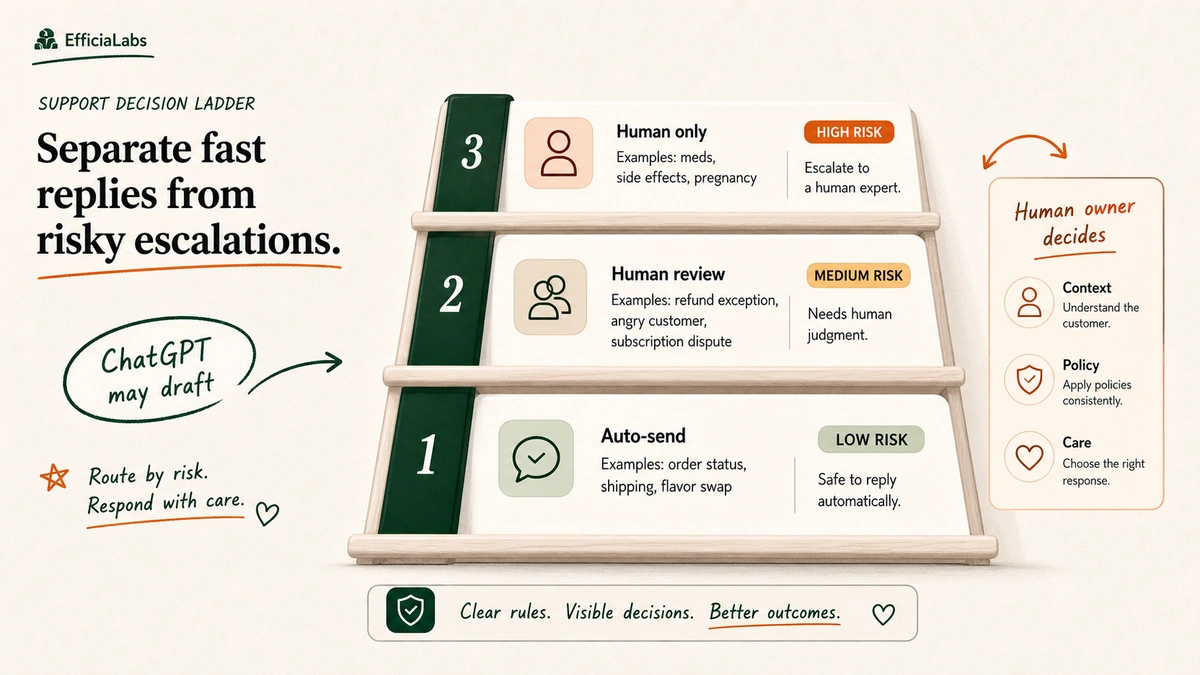
Three rungs:
- Low risk: auto-send. Order status, flavor swaps, FAQ, “do you ship to Canada.” The AI drafts and sends. No human needed.
- Medium risk: human review. Refunds outside policy, subscription disputes, an angry customer. The AI drafts, a person approves before it goes out.
- High risk: human only. Medication interactions, side effects, pregnancy, anything that reads like an adverse event. The AI does not draft an answer. It tags the ticket, alerts a human, and steps back.
The higher the risk, the slower the reply. That is the right trade. A customer waiting twenty minutes for a careful human answer on a medication question is a customer you kept. A customer who got a fast, wrong, automated one is a customer you might hear from again through a lawyer.
Note: the gate is also how you protect brand voice. Replies that sound like a robot erode trust fast, and supplement buyers are already skeptical. Getting the AI to match your brand voice in customer support is its own discipline, and the review gate is where you catch the misses while the system learns.
We will not ship a system whose replies sound like AI. If it does, you should not pay for it.
What AI customer service actually costs for a supplements brand
Most “AI support” pricing hides the meter. You sign up for a flat fee, then pay again per resolution, and the bill scales with your success. Sell more, get more tickets, pay more. The model is upside down.
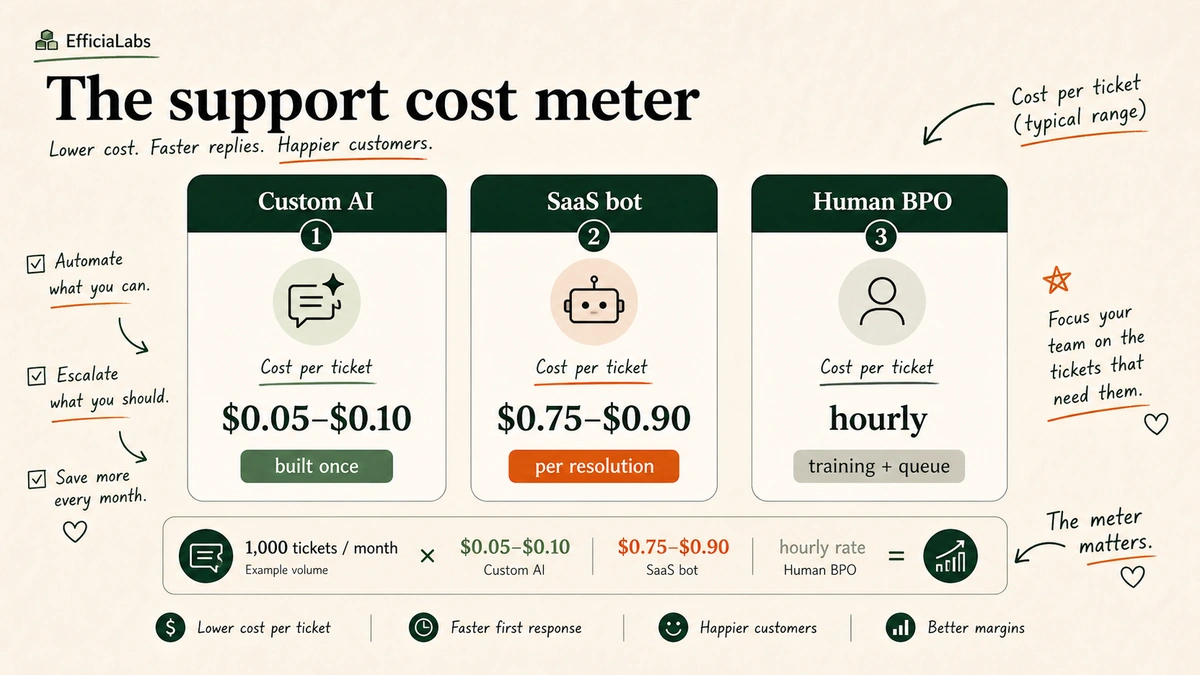
Here is the real math.
| Path | Cost per ticket | The catch |
|---|---|---|
| Custom AI (built for you) | $0.05 to $0.10 | Built once, runs for years |
| Per-resolution SaaS bot | $0.75 to $0.90 | The meter never stops |
| Human BPO agent | Highest | Trained agents, billed hourly |
The SaaS numbers are not hypothetical. Siena AI runs about $0.90 per ticket on top of a monthly fee, and Rep AI runs about $0.75 per conversation. At 1,000 tickets a month, the gap between custom and per-resolution pricing is several hundred dollars. Every month. Forever.
A custom system inverts the meter. You pay to build it once. After that, the running cost is the model tokens, which land around a nickel a ticket. It does not need rebuilding every year, and there is no per-resolution tax sitting between you and your own customers. If you are weighing a platform bot against a build, our Gorgias customer support AI vs custom AI breakdown runs the same math in more detail.
Pro tip: when a vendor quotes “per resolution,” multiply by your monthly ticket volume, then by twelve. That is the number that matters, and it is the one the pricing page buries. For more on where the money actually goes, see our breakdown of how Shopify stores use AI to improve profitability.
How to launch in 7 days
You do not need a six-month project. The reason it goes fast is that you do almost none of the work. You grant access. The build, the guardrails, the testing: handled. Here is the week.
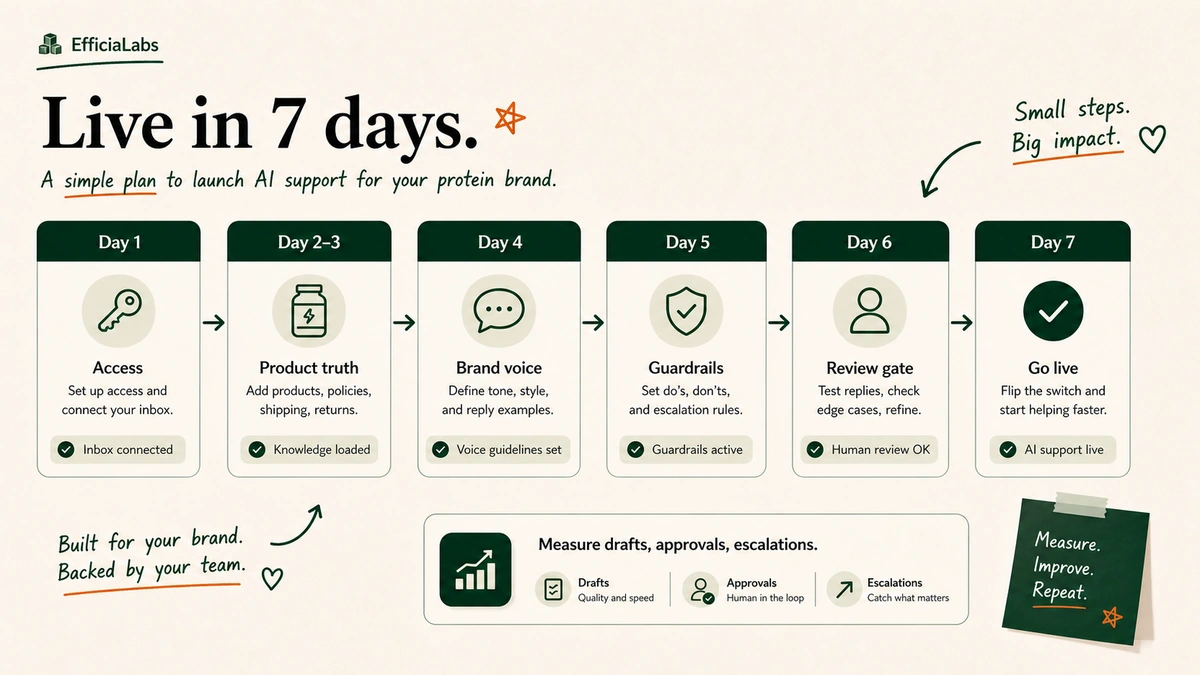
Day 1: Grant access
Connect the AI to your helpdesk (Gorgias, Zendesk, Freshdesk, or Gmail), your Shopify store, and your product catalog. This is the only step that needs you, and it takes an hour.
Day 2 to 3: Ingest product and policy truth
The system reads your real facts. Labels, ingredients, certifications, return policy, shipping rules, subscription logic. This becomes the only thing it is allowed to repeat. No open-web guessing.
Day 4: Set the brand voice
Feed it 20 to 30 of your best past replies. It learns your tone, your phrasing, your sign-off. The goal is simple: a customer should not be able to tell.
Day 5: Write the compliance guardrails
Lock in the structure/function rule, the auto-disclaimer, and the escalation triggers from the section above. Test it against the worst questions you can think of before a real customer asks them.
Day 6: Wire the human-review gate
Set the low, medium, and high rungs. Decide what auto-sends and what waits for a person. Point the high-risk tickets at the right inbox.
Day 7: Go live and measure
Turn it on for a slice of traffic first. Watch the drafts. Approve, correct, and let it learn. Within days it is handling the bulk of your logistics tickets while your team handles the humans who need a human.
That is the same playbook we shipped for deploying AI customer service for skincare brands in 7 days. The skincare guardrails are about cosmetic claims. The protein guardrails are about disease claims. The week is the same.
Frequently asked questions
Can AI customer service handle supplement compliance on its own?
No, and you should not want it to. AI handles the volume safely when it is grounded in your verified labels and wrapped in guardrails. But a human stays in the loop for medication, conditions, and adverse events. The system makes the safe 80% fast and routes the risky 20% to a person.
Will AI replies sound robotic to my customers?
Only if it is built lazily. A custom system trained on your past replies matches your tone closely enough that customers cannot tell. The human-review gate catches the misses early. If the replies sound like AI, the build was done wrong.
How much does AI customer service cost for a protein brand?
A custom build runs roughly $0.05 to $0.10 per ticket to operate after it is built. Per-resolution SaaS bots typically charge $0.75 to $0.90 per ticket plus a monthly fee. At 1,000 tickets a month, that difference is several hundred dollars every month.
What tickets should I never automate for a supplements brand?
Anything with a health consequence. Medication interactions, dosing for a medical condition, pregnancy questions, and side effect or reaction reports. These get tagged and routed to a human. Everything logistical, which is most of your inbox, is safe to automate.
Live in 7 days, not 7 months
You already have the tickets. You already have the labels, the policies, the return window. The work is not creating any of that. It is putting a system between your inbox and your team so the repetitive stuff answers itself and the risky stuff reaches a person fast.
Automate the facts. Guard the health. Keep a human on the rung that matters. Do that and your support stops being the tax on your growth.
See you in the next one.
— Vai
P.S. Those two tickets from the top. The order question got answered in 11 seconds. The medication question reached a human in two minutes, with the AI’s note already attached. Both customers stayed.

No comment yet, add your voice below!