

Friday night. A founder I know is still in her inbox at 11pm, answering the same three questions she answered at 9am. “Where’s my order.” “How do I condition the leather.” “Is this real.” Beautiful bags. A queue that never sleeps.
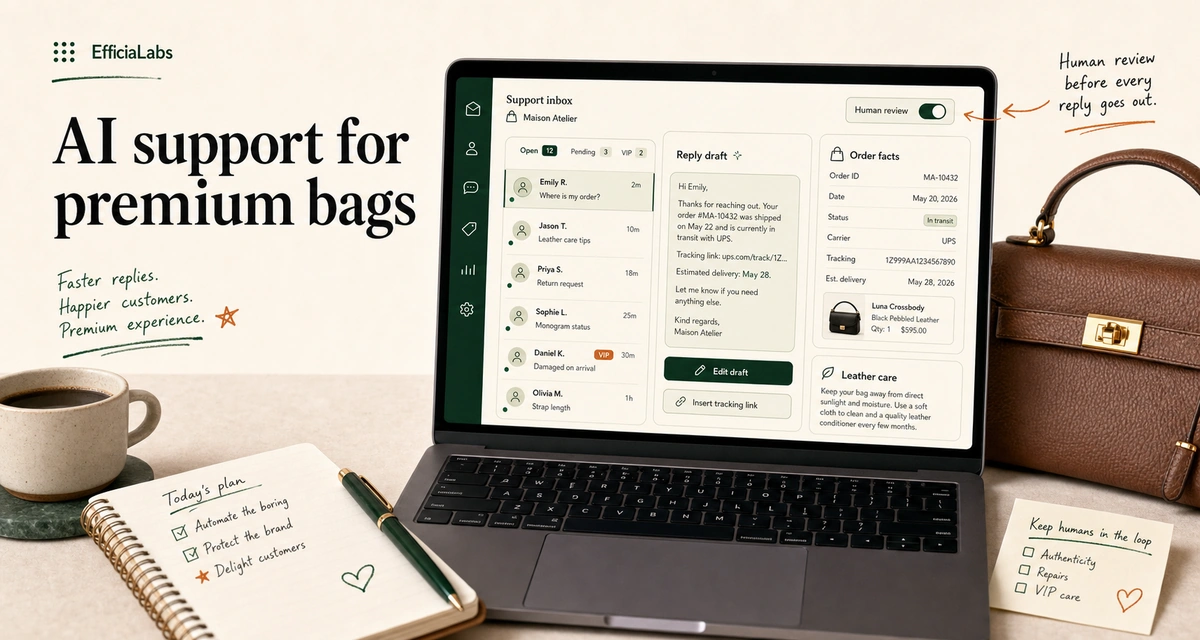
You can use AI customer service for a premium handbag and leather goods brand by drafting replies from your real order, product, and policy data, keeping a human approval gate on anything risky, and routing authenticity, repair, and VIP tickets to a person. Built right, it goes live in about a week.
In a sentence
- Automate the boring 60%. Keep humans on the 40% that protects the brand.
- Premium support lives or dies on voice, authenticity, and repairs. Build guardrails for those first.
- Custom AI runs at roughly $0.05 to $0.10 per ticket, not per seat.
- A focused build ships in 7 days and needs almost no upkeep after.
What does AI customer service mean for a premium handbag and leather goods brand?
Two different things wear the same name. Don’t confuse them.
One is styling. The pre-purchase assistant that helps someone pick a crossbody for a wedding. Mango shipped exactly this with Mango Stylist in July 2025, and tied it to their existing after-sales assistant, Iris.
“Mango Stylist consolidates the vision of a single conversational point of contact for customers.”
— Mango Stylist launch, July 2025
Lovely. Not what this post is about.
The other is support. The post-purchase inbox. Order status, returns, leather care, repairs, warranty, “did my monogram ship.” The unglamorous tickets that pile up while you’re trying to design the next collection. That’s what we’re automating here.
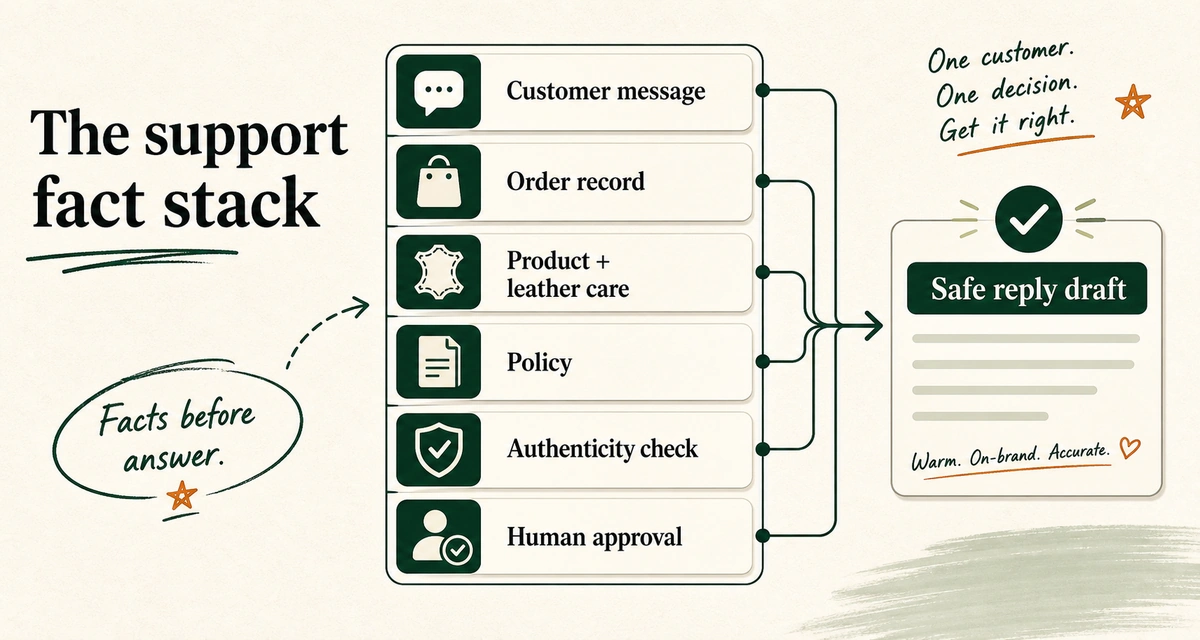
The mechanics are simple. The AI reads the customer’s message, pulls the real facts behind it (their order, your policy, the product details), drafts a reply in your voice, and a human approves before it sends. Same way DTC brands already run Tier-1 tickets through ChatGPT and Claude, the workhorse models from OpenAI and Anthropic.
The hard part was never the model. In our work it’s always the same two things. The context and the guardrails.
Which support tickets should you automate first?
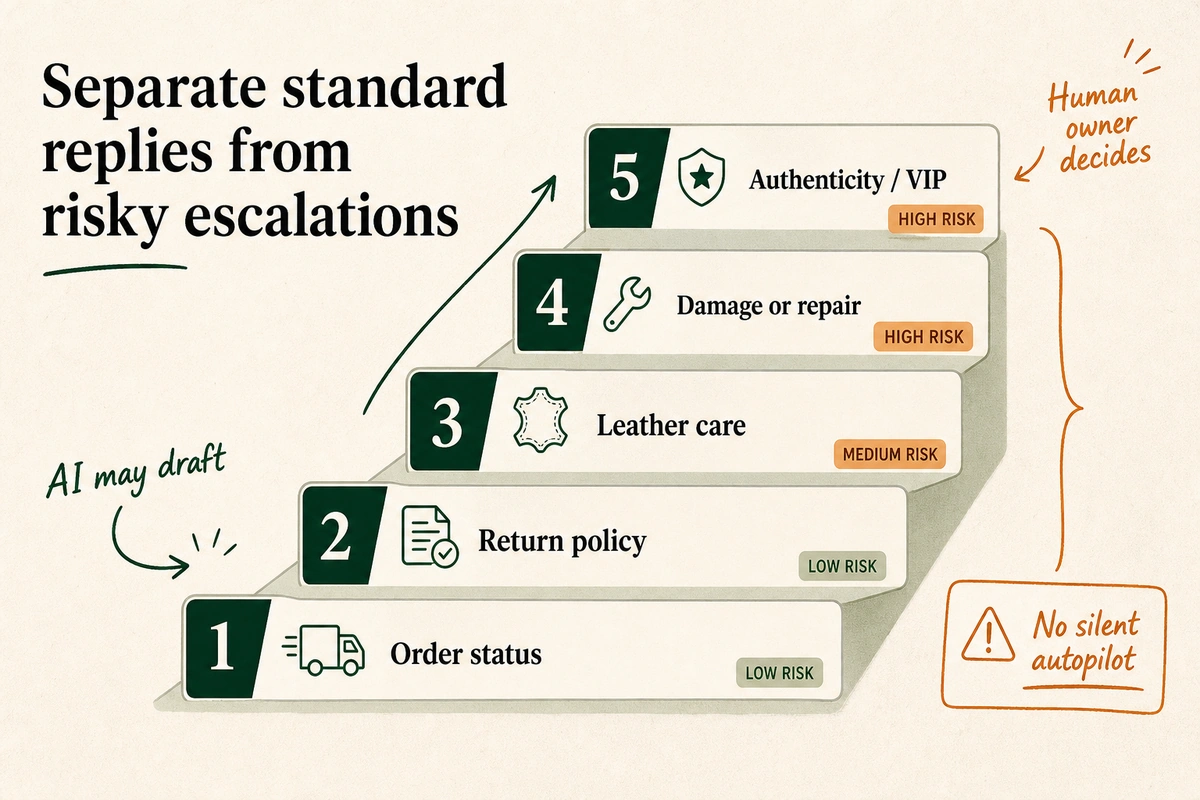
Start with the tickets that are high-volume and low-risk. Leave the ones that touch money, authenticity, or a customer’s feelings to a person, at least at first.
Returns are the loudest of the low-risk pile. Online returns ran 17.6% in 2024, higher than the in-store rate, and apparel and accessories sit above even that. Cc: NRF, 2024. Every one of those lands as a “how do I send it back” ticket.
For a handbag and leather brand, the safe-to-automate list is longer than you’d think:
- Order status and tracking. “Where is it.” The single most common ticket in ecommerce.
- Returns and exchange policy. What qualifies, the window, how to start one.
- Leather care. How to condition it, store it, keep the hardware from tarnishing.
- Product details. Dimensions, strap drop, what fits inside, materials.
- Gifting basics. Lead times, gift notes, what’s in stock for the date they need.
Now the escalation list. The tickets AI should never close on its own:
- Authenticity disputes. Someone questioning whether their bag is real, or reselling one. Brand-defining. Human only.
- Damaged on arrival. A scuffed corner on a $600 bag is an emotional ticket, not a logistics one.
- Repairs and warranty claims. Real money, real turnaround promises, real liability.
- Chargebacks and refunds above your threshold. Set a dollar line. Above it, a person decides.
- VIP and press. Your best customer should never feel like she’s talking to a bot.
Pro tip: Sort one month of tickets by type before you build anything. Most brands find that order status, returns, and care questions alone are over half the queue. That half is your week-one win.
How do you keep AI replies on-brand and safe for a premium brand?
This is where premium is different. A discount brand can sound a little robotic. You can’t. The whole product is the feeling of being looked after.
So the guardrails matter more than the model. Six of them carry most of the weight.
Brand voice. The AI has to sound like you wrote it at your desk, not like a help center. That means real rules, real example replies, and a tone your customer already recognizes. In our work this is the single most common reason AI support feels cheap, and it’s fixable.
We wrote a full method for how to match the AI’s voice to your brand voice. Get this wrong and nothing else matters.
Authenticity. Counterfeits are a luxury-adjacent fact of life. Your AI needs a scripted, careful path: verify serials or proof of purchase, never accuse, always route to a human for the actual call.
Gifting and monogramming. High-emotion, deadline-driven, easy to get wrong. The AI should know lead times cold and flag anything tight to a person.
Leather care. Real answers, not generic ones. Full-grain and suede are not the same conversation. This is content your product team already owns.
Repairs and warranty. What’s covered, what’s not, turnaround, cost. The AI states policy. A human owns the promise.
VIP routing. Your top spenders and your press contacts skip the queue, every time.
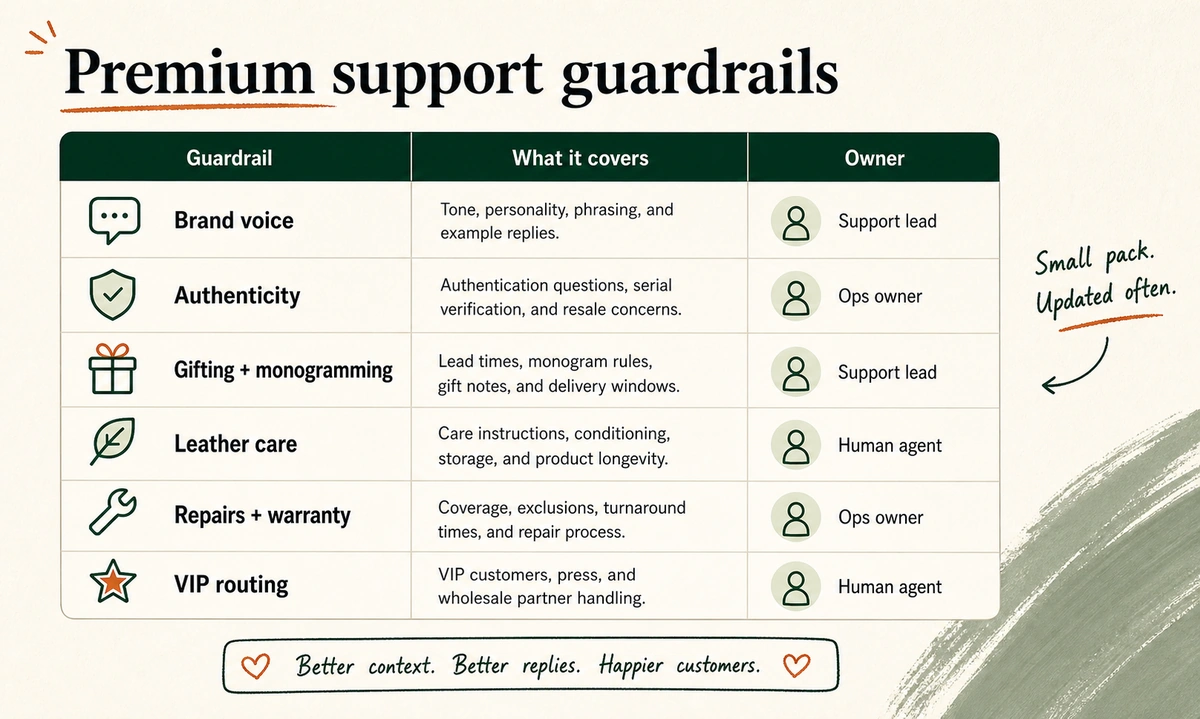
Note: Keep this pack small and update it often. A two-page, current context pack beats a fifty-page one nobody maintains. Small. Sharp. Owned.
How to deploy AI customer service in 7 days
Here’s the build. It’s the same seven-day shape we’ve shipped for other verticals, including the skincare and protein supplements brands we deployed it for. The vertical changes. The rhythm doesn’t.
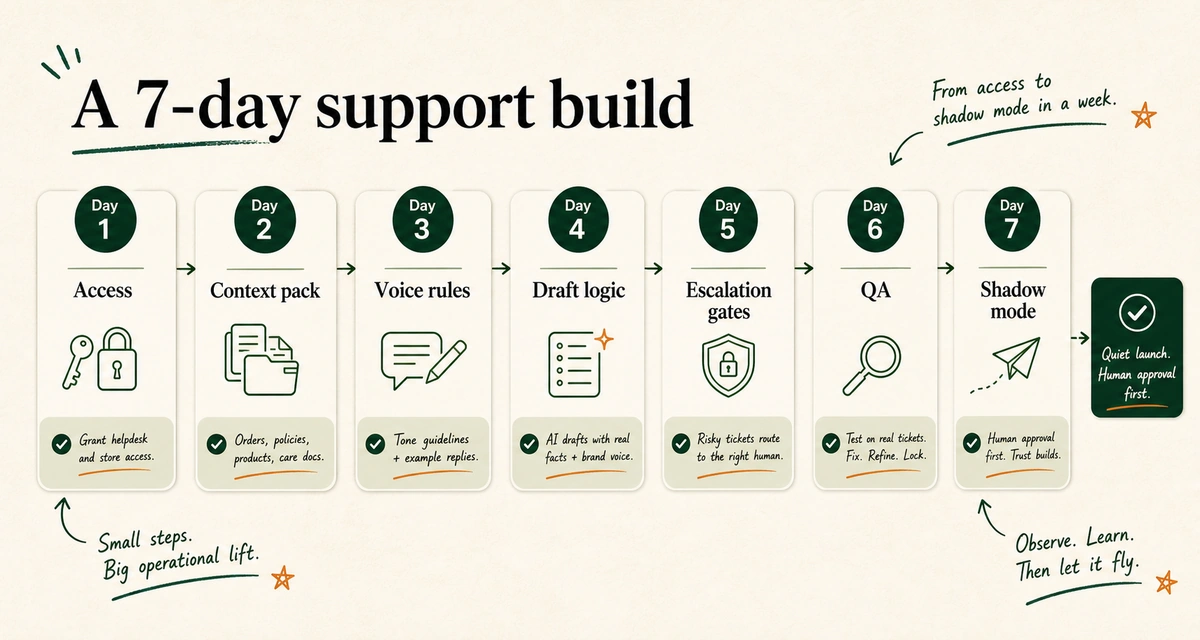
Days 1 to 2: Access and the context pack
You grant access to your helpdesk and store. We pull the raw material: your last few hundred tickets, your policies, your product and care docs, your order data. Then we build the context pack the AI reads from. This is 80% of the quality and it’s mostly your existing knowledge, organized.
Days 3 to 4: Voice rules and draft logic
We write the voice rules and example replies, then wire the drafting. The AI starts producing replies that pull real order facts and read like your brand. You’re not live yet. You’re reviewing drafts side by side with how you’d have answered.
Day 5: Escalation gates
We set the hard lines from your decision ladder. Authenticity, damage, repairs, refunds over your threshold, VIP. Each gets a rule that stops the AI and hands the ticket to a named human. This is the part that protects you.
Day 6: QA on real tickets
We ran the AI against real, recent tickets and read every reply. Wrong tone gets fixed. A missed policy gets added.
This is the same idea as choosing to build a customer service AI chatbot on Shopify with safe use cases defined up front, not bolted on later.
Day 7: Go live in shadow mode
You launch quietly. The AI drafts, a human approves every reply for the first stretch, and you watch. As trust builds, you let the safest categories auto-send. Nobody finds out by getting a bad reply first.
Pro tip: Don’t skip shadow mode to save two days. The first week of human-approved drafts is also how the system learns your edge cases. It pays for itself.
What does AI customer service actually cost per ticket?
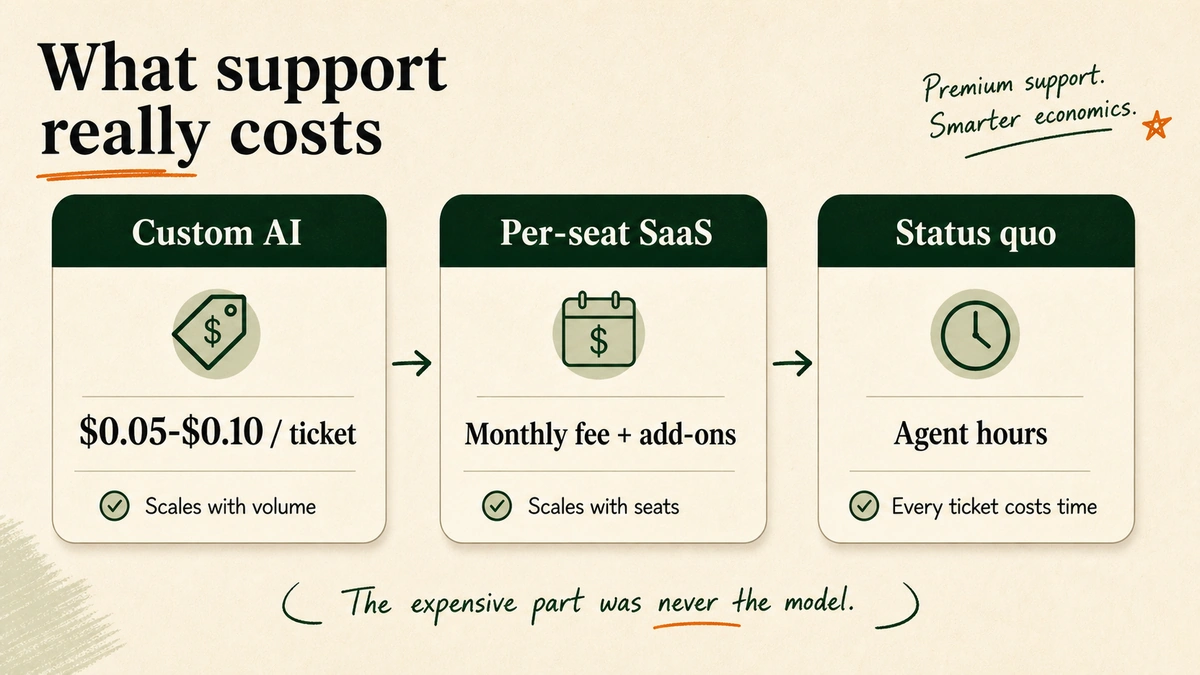
Here’s the number nobody on the search results page will give you. Custom AI costs roughly $0.05 to $0.10 per ticket to run. That’s the model cost to read a ticket and draft a reply. Not per seat. Not a tier you outgrow.
Run the math at your volume. A brand doing 1,000 support tickets a month is looking at $50 to $100 in run cost for the AI to draft all of them.
The expensive part of support was never the software. It was the hours.
| Path | What you pay | How it scales |
|---|---|---|
| Custom AI | ~$0.05 to $0.10 per ticket | Flat. Volume barely moves it |
| Per-seat SaaS | Monthly fee plus per-resolution add-ons | Climbs with tickets and seats |
| Status quo | Agent hours | Every ticket costs a person’s time |
The payoff isn’t only cost. It’s revenue. A UK studio, Lotusbrains Studio, rebuilt a premium beaded-bag brand’s chat and reported conversion going from 28% to 42%, response time dropping from 4.5 hours to 1.5, and average order value up about 73%.
“What Lotusbrains Studio did for us was not just automate our replies. They helped us turn WhatsApp into a lucrative inbound sales channel.”
— Riona Atelier, h/t Lotusbrains Studio
That’s one case, on one channel. But the direction is the whole industry’s. McKinsey estimates generative AI could add $150 billion, conservatively, and up to $275 billion to the apparel, fashion, and luxury sectors’ operating profits over the next three to five years. Cc: McKinsey, 2023.
And the volume isn’t slowing. U.S. shoppers returned $247 billion of online orders in 2024 alone, every one a support ticket waiting to happen. Cc: NRF, 2024. If you want the broader picture, we keep a running list of the DTC AI numbers.
If you’d rather not stand it up yourself, this is the part we do for brands: build it, deploy it, maintain it, and match your voice so replies don’t sound like AI. The honest cost math is the same reason we wrote up Gorgias’ AI versus a custom build.
How do you measure AI support without vanity metrics?
Deflection rate is the vanity metric of support AI. A ticket the AI “deflected” that comes back angry two days later wasn’t deflected. It was delayed.
Measure the things that actually tell you it’s working:
- Resolved and stayed resolved. Did the customer come back about the same issue? If not, it worked.
- First response time. Minutes, not hours. This is where premium customers judge you.
- Escalation accuracy. Did the AI correctly hand off the authenticity and repair tickets? Misses here are the only ones that hurt.
- CSAT on AI-handled tickets. Track it separately from human-handled. You want them indistinguishable.
- Repeat-contact rate. The truest signal. Good support makes the second ticket disappear.
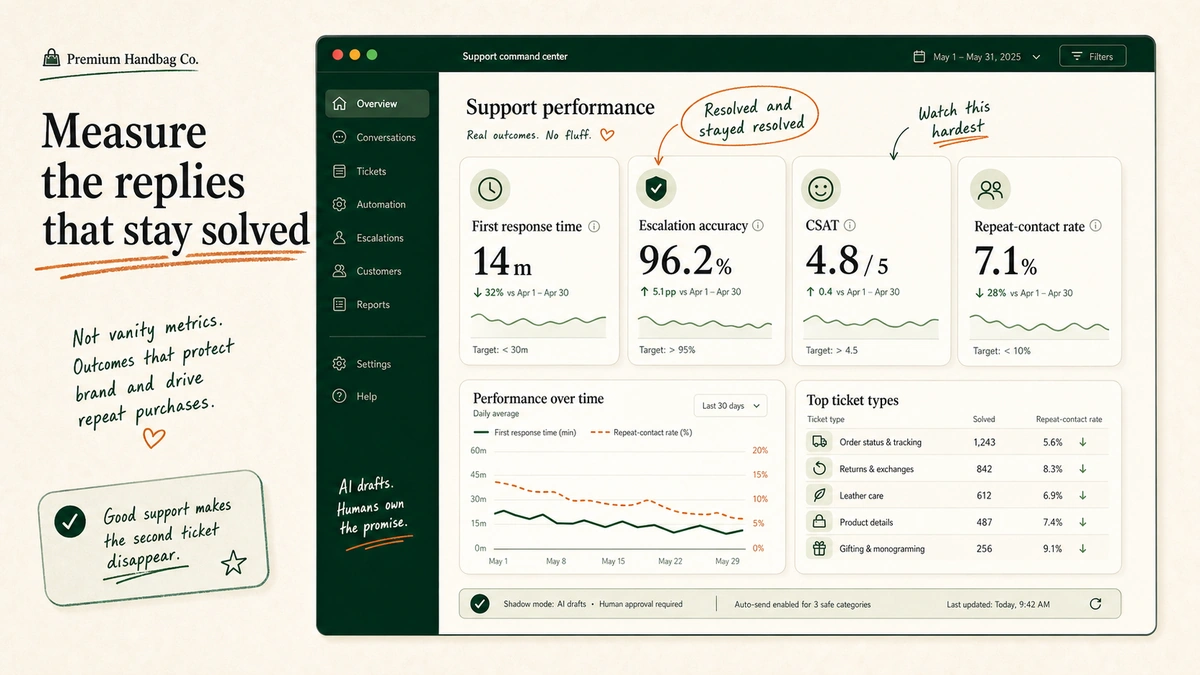
Watch escalation accuracy hardest. On a premium brand, a fast wrong answer about whether a bag is authentic costs you more than ten slow right ones.
Frequently asked questions about AI customer service for handbag and leather goods brands
Will AI replies sound robotic to luxury customers?
Only if you skip the voice work. The reason most AI support feels cheap is a thin or generic context pack. Built from your real replies, your tone rules, and your product knowledge, customers can’t tell. That’s the bar. If they can tell, it isn’t done.
Can AI handle authenticity and repair questions?
It can gather the facts. It should not make the call. Authenticity disputes, repairs, and warranty claims carry brand and legal weight, so the right setup has the AI verify details and route straight to a human. Speed on the easy stuff. Care on the sensitive stuff.
How fast can a small brand actually launch this?
About a week for a focused build, then a shadow-mode period before anything auto-sends. The slow part isn’t the technology. It’s deciding which tickets you trust it with and writing the escalation rules. Do that well and the build is fast.
Does this work with Gorgias, Zendesk, Gmail, or Freshdesk?
Yes. A custom build sits on top of the helpdesk you already use, including Gorgias, Zendesk, Gmail, and Freshdesk. You don’t rip anything out. You grant access, and the AI drafts inside the inbox your team already works in.
Get a week back
You started a handbag brand to make beautiful things, not to answer “where’s my order” at 11pm. Used well, AI customer service hands you the boring 60% of the inbox and keeps a human on the 40% that protects the brand. Cheap to run, fast to launch, quiet about it.
Start with one month of tickets and the five questions you’re tired of answering. Build from there.
See you in the next one.
— Vai
P.S. The best support reply I read last month was four words long: “Already on its way.” Speed is a luxury too.
Sources
- Lotusbrains Studio, AI WhatsApp Shopping Concierge case study (Riona Atelier): https://lotusbrainsstudio.com/case-studies/ai-automation-case-study/
- McKinsey, “Generative AI: Unlocking the future of fashion,” 2023: https://www.mckinsey.com/industries/retail/our-insights/generative-ai-unlocking-the-future-of-fashion
- Mango, “Mango launches Mango Stylist,” press release, July 2, 2025: https://mangofashiongroup.com/en/w/mango-lanza-mango-stylist-su-nuevo-asistente-de-moda-que-utiliza-ia-2
- National Retail Federation and Happy Returns, “2024 Retail Returns to Total $890 Billion,” 2024: https://nrf.com/media-center/press-releases/nrf-and-happy-returns-report-2024-retail-returns-total-890-billion

No comment yet, add your voice below!