

A ticket lands at 11:42pm. “Is the 1.2ct lab-grown in the solitaire GIA certified, and can I get it sized to a 5.5 before our anniversary on Saturday?” That’s not a support ticket. That’s a $2,400 decision with a deadline. And it sat unanswered until morning.
That gap is the whole game. AI customer service for jewelry ecommerce stores is the practice of letting an AI draft accurate, on-brand replies to the routine tickets, while a human still signs off on the high-value ones. Done right, you answer in seconds instead of hours, your replies sound like your best jeweler, and you never let a bot approve a refund on a $2,000 ring.
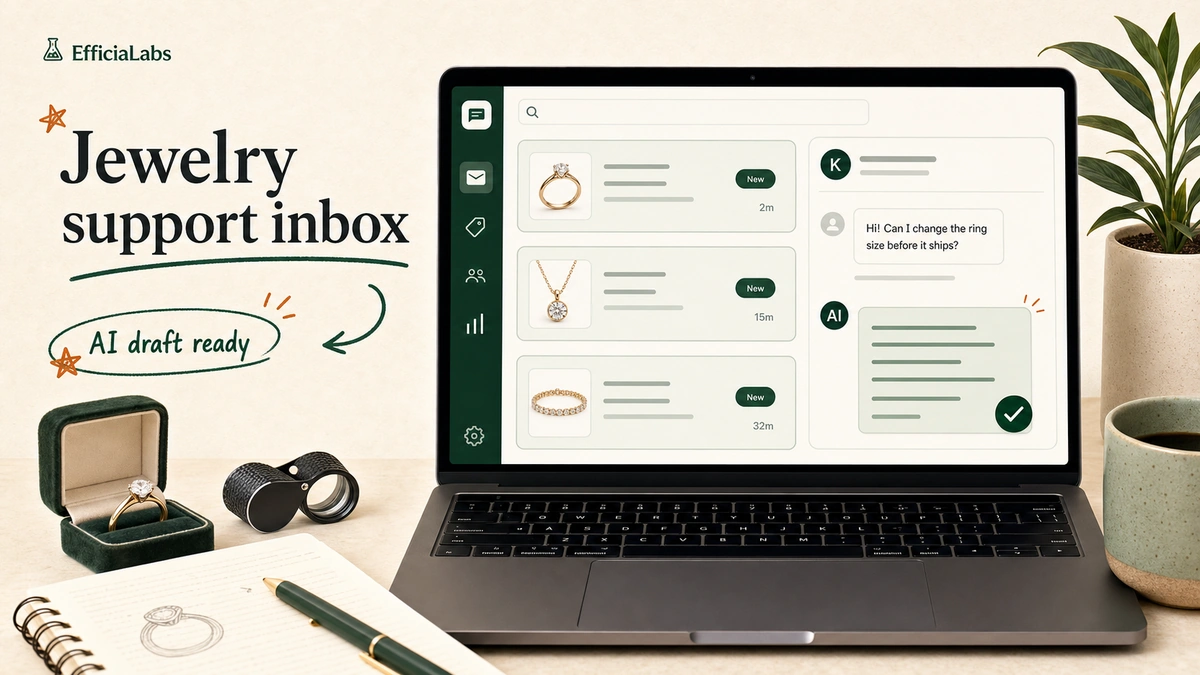
This is a build guide, not a pitch. By the end you’ll know which tickets to hand the AI, which ones to keep behind a human, what it actually costs per ticket, and how to get the whole thing live in a week.
In a sentence
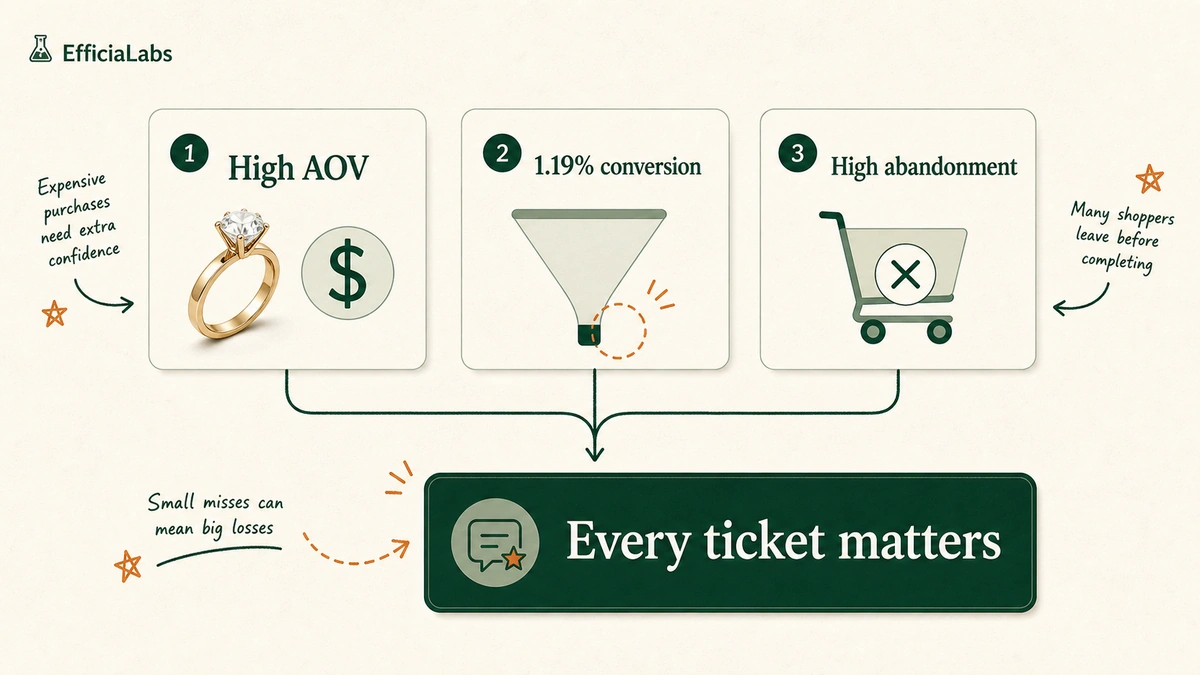
- Jewelry has the highest stakes per ticket in ecommerce: high order values, the lowest conversion rate in retail, and the highest cart abandonment. Slow answers cost real money.
- Automate the routine tickets (order status, sizing, care, certificate explainers). Keep a human on authenticity disputes, chargebacks, big lost-in-transit claims, and engraving errors.
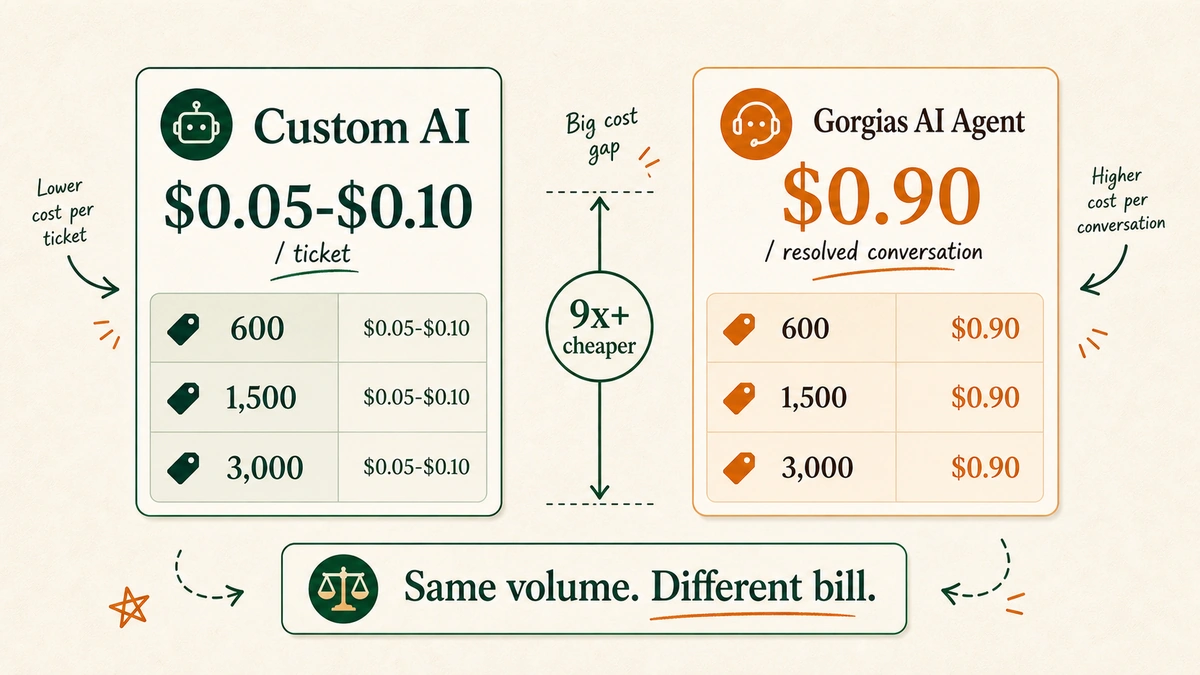
- The cost difference is large. Custom AI runs about $0.05 to $0.10 per ticket. Gorgias currently lists AI Agent at $0.90 per resolved conversation.
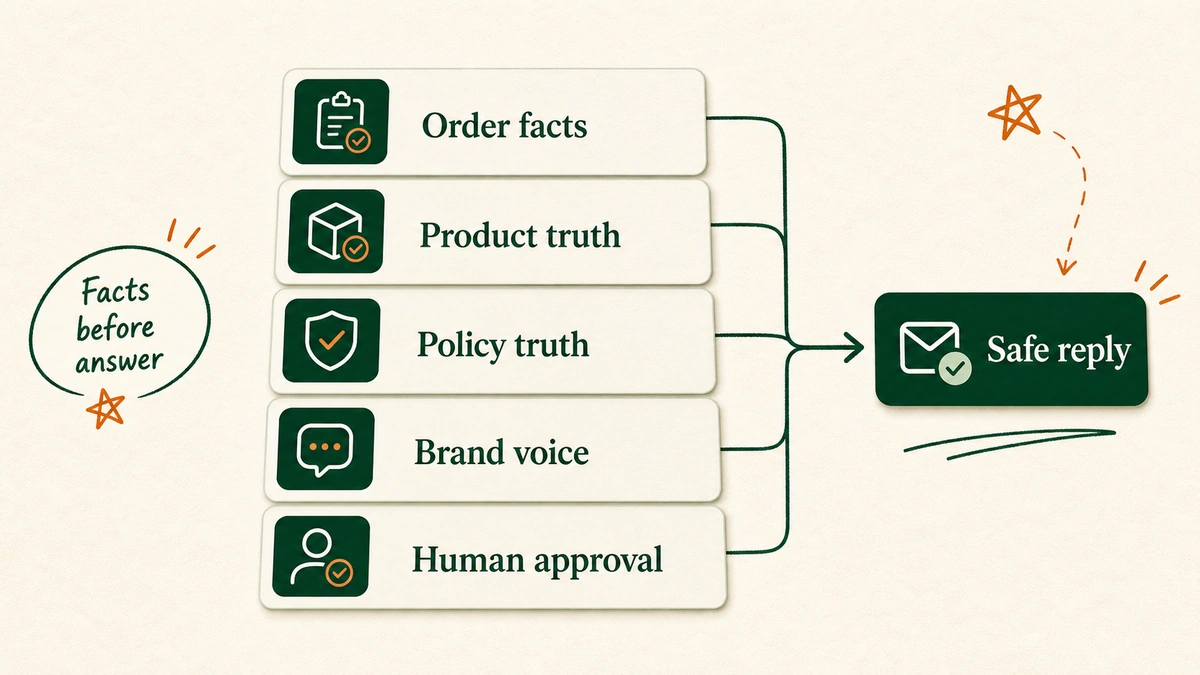
- “Facts before answer” is the rule. The AI pulls order, product, and policy facts first, then drafts in your brand voice, then a human approves the risky ones.
- A focused build goes live in 7 days. You grant access. The build, tuning, and brand-voice work happen for you.
Why does jewelry support break differently from other ecommerce?
Because every ticket is attached to a high-value, high-emotion purchase, and the math is unforgiving.
Online jewelry and watch sales in the US were worth roughly $17.0 billion in 2025, per IBISWorld. But the category converts worse than almost anything else online. Triple Whale’s 2025 benchmarks put jewelry conversion near 1.19%, among the lowest in retail. And cart abandonment for jewelry and luxury runs higher than any other category, well above the roughly 70% average Baymard tracks across 49 studies.
Read those three numbers together. High prices. Low conversion. High abandonment. (We pulled more of these in our 49 AI in DTC statistics for 2026 roundup.)
It means the handful of people who do reach out are the ones closest to buying. A slow or generic answer on a $1,200 order is not a minor service miss. It’s a lost sale that already cost you ad spend to create.
Generic chatbots fail the trust test here. A shopper deciding between you and a brand with a real showroom does not want a canned “Thanks for reaching out!” They want to know the metal, the stone, the certificate, the resize window, and the delivery date. Specific facts, in your voice, fast. That’s the bar.
“Great support starts with writing clear, direct answers”
- Mark Macdonald, Shopify. Cc: Shopify
Which jewelry support tickets should AI actually handle?
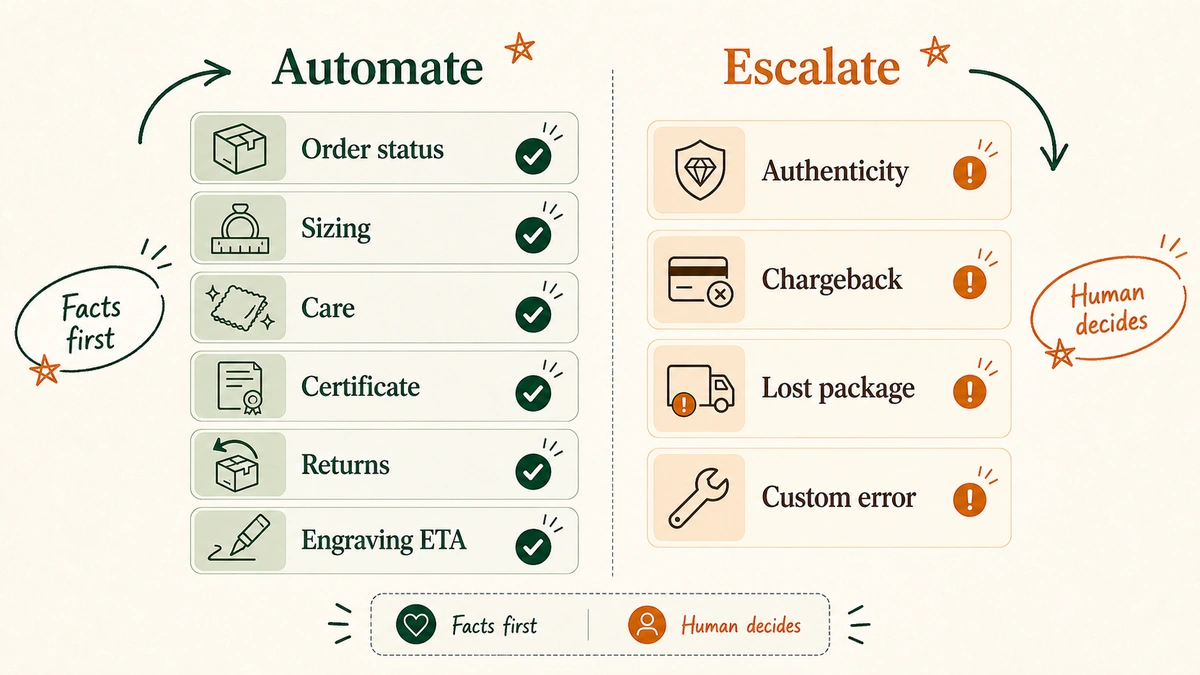
Start by sorting your tickets into two piles: routine and risky. The AI gets the routine pile. A human keeps the risky one.
Most jewelry stores find that the bulk of their volume is routine and repetitive. Where is my order. Do you ship insured. What’s your return window. How do I find my ring size. What does VS1 clarity mean. These are perfect for AI, because the answer lives in your order data, your product specs, and your policy docs. Nothing is being decided. Facts are being retrieved and explained.
Here’s the split we use as a starting point.
| Ticket type | Default | Why |
|---|---|---|
| Where is my order? (WISMO) | Automate | Pulls live order and tracking status |
| Ring sizing guidance | Automate | Reads your published size guide |
| Care and cleaning | Automate | Standard, repeatable answer |
| Explain the 4Cs or a certificate | Automate | Educational, drawn from product data |
| Return and exchange policy | Automate | Lives in your policy docs |
| Engraving lead time | Automate | Known production timeline |
| Authenticity dispute | Escalate | Brand and legal risk |
| Chargeback or fraud claim | Escalate | Money and compliance risk |
| High-value lost-in-transit | Escalate | Large refund decision |
| Engraving or resize error | Escalate | Custom, irreversible work |
Pro tip: Don’t guess the split from memory. Export 60 days of tickets, tag them by type, and sort by volume. The top five or six types usually cover most of your inbox, and they’re almost always automatable. If you need the broader AI support setup before the jewelry-specific filters, start with our Shopify support chatbot build guide.
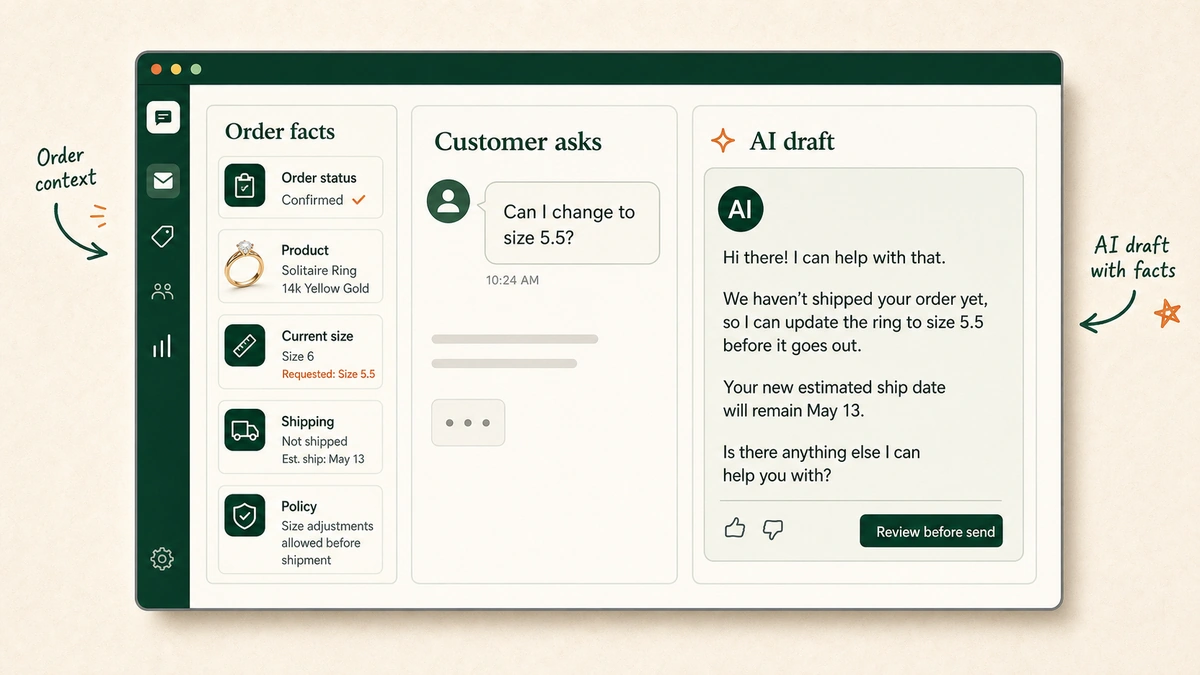
A good reply doesn’t just answer. It answers using your real facts and your real policy. Here’s what that looks like when the AI drafts a sizing question with the order context already attached.
If you want the deeper version of this safe-list logic, we walked through it for a similar high-value vertical in our guide to AI customer service for a premium handbag and leather goods brand. The principle carries straight over to jewelry.
What are the four jewelry tickets where a human must review first?
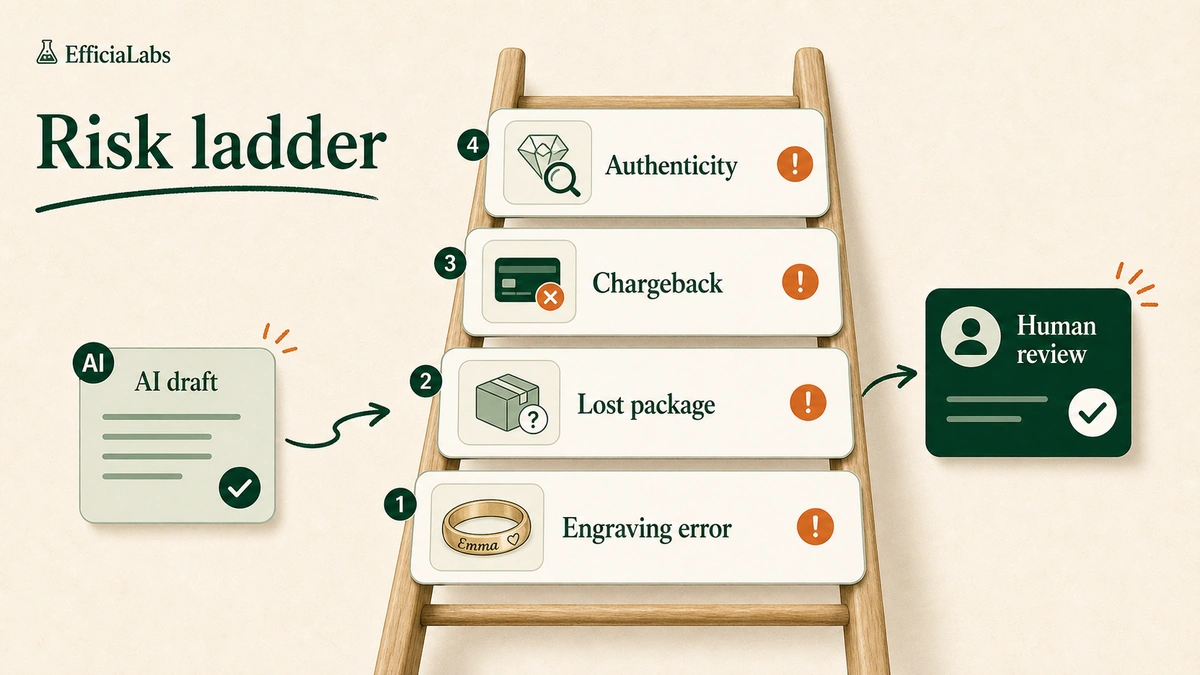
Four. Authenticity disputes, chargebacks, high-value lost-in-transit claims, and engraving or resize errors. These never go out on autopilot.
This is the section almost every other guide skips, and it’s the one that protects your margin. In our work building support AI for high-value stores, we found these four are where a bad automated reply actually costs money. The risk isn’t that the AI gets a tracking number wrong. The risk is that it confidently resolves a ticket that should have been a human conversation, and you eat a $2,000 loss or a brand-damaging reply.
Authenticity disputes. “Is this a real diamond?” or “I think my hallmark is wrong.” These touch legal exposure and brand trust. The AI can gather the certificate, the order, and the product record. A human makes the call.
Chargebacks and fraud claims. Money and compliance risk. Let the AI assemble the evidence pack. Don’t let it negotiate.
High-value lost-in-transit. A $1,200 pendant marked delivered but not received is a real financial decision, often involving your insured-shipping carrier claim. Human owns it.
Engraving and resize errors. Custom work is irreversible. If a name was misspelled or a band was cut to the wrong size, that’s a remake conversation, not a templated apology.
Important note: The AI still does useful work on all four. It triages, pulls the facts, and drafts a starting reply. It just never hits send without a person. That’s the difference between AI that helps and AI that creates liability.
How do you make AI replies sound like your brand, not a bot?
You give it facts before it answers, and you write down your tone rules. That’s most of the job.
The reason AI replies sound robotic is that teams skip the inputs. They drop in a generic model and hope. We built our process the opposite way. Before the AI writes a single word, it reads a stack of truth: the order facts, the product truth, the policy truth, and your brand-voice rules. Then it drafts. Then, on risky tickets, a human approves.
Tone matters more in jewelry than almost anywhere. A heritage fine-jewelry house and a fun, colorful fashion-jewelry brand should not sound the same. One is measured and reassuring. The other is warm and quick. The voice rules are where you encode that: the words you always use, the words you never use, how you handle a nervous first-time buyer, how you talk about price.
We go deep on this in our guide to matching AI voice to your brand voice in customer support, but the reusable shape of the prompt looks like this.
“A sincere apology delivered on its own can often feel like a dead end”
- Mitchell Rossit-Lavigne, Support Lead on Shopify’s Guru Team. Cc: Shopify
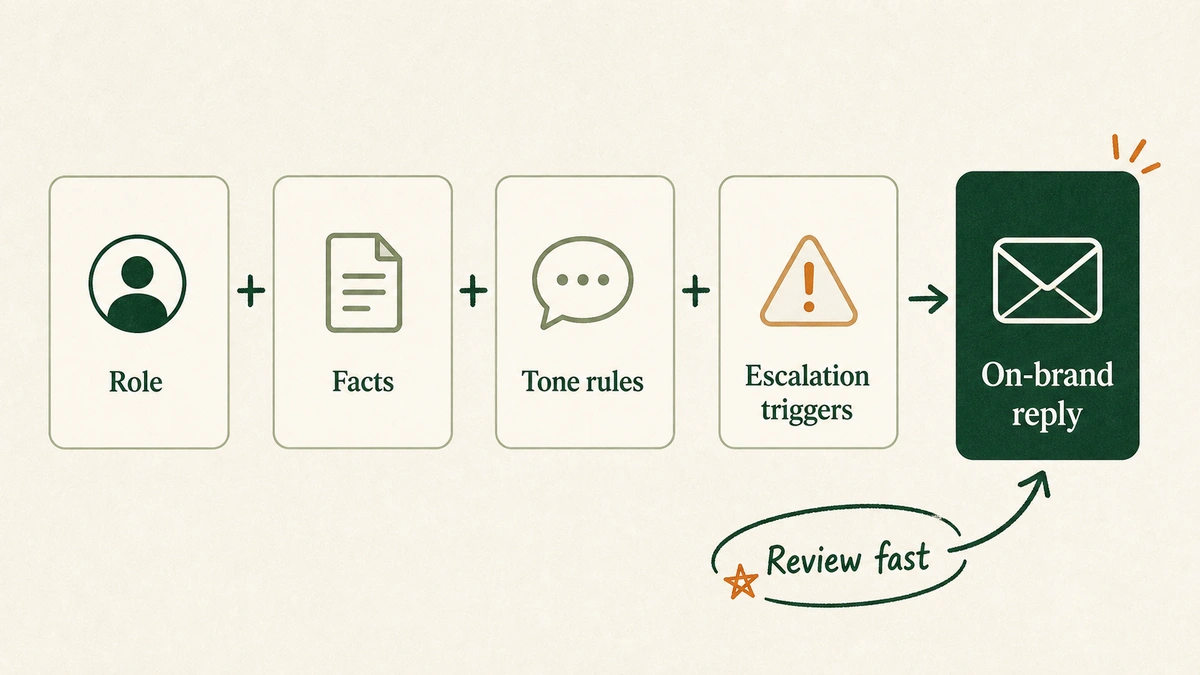
ROLE
You are the senior jeweler for [Brand]. You answer support emails
the way our best human rep would: warm, precise, never pushy.

FACTS (use only these, never invent)
- Order: {order_status, items, shipping, tracking}
- Product: {metal, stones, carat, certificate, care}
- Policy: {returns, resizing window, warranty, engraving lead time}

TONE RULES
- Reassure first, then give the specific fact.
- Use the customer's name. Keep it under 120 words.
- Never say "unfortunately." Never pressure a purchase.

ESCALATION TRIGGERS (do not send, route to a human)
- Authenticity dispute, chargeback, lost-in-transit over $1,000,
  engraving or resize error, anything legal.

OUTPUT
A short reply a human can approve in seconds, or a flag if escalated.
Pro tip: Feed the model 20 of your own past replies you were proud of. Brand voice is learned faster from your real examples than from any description of it.
What does AI customer service for jewelry ecommerce stores actually cost?
Less than you think, and the structure matters more than the headline rate. Custom AI runs about $0.05 to $0.10 per ticket resolved. Gorgias currently lists AI Agent at $0.90 per resolved conversation, paid only when the interaction is fully automated.
The reason to look at per-ticket cost, not a flat monthly fee, is that your bill should track your actual volume. Quiet month, smaller bill. Big Q4, bigger bill, but still cheap per ticket. Here’s how that scales.
| Tickets / month | Custom AI ($0.05–$0.10) | Gorgias AI Agent ($0.90) |
|---|---|---|
| 600 | $30 to $60 | about $540 |
| 1,500 | $75 to $150 | about $1,350 |
| 3,000 | $150 to $300 | about $2,700 |
At 1,500 tickets a month, that’s roughly $150 versus $1,350. Same volume. Different bill. Over a year, the gap is real money you could put into inventory or ads.
We broke down the per-conversation pricing math in detail in our look at Gorgias customer support AI versus custom AI, if you want to see where the SaaS meters add up. The same pattern shows up in our Rep AI versus custom AI comparison and the broader ecommerce AI customer care company roundup.
Note: Once a custom system is built and tuned, it usually needs no ongoing maintenance for a long stretch. The cost above is the run cost, not a rebuild-every-quarter cost.
What does the 7-day rollout plan look like?
Seven days, and the heavy lifting isn’t on you. You grant access to your store and helpdesk. The build, the brand-voice work, and the testing happen for you.
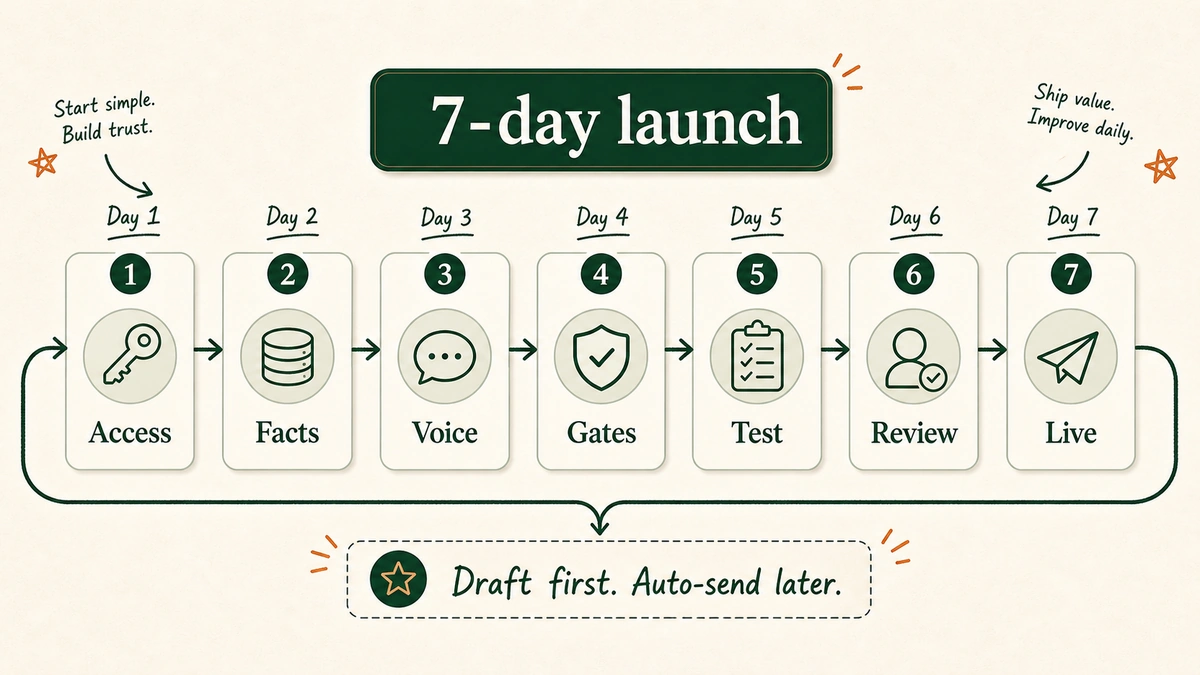
Day 1: Grant access and audit the tickets
Connect your store (most jewelry stores run on Shopify) and your helpdesk: Gorgias, Zendesk, Gmail, Freshdesk, whatever you use. Pull 60 days of tickets and tag them by type. The top types become the automation list.
Day 2: Build the fact sources
Wire up the truth the AI will read: live order and tracking data, product specs and certificates, and your policy docs for returns, resizing, and warranty. Garbage in, garbage out, so this day matters.
Day 3: Write the brand-voice rules
Encode tone, phrasing, and the do-not-say list. Load 20 of your best past replies as examples.
Day 4: Set the escalation gates
Define the triggers that route a ticket to a human: authenticity, chargebacks, big lost-in-transit, engraving or resize errors. Nothing risky sends on its own.
Day 5: Test on real past tickets
Replay historical tickets through the system and grade the drafts. Accuracy, tone, policy compliance. Fix what misses.
Day 6: Run a human-in-the-loop trial
Go live in draft-only mode. Every AI reply waits for a human to approve or edit. This is where confidence is built and the last rough edges come off.
Day 7: Go live
Turn on auto-send for the safe ticket types. Keep the human gate on the risky ones. You’re answering in seconds, and the inbox finally feels calm.
If you want a fuller worked example of this exact cadence on another high-trust vertical, our 7-day deployment guide for skincare ecommerce brands walks it step by step.
What are the common mistakes jewelry stores make with support AI?
Most failures trace back to one root cause: letting the AI decide instead of draft. Here are the ones I see most.
Mistake: letting AI approve refunds and disputes. On a high-AOV catalog, that’s how you lose real money to a confident wrong answer.
How to avoid it: Draft-only on anything financial. A human approves every refund and dispute.
Mistake: one tone for every product. A $40 fashion piece and a $4,000 engagement ring don’t get the same voice.
How to avoid it: Write voice rules per collection or tier, and let the AI pick based on the product in the order.
Mistake: no certificate or spec facts loaded. The AI invents an answer about clarity or metal, and now you’ve got a trust problem.
How to avoid it: Load the real product data, the 4Cs, and the GIA or IGI documents. If a fact isn’t in the data, the AI should say so and route to a human, not guess.
Mistake: guessing at sizing. Ring sizing drives returns. A vague answer creates one.
How to avoid it: Point the AI at your real, published size guide and resize policy.
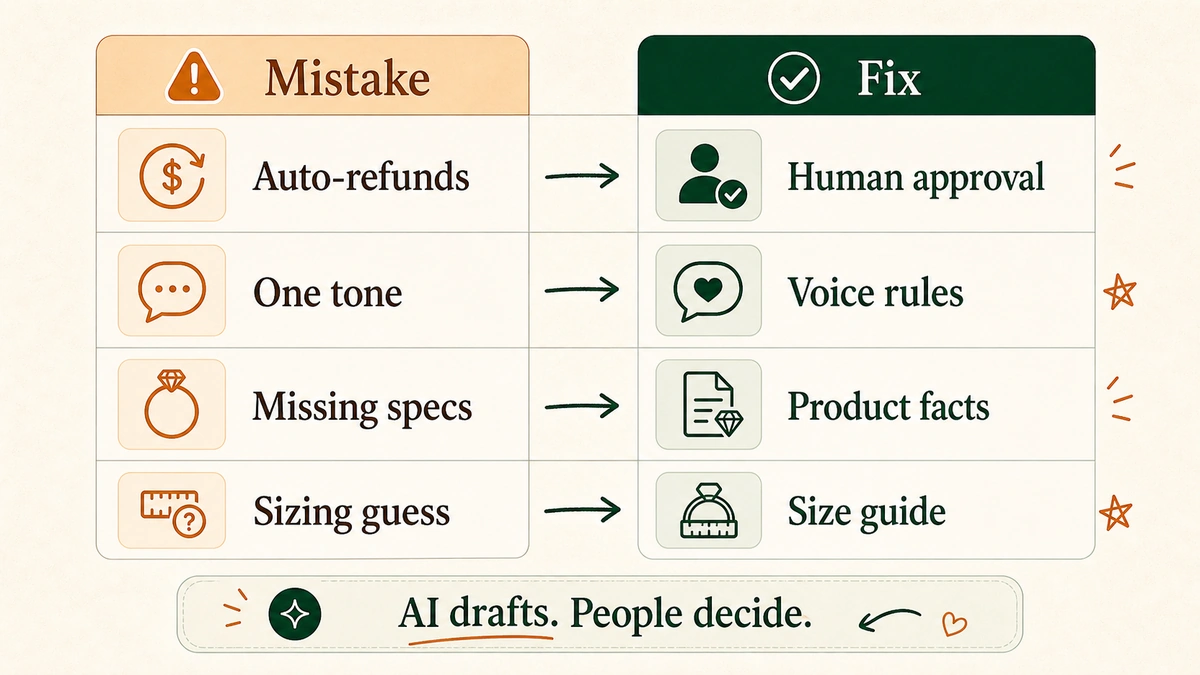
Important note: AI drafts. People decide. Tape that to the wall. Every safe deployment we’ve built for a high-value store follows that one line.
Frequently asked questions
Is AI customer service safe for high-value jewelry orders?
Yes, when it’s set up to draft rather than decide. The AI handles routine tickets end to end and prepares risky ones for a human. Authenticity disputes, chargebacks, large lost-in-transit claims, and custom-work errors always get a human sign-off. That structure is what keeps a high-AOV catalog protected.
Will the AI replies sound like a robot?
Not if you feed it facts and tone rules. The robotic feeling comes from generic models with no context. A custom build reads your order data, product specs, and policy first, then drafts in your brand voice using examples of your own past replies. A human reviews the risky ones before they send.
How much does AI customer service for a jewelry store cost?
Custom AI typically runs about $0.05 to $0.10 per ticket resolved. At 1,500 tickets a month, that’s roughly $75 to $150. Gorgias currently lists AI Agent at $0.90 per resolved conversation, which lands around $1,350 at the same volume. Per-ticket pricing means your bill tracks your real volume.
Does it work with Shopify and my helpdesk?
Yes. Most jewelry stores run on Shopify, and a custom build connects to your store plus your helpdesk, whether that’s Gorgias, Zendesk, Gmail, or Freshdesk. You grant access to those portals, and the build happens around them. Our Shopify support chatbot build guide covers the setup in more depth.
How long until it’s live?
About seven days for a focused build. One week to connect your systems, load your facts, write your voice rules, set escalation gates, test on real tickets, and go live with a human-in-the-loop trial first.
Get your jewelry store answering in seconds
The stores that win the high-value sale are the ones that answer fast, sound human, and never let a bot make a $2,000 call. That’s the whole point of building AI customer service for jewelry ecommerce stores the careful way: automate the routine, protect the risky, keep your voice, and launch in a week. You’ve already got enough on your plate. This is one stack of tickets you can hand off and stop carrying.
See you in the next one. — Vai
P.S. The 11:42pm anniversary ticket from the intro? With the fact sources wired up, that one’s a 12-second draft. Answered before the customer closes the laptop.
Sources
- IBISWorld, Online Jewelry & Watch Sales in the US, 2025.
- Triple Whale, Ecommerce Benchmarks 2025.
- Baymard Institute, Cart Abandonment Rate Statistics.
- Shopify, Benefits of Providing Good Customer Service.
- Gorgias, Pricing, checked 2026-06-16.

No comment yet, add your voice below!