

It’s 2am. A $1,900 watch shipped Tuesday, and the buyer has already emailed twice, DM’d once, and refreshed the tracking page nine times. That box is half a month of his salary, somewhere in a van.
That is the job. Here is how to use AI customer service for watch ecommerce stores. Let AI draft the routine replies from your real order and product data, and keep a human on anything risky.
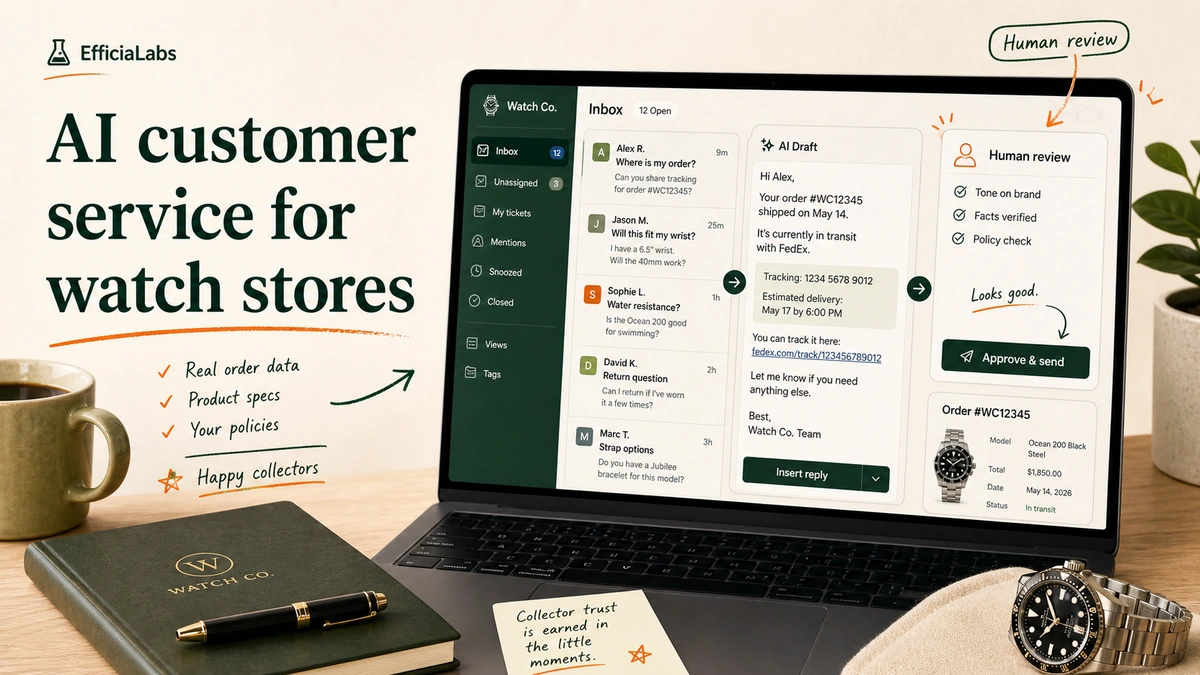
That buyer isn’t being difficult. They spent two months’ worth of dinners-out on a single object, and now it’s in a van somewhere.
Premium orders carry premium anxiety.
The good news: most of what they ask is the same five things, over and over. Where is it, will it fit, is it real, what if it breaks, can I send it back.
Routine questions, sitting on top of a high emotion. That gap is exactly where AI earns its keep.
Key Takeaways
- Automate the routine tickets first: order status, sizing, water resistance, returns. Keep warranty disputes and authenticity claims on a human.
- Answer from your own data: order facts, the spec sheet, your policy. Never from the model’s guesses.
- Custom AI runs around $0.05 to $0.10 per ticket. Per-conversation tools run closer to $0.75 to $0.90.
- A done-for-you build goes live in 7 days. You grant portal access. We do the rest.
Table of Contents
- How to use AI customer service for watch ecommerce stores
- Which watch tickets to automate first
- Guardrails for $500 to $5,000 watch orders
- What AI customer service actually costs for a watch store
- The 7-day launch plan
- Keeping replies sounding like your brand, not a bot
- Frequently asked questions
How to use AI customer service for watch ecommerce stores
AI customer service for a watch store is not a chatbot bolted to your homepage. It sits inside your helpdesk: Gorgias, Zendesk, Freshdesk, or plain Gmail. It reads the ticket, pulls the real facts from Shopify and your tracking app (AfterShip, Wonderment), and drafts a reply in your brand voice.
A human approves it. Then it sends.
It’s the same backbone we use to build a customer service AI chatbot for Shopify, tuned for a watch catalog.
The whole system runs in a fixed order:
- Read the customer’s message.
- Pull the real facts: order, spec sheet, policy.
- Draft a reply in your brand voice.
- A human reviews it.
- Send.
“Facts before answer. The model never invents a delivery date or a water rating. It looks them up.”
— Vaibhav Sharan, founder of EfficiaLabs
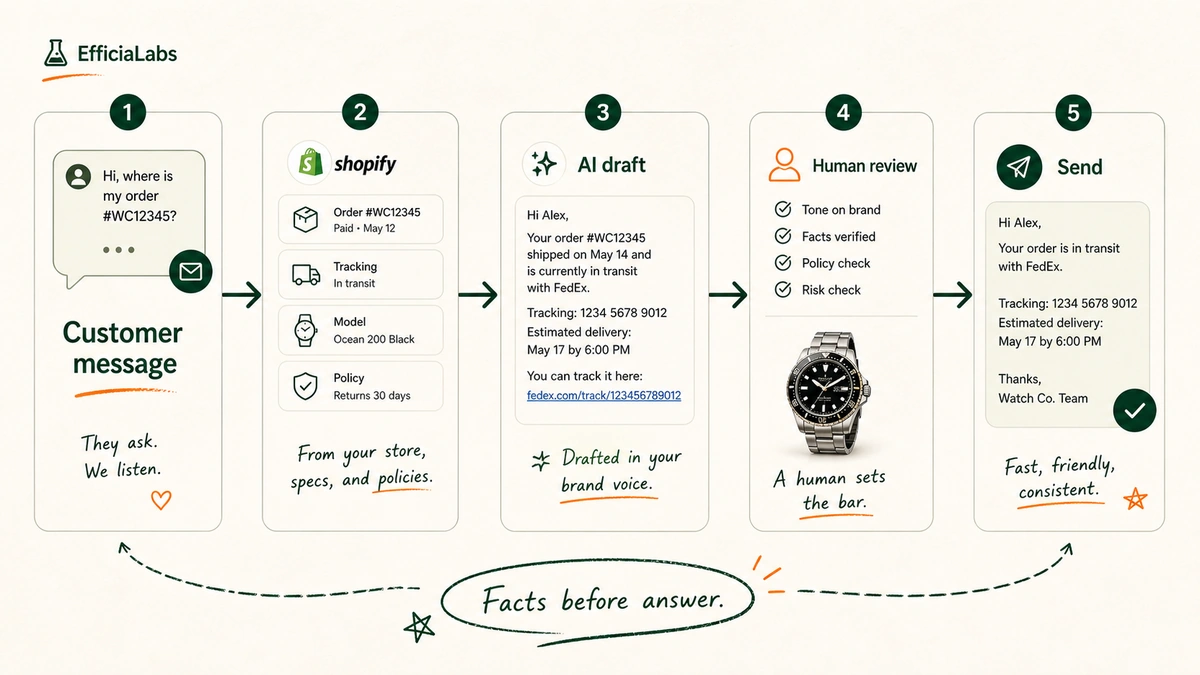
The order of those steps is the whole thing. The AI never invents a delivery date or a water rating.
It looks up the order in Shopify, reads your spec sheet, checks your policy doc, and only then drafts. Facts before answer.
The cost of a wrong answer is higher for a watch than for a $20 phone case. Tell someone their dive watch is good to 200m when the ISO 22810 rating says 50m, and you’ve got a flooded movement and a furious review.
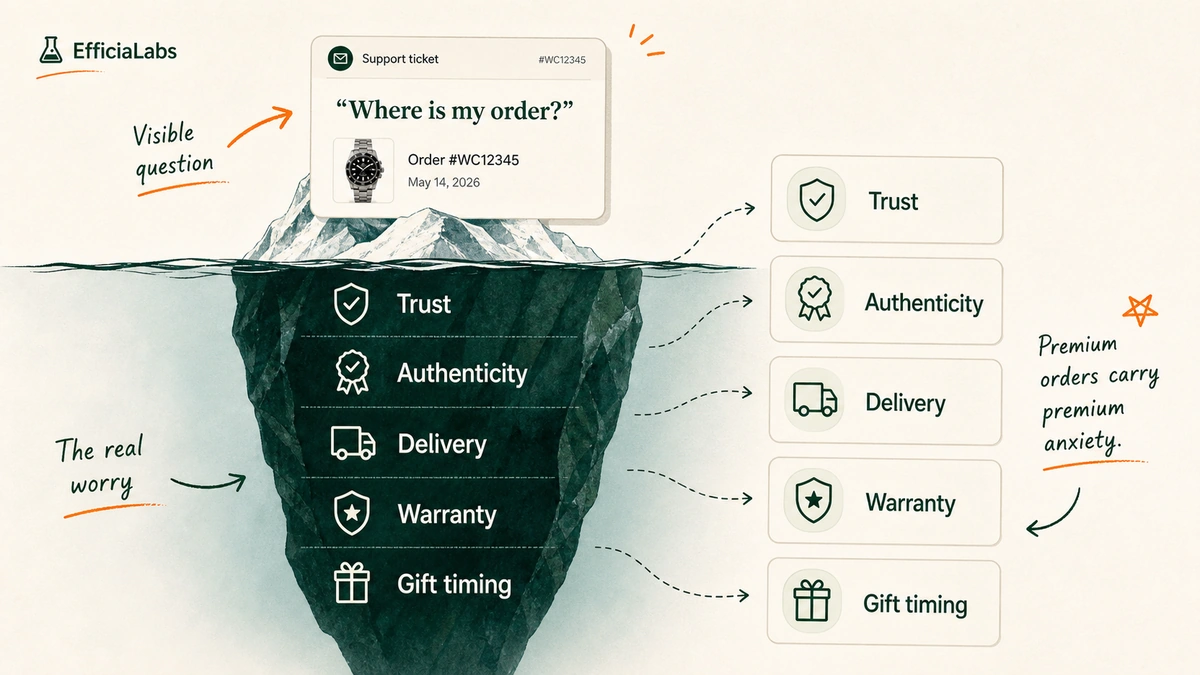
The premium microbrands a buyer obsesses over, think Baltic, Lorier, or Christopher Ward, live and die on getting these details right. Premium tickets sit on top of premium worries.
So the system is cautious by default. It handles the boring 80% beautifully and hands you the 20% that needs a human eye.
Nearly 90% of CX leaders expect AI to resolve most issues within a few years, per Zendesk’s 2026 customer service research. For a lean watch brand, “most” is the right target. Not “all.”
Which watch tickets to automate first
Start where the volume is and the risk is low. “Where is my order” alone is 18% of incoming ecommerce requests on average, per Gorgias’s own data. That’s nearly one in five tickets that an AI can draft in seconds from your tracking data.
Here’s how we sort a watch brand’s inbox on day one.
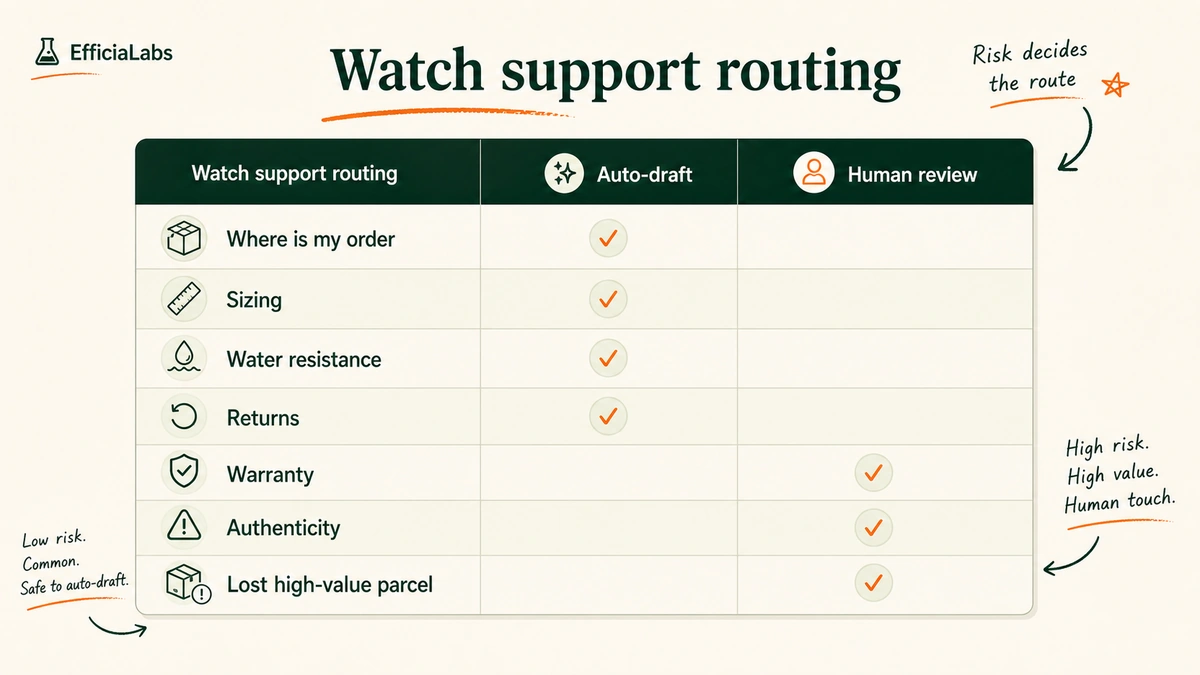
| Ticket type | Auto-draft | Human review |
|---|---|---|
| Where is my order (WISMO) | Yes | |
| Strap, sizing, lug-to-lug | Yes | |
| Water resistance and care | Yes | |
| Returns and exchanges (in policy) | Yes | |
| Warranty and movement servicing | Yes | |
| Authenticity and serial disputes | Yes |
The left column is your quick win. WISMO, sizing, water resistance, in-policy returns.
These are answerable from facts you already have. A customer would rather get a correct answer in 30 seconds than wait six hours for a human to paste the same tracking link.
Take sizing. A buyer asks if a 40mm case will work on a 6.5-inch wrist.
The AI doesn’t guess. It pulls the case diameter, the lug-to-lug, the strap width, and your sizing guide, then writes a plain answer.
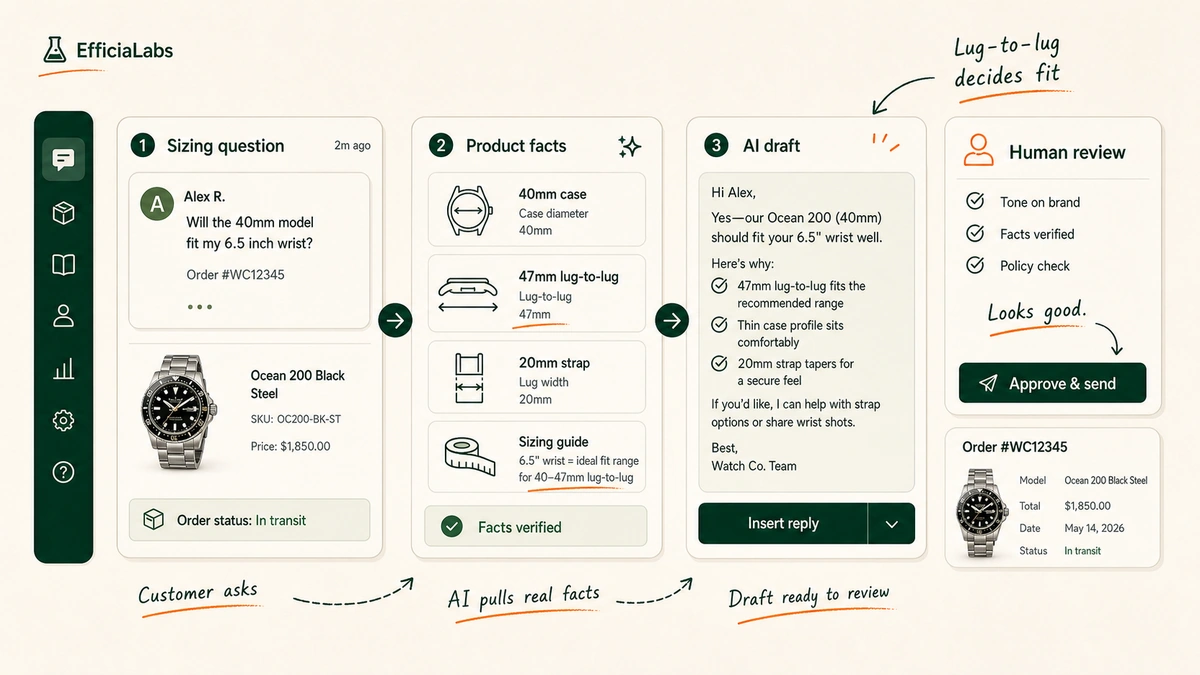
Pro tip: Lug-to-lug, not case diameter, is what decides whether a watch overhangs a wrist. Put it in your product data and your AI will stop giving vague “it depends” answers and start giving real ones. This is the same approach we use for jewelry stores, where ring sizing carries the same trap.
The right column stays human, on purpose. More on that next.
Guardrails for $500 to $5,000 watch orders
The mistake people fear is the AI confidently refunding a $4,000 chronograph it shouldn’t have. So you build the rule before you build the bot: risk decides the route.
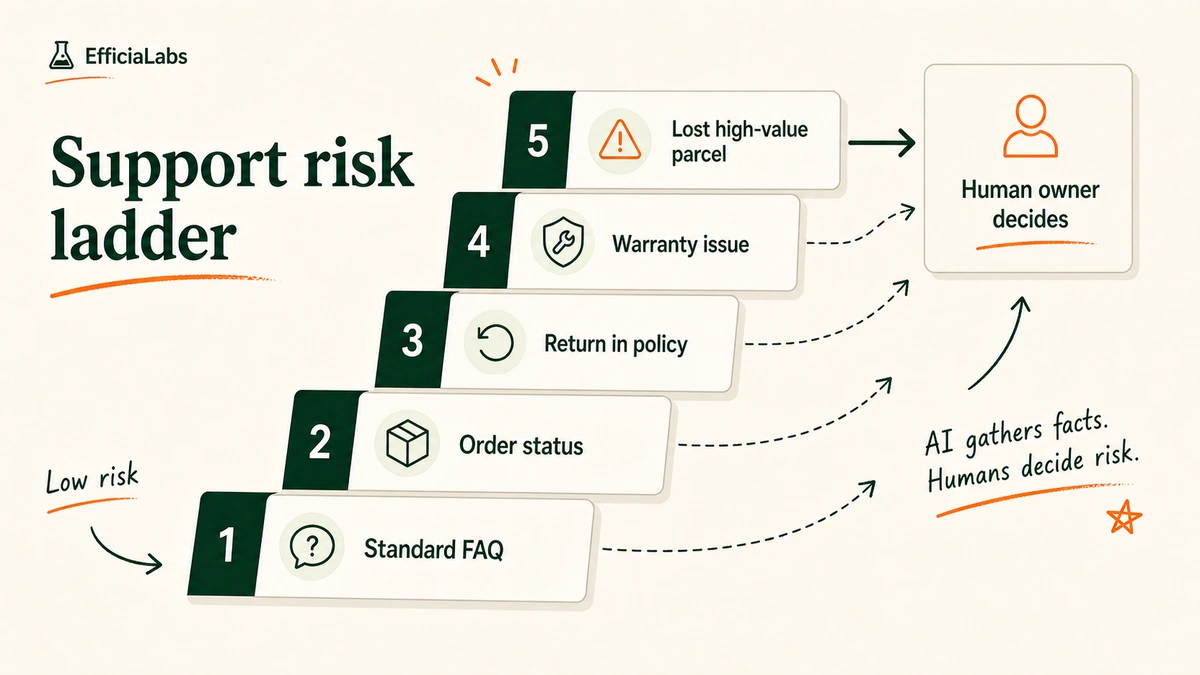
Low risk, the AI drafts and a human glances. Standard FAQ, order status, a return inside policy.
Medium risk, a human reads every word before it sends.
High risk, the AI doesn’t draft a decision at all. It gathers the facts, flags the ticket, and a named owner handles it.
Three buckets always sit at the top of the ladder for a watch brand:
- Authenticity and serial disputes. A gray-market or “is this real” claim is brand-defining. A human answers it, every time.
- Warranty and servicing. Movement issues, water ingress, a crown that won’t screw down. These need judgment and sometimes a returns authorization.
- Big-ticket order problems. A lost or damaged $5,000 parcel, a FedEx or UPS claim and a nervous customer, is a human conversation, not a macro.
Important note: “Human review” is not a fallback for when the AI fails. It’s a designed step. The AI does the heavy lift; the human sets the bar on tone, accuracy, and exceptions.
In our work with watch and jewelry brands, that review gate is what makes founders comfortable letting AI near a high-AOV inbox at all. We’ve built this exact setup for premium verticals. Nobody regrets the gate.
What AI customer service actually costs for a watch store
This is where the math gets fun. The model cost of drafting one support reply is tiny. We typically see $0.05 to $0.10 per ticket all-in once a custom system is running.
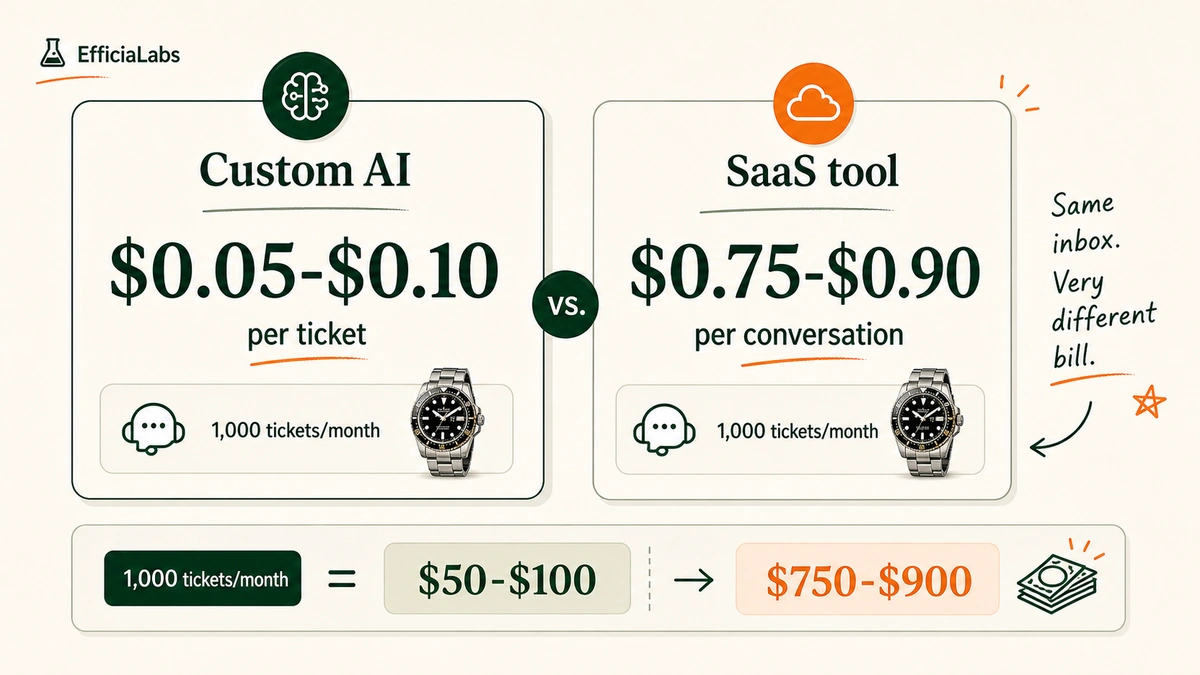
Compare that to the off-the-shelf tools that bill per conversation. Many land at $0.75 to $0.90 each. We did the math on a few of these tools, and the gap isn’t subtle.
Run 1,000 tickets a month:
- Custom AI: roughly $50 to $100.
- Per-conversation tool: roughly $750 to $900.
That’s $700 a month, give or take, for the same drafted reply. Over a year, that’s a Klaviyo plan and a new photographer for your next drop.
Note: Per-conversation pricing isn’t a scam, it’s a business model. It just stops making sense once your volume climbs. The more you grow, the more it costs you to grow.
Custom AI runs the other way. Build once, and the per-ticket cost barely moves for years.
The 7-day launch plan
Here’s the part most guides skip. The actual week.
You grant access to your helpdesk and store. We build, deploy, and maintain. That’s the deal.
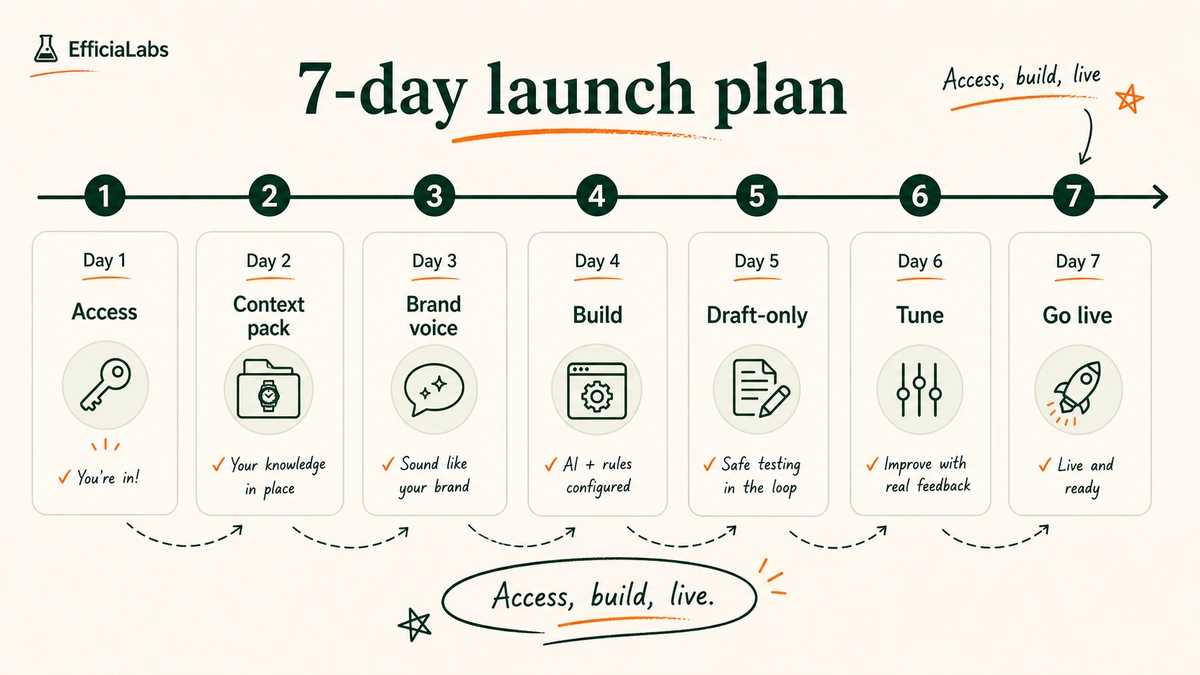
- Day 1: Access and audit. You grant read access to your helpdesk and Shopify. We read 60 to 90 days of real tickets and find your top question types.
- Day 2: Context pack. We assemble your order facts, product specs, policies, and FAQs into one source the AI reads from.
- Day 3: Brand voice. We capture your tone, your do’s and don’ts, and 10 to 15 example replies you’d be proud to send.
- Day 4: Build and connect. We wire the AI into your helpdesk and lock the escalation rules from the risk ladder above.
- Day 5: Draft-only mode. The AI drafts on live tickets but sends nothing. Your team reads every draft.
- Day 6: Review and tune. We fix the misses, tighten the voice, and adjust what’s auto versus human.
- Day 7: Go live. Low-risk replies start sending. The high-risk ladder stays human.
Day 5 is the one founders watch closely. We tested draft-only mode across watch and jewelry inboxes.
It’s the day the team realizes the drafts already beat the rushed replies they were sending at 11pm.
Seven days. Access, build, live.
After that, most of our builds need no real maintenance for years. Once your policies and specs are in, the system holds.
Keeping replies sounding like your brand, not a bot
A watch buyer who reads Hodinkee every morning can smell a generic reply from across the room. “We apologize for any inconvenience this may have caused” is the fastest way to make a $2,000 customer feel like a ticket number.
These are people who can tell a Seiko movement from an ETA by ear. They notice tone.
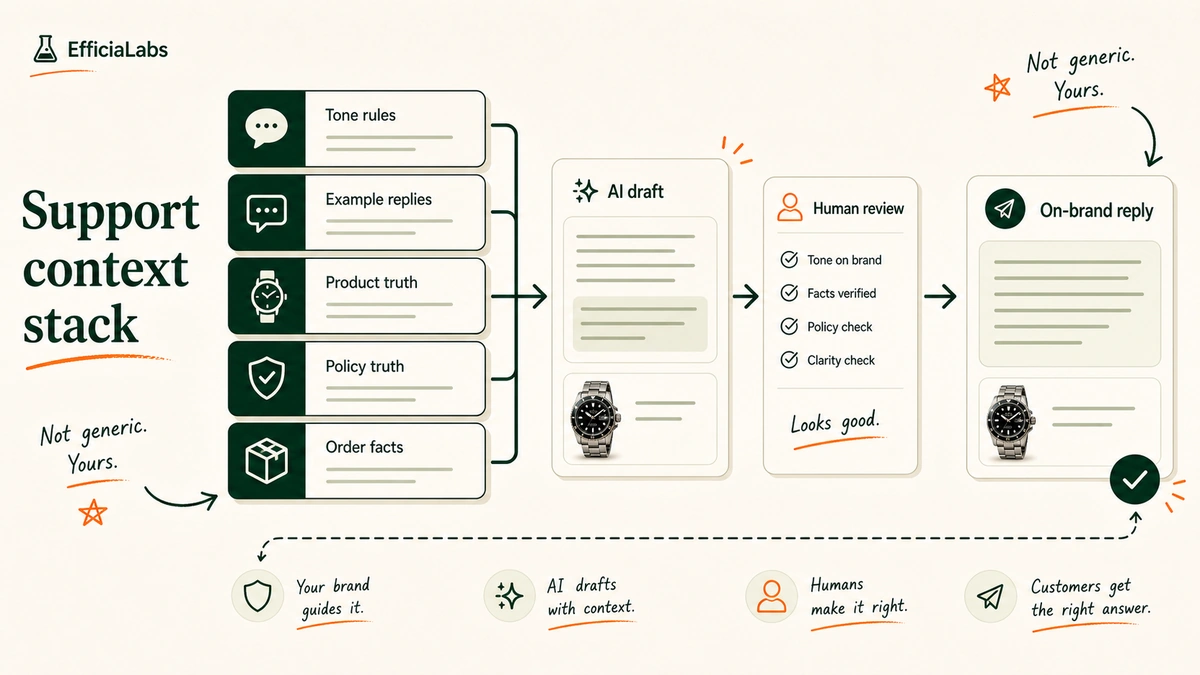
So the AI doesn’t write from a generic template. It writes from your voice, layered on your facts:
- Tone, do’s and don’ts
- Real example replies
- Product truth
- Policy truth
- Order facts
Then a human checks it sounds like you.
We treat this as the whole product, not a nice-to-have. There’s a full method to matching the AI’s voice to your brand voice, and we hold ourselves to it hard.
“If the replies sound like AI, you don’t pay. That’s the bar.”
— Vaibhav Sharan, founder of EfficiaLabs
This is also where being small is the feature, not the bug. I personally read what each client tells us and make sure my team follows it.
You’re not handed a success manager whose targets depend on selling you another module. You get the founder.
Every customer matters when you’re our size.
Frequently asked questions
Can AI handle “where is my order” tickets for a watch store?
Yes, and it’s the best place to start. WISMO is around 18% of ecommerce tickets. The AI reads the order and tracking data and drafts an accurate, on-brand status reply in seconds, with a human glance for anything unusual.
Is it safe to automate support for $1,000+ watch orders?
Yes, when you route by risk. Routine questions get drafted and approved, while authenticity disputes, warranty claims, and damaged high-value parcels go straight to a human. The AI gathers facts on those but never decides.
How much does AI customer service cost for a watch ecommerce store?
A custom build typically runs $0.05 to $0.10 per ticket. Per-conversation tools often charge $0.75 to $0.90. At 1,000 tickets a month, that’s roughly $50 to $100 versus $750 to $900.
Will the replies sound like a robot?
Not if it’s built right. The AI writes from your tone rules and real example replies, then a human reviews it. Our standard: if it sounds like AI, you don’t pay.
How long does it take to launch?
About 7 days for a done-for-you build. You grant helpdesk and store access; we audit tickets, build the context pack, capture your voice, run a draft-only test, then go live. Most builds need little upkeep after that.
Better answers today. Fewer tickets tomorrow.
Every watch ticket you handle well teaches the system the next one. Capture once, reuse everywhere, and the inbox gets quieter while the buyer gets happier.
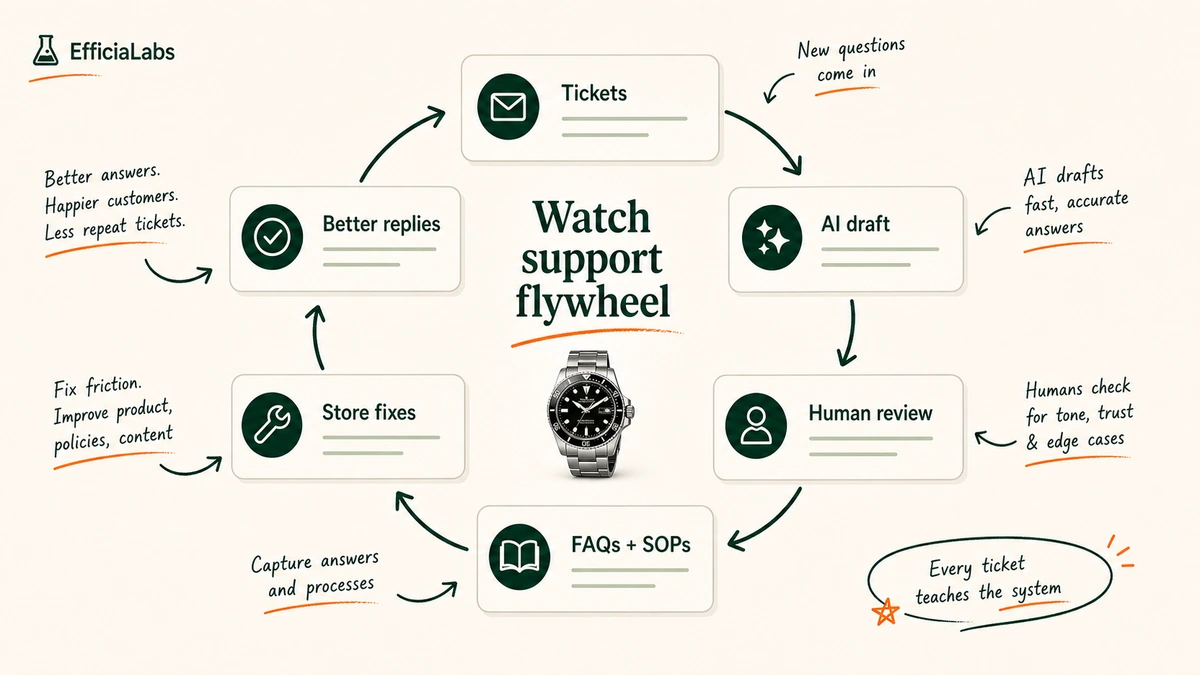
That’s the whole promise of AI customer service for a watch ecommerce store: routine handled in seconds, risk handed to a human, bill measured in cents. We build it, deploy it, and maintain it, so you can go back to building watches.
If you’re weighing options, here’s how to pick a partner for ecommerce AI customer care, and the wider picture on AI adoption across DTC.
See you in the next one.
— Vai
P.S. The handbag and leather-goods crowd has the same high-AOV, high-anxiety inbox. Here’s the version of this for premium handbag brands.
Sources
- WISMO: where is my order, automate the requests — Gorgias (WISMO = 18% of incoming requests)
- Customer service statistics — Zendesk, 2026 (AI resolution expectations, personalization)
- CX Trends 2026 — Zendesk

No comment yet, add your voice below!