

It’s a Monday in June. A heatwave just hit the East Coast. Your “where is my order” tickets tripled overnight, a wholesale buyer wants 40 cases by Friday, and somewhere in the pile is a customer asking if your grapefruit can is safe during pregnancy.
Three very different tickets. One inbox. One small team.
Here’s the short version.
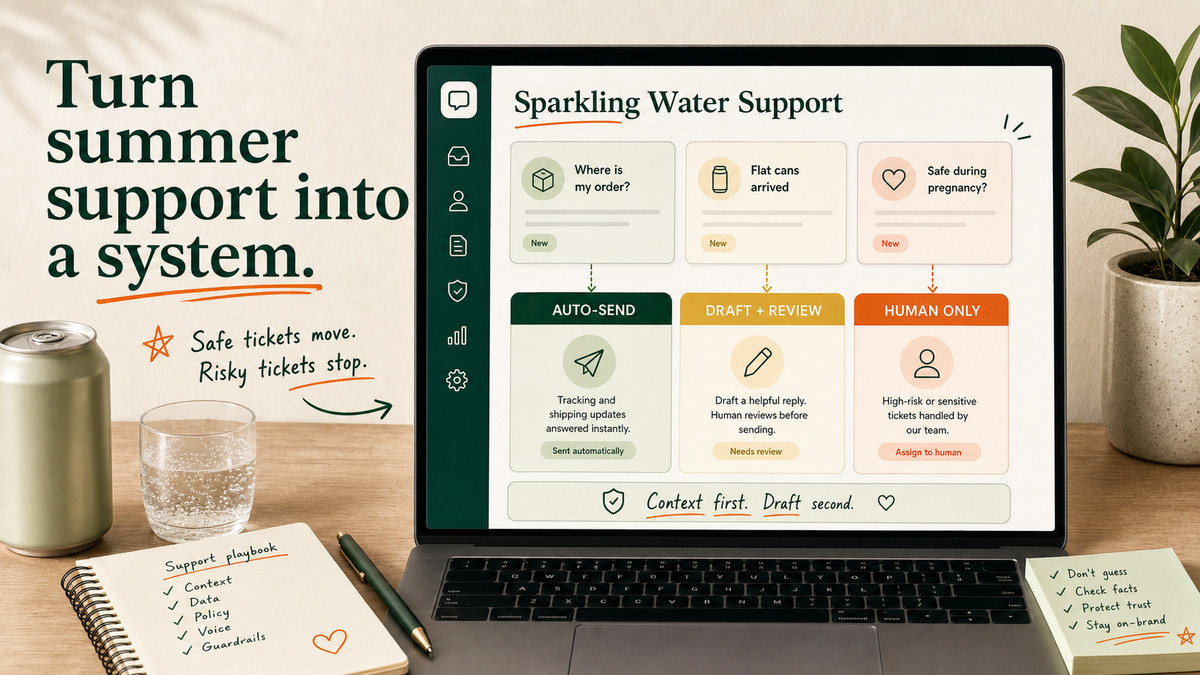
AI customer service for sparkling water brands means putting an AI layer on your support inbox. It drafts replies for repeat questions, looks up real order data, and routes anything risky to a human. Set up right, it answers the boring 60% in seconds and leaves the 40% that needs a person to your team.
We build these for DTC brands every week. The setup below is the one we’d run for a seltzer brand, start to finish, in seven days.
The hard part isn’t the AI. It’s knowing which cans of worms to keep closed. So let’s go ticket by ticket.
What AI customer service for sparkling water brands actually means
It is not a chatbot bolted to your homepage that says “I’m sorry, I didn’t understand that.”
It’s a system that sits inside the helpdesk you already use, whether that’s Gorgias, Zendesk, Freshdesk, or plain Gmail. Every time a ticket lands, it does three jobs:
- Reads the ticket and pulls the customer’s real order from Shopify.
- Drafts a reply in your brand voice for a human to approve or send.
- Routes anything risky, like a health or wholesale question, to a person.
Over weeks, the safe stuff goes out faster and the team stops re-typing the same six answers.
Why does this matter so much for a beverage brand? Volume and repetition.
“Where is my order” tickets alone run between 30% and 50% of support volume for most DTC stores in 2025 (Shopify). They spike in summer, when cans sit on hot porches. Sparkling water is a high-frequency, low-price, subscription-heavy product.
That means a flood of near-identical questions: tracking, multipacks, fizz, flavor swaps, “cancel my subscription.”
The demand is real too. 67% of consumers expect more personalized service now that AI can read their history, per the Zendesk CX Trends Report (2025), and the same report found nearly 90% of CX leaders expect AI to resolve most customer issues within a few years (Zendesk). For more numbers on where DTC teams are actually spending, we keep a running list of AI in DTC statistics.
Near-identical questions are exactly what AI is good at. In our work with beverage brands, the trick is always drawing the line between those and the questions where a wrong answer costs you money or a regulator’s attention.
Which sparkling water support tickets should you automate first?
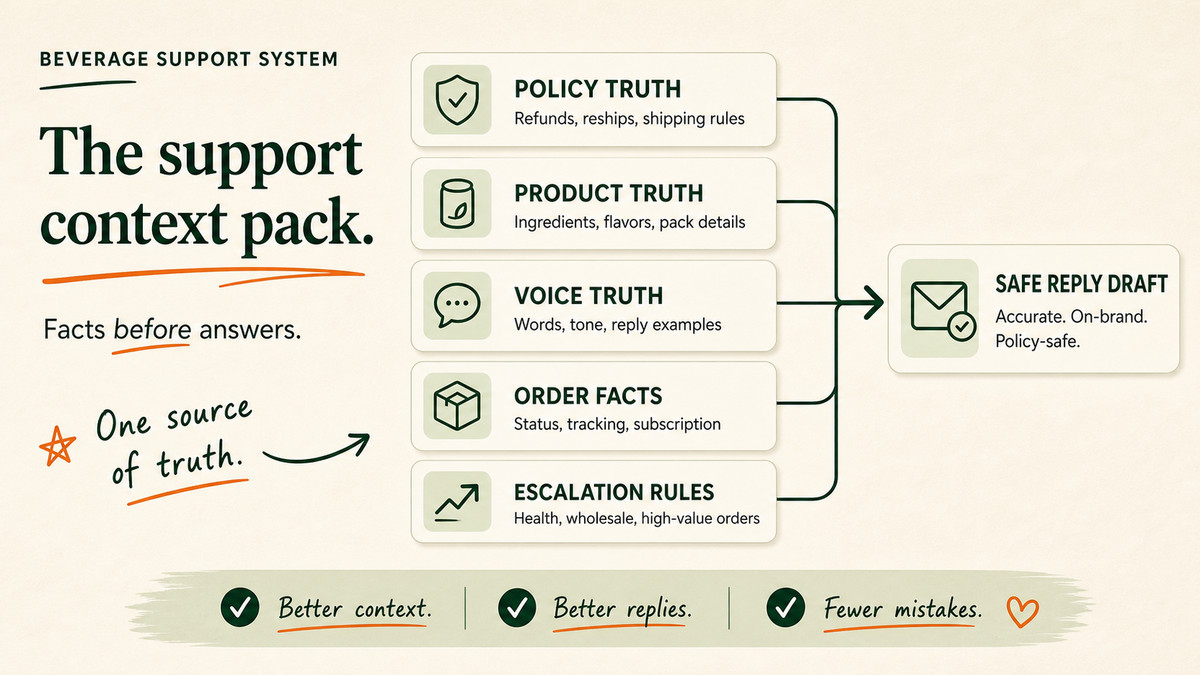
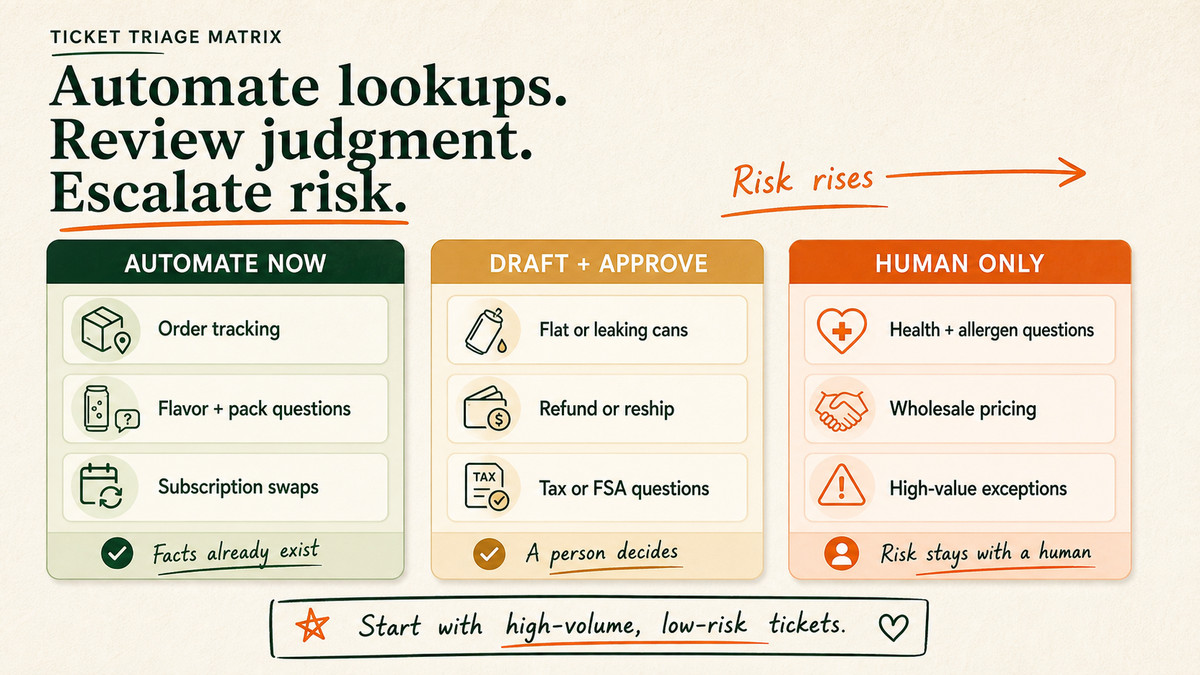
Start with the tickets that are high-volume, low-risk, and answerable from data you already have. Leave anything involving health, money over a threshold, or a wholesale relationship to a person.
Here’s how we sort a typical seltzer inbox on day one.
| Ticket type | Automate now | Keep human-in-loop | Why |
|---|---|---|---|
| Where is my order / tracking | Yes | No | Pulls straight from Shopify and the carrier. The 30 to 50% chunk. |
| Multipack / flavor mix questions | Yes | No | Answerable from your product catalog. |
| Flat or leaking cans on arrival | Draft only | Approve before send | Needs a refund or reship decision and a photo check. |
| Subscription swap, skip, or pause | Yes | No | Recharge or Shopify subscriptions handles the action; AI explains it. |
| FSA / HSA or tax questions | Draft only | Approve before send | Easy to say something wrong. Keep eyes on it. |
| Ingredient, allergen, or health claims | No | Human writes it | Regulated speech. More on this next. |
| Wholesale and bulk orders | No | Route to sales | Relationship and pricing. Not a support task. |
The pattern: anything that is a lookup, automate. Anything that is a judgment call, draft and review. Anything that is a legal or revenue decision, hand to a human.
We walk through the same sort for ingestible products in our protein supplements support guide, and the shipping-damage logic is nearly identical to what we set up for brewery stores.
Pro tip: Pull your last 500 tickets and tag them by these buckets before you automate a single thing. You’ll usually find five ticket types cover 80% of the inbox. Build for those five and ignore the long tail until week two.
The guardrails that matter for canned beverages
This is the section the generic guides skip, and it’s the one that can actually hurt you.
Sparkling water with “prebiotic,” “gut health,” “immunity,” or “energy” on the can is a functional food in the eyes of the FTC. Any claim about what your drink does to a body has to be truthful and backed by evidence. The bar, straight from the FTC’s Health Products Compliance Guidance (December 2022), is “competent and reliable scientific evidence.”
Boring, yes. Also the part that keeps you out of trouble.
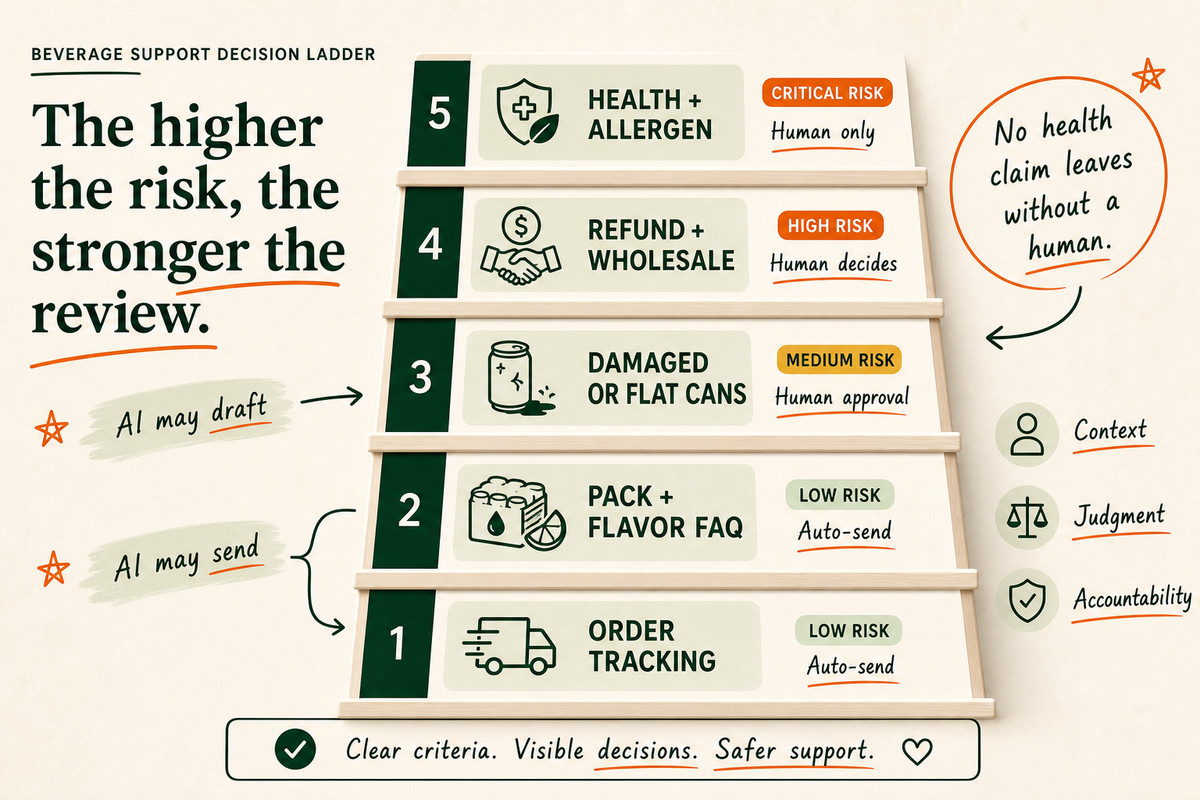
An AI that freelances a sentence like “yes, our drink will improve your digestion” is a liability. So we hard-wire the model to never make a health, medical, or safety claim.
If a ticket touches pregnancy, allergies, medication, a medical condition, or “is this safe for my kid,” it doesn’t get an AI answer. It gets escalated to a named human, every time.
The rest of the risk ladder is about money and trust. The same high-value-order logic we use for premium watch stores applies here: the bigger the dollar amount, the more a human stays in the loop.
Here is the guardrail logic we drop into every beverage build:
Never do this:
- Make any health, medical, safety, or "is it safe during X" claim
- Approve a refund or reship above $[your threshold]
- Quote wholesale or bulk pricing
- Promise a delivery date the carrier hasn't confirmed

Always do this:
- For health/ingredient/allergen questions, escalate to a human
- For damaged or leaking cans, ask for a photo, then draft for approval
- For anything you're unsure about, say a teammate will follow up
- Match the brand voice rules below
Two more worth hard-coding. Heat and freeze damage is the first: cans that ship in summer or winter arrive flat, frozen, or burst. The AI should treat a weather-damage ticket as a draft-and-approve reship, not an auto-refund.
Shipping restrictions are the second. Some carriers and states limit what you can ship where, so the AI should never promise delivery to an address it can’t verify.
How do you make AI match a playful beverage brand voice?
You write the voice down. Then you make the AI obey it.
Beverage is the most voice-driven category in DTC. Liquid Death sells water with death-metal copy. Olipop and Spindrift are bright and clean.
Waterloo is friendly and plain. A support reply that reads like a bank email breaks the spell your marketing spent millions building.
The fix is a short, specific voice spec. Not “be friendly.” Real rules with real examples.
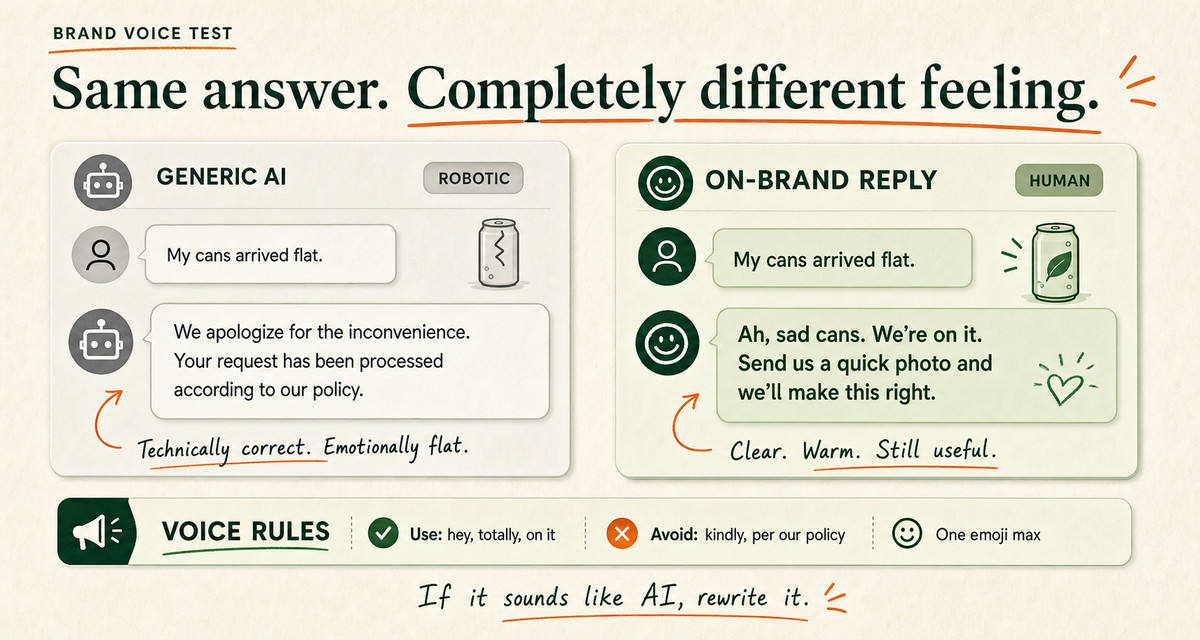
- Words we use: “hey,” “totally,” “on it,” the customer’s first name.
- Words we never use: “kindly,” “we apologize for the inconvenience,” “per our policy.”
- Emoji: one, max, and only the can or the wave.
- One real before-and-after: a flat “Your refund has been processed” becomes “Done. Refund’s on its way back to you. Sorry your cans showed up sad.”
We built and tested this across enough beverage inboxes to know the brand-voice rules matter more than the model you pick. A cheap model with a tight voice spec beats an expensive one running on defaults. The full method, including the weekly QA loop we use to keep it on-brand, is in our guide on matching AI to your brand voice.
“If the replies sound like AI, you don’t pay. That’s the whole bar,” says Vaibhav Sharan, founder of EfficiaLabs.
What does AI customer service for a sparkling water brand actually cost?
Less than you think, and the pricing model is the part nobody explains.
Most support SaaS charges per seat or per resolution. A per-resolution tool at $0.75 to $0.90 a conversation looks fine until your summer WISMO wave hits and the bill scales with every ticket.
A custom build runs on raw model cost. We measured this across client inboxes, and we typically land between $0.05 and $0.10 per ticket. Here’s the math on a brand doing 2,000 support tickets a month.
| Approach | Per-ticket cost | 2,000 tickets / month | At summer peak (4,000) |
|---|---|---|---|
| Per-resolution SaaS | $0.75 | $1,500 | $3,000 |
| Custom AI (EfficiaLabs) | $0.05 to $0.10 | $100 to $200 | $200 to $400 |
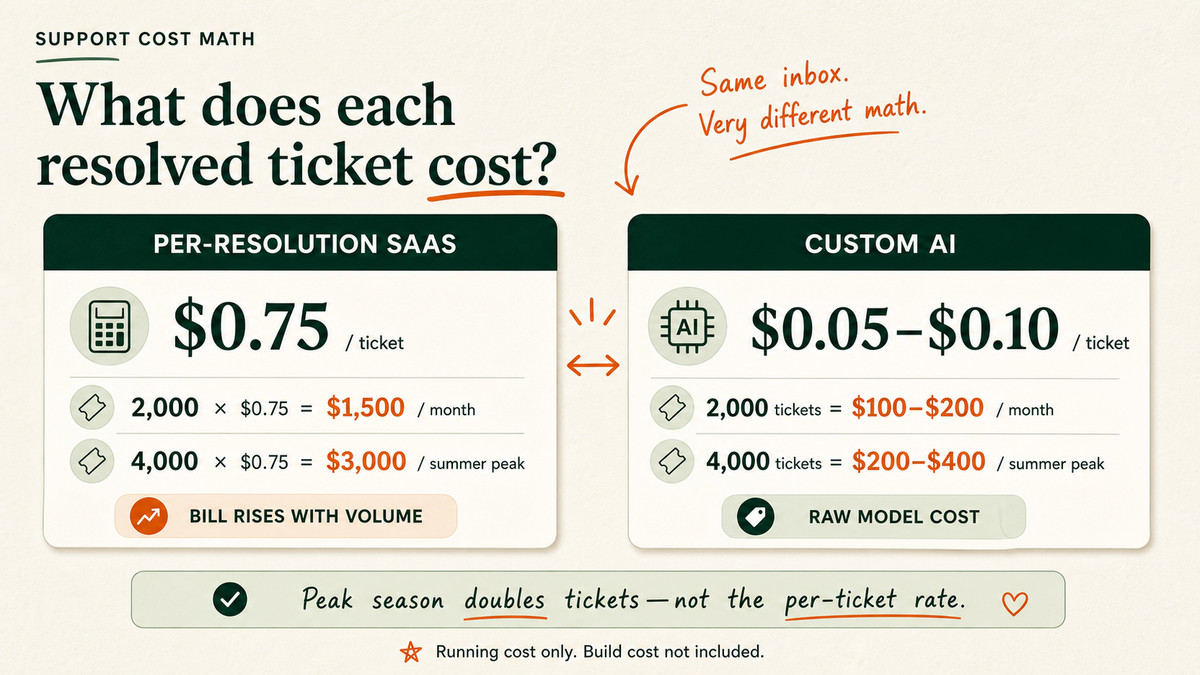
That gap is the difference between support being a line item you watch and one you forget about. And the custom build doesn’t charge you more in July just because more people asked where their water is.
We did the same cost breakdown for skincare brands in our 7-day skincare support guide, and the per-ticket numbers hold across categories.
Note: the per-ticket figure is the running cost, not the build. We handle the build, deploy, and upkeep, so the only thing your team spends is the hour it takes to grant portal access.
Your 7-day launch plan
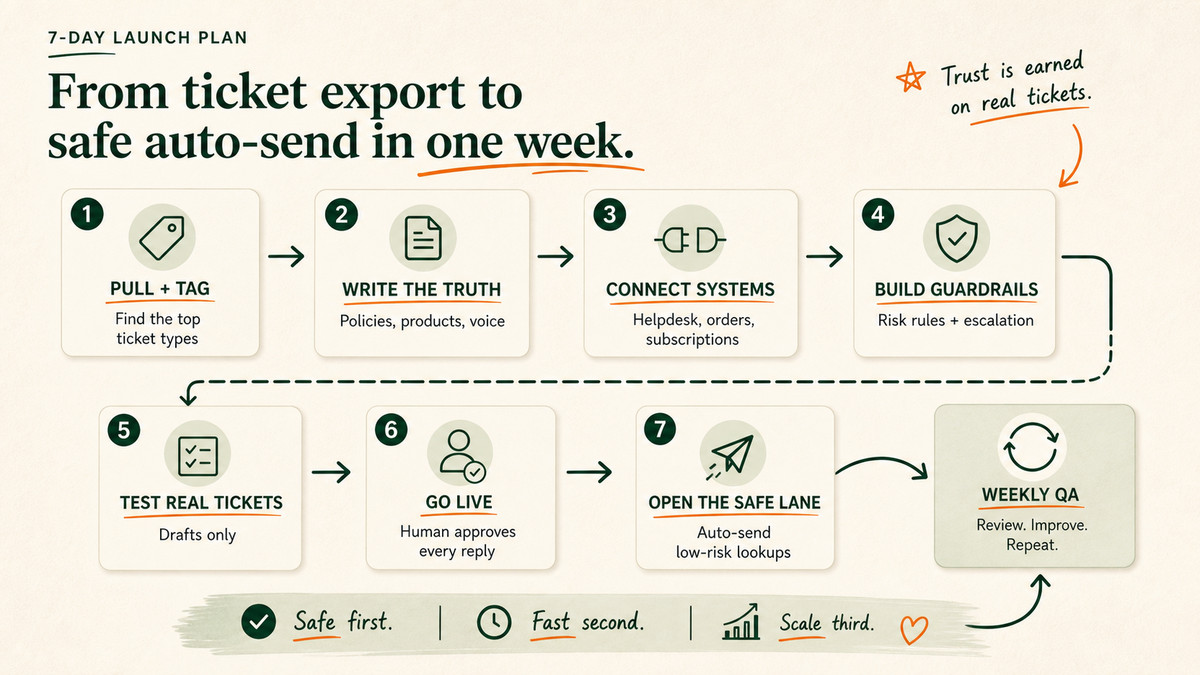
Here’s the exact week. This is the schedule we run with brands, and it’s why “7 days” isn’t marketing.
Day 1: Pull and tag the tickets
Export your last 500 to 1,000 tickets. Tag them into the buckets from the table above. Find the five types that cover most of the volume.
Day 2: Write the truth
Document your policies, product facts, shipping rules, and the voice spec. This “context pack” is what the AI reads from. Most brands have it scattered across five docs and one founder’s head, so we pull it together.
Day 3: Connect the systems
Grant access to your helpdesk and Shopify. The AI needs to read orders, tracking, and subscription status to be useful. This is the only step that needs you.
Day 4: Build the guardrails
Wire in the never-do list, the health-claim escalation, the refund threshold, and the voice rules. Nothing ships without these.
Day 5: Test on real tickets
Run the AI against last month’s tickets in draft mode. Read the drafts, tighten the voice, and catch the misses before a customer ever sees them.
Day 6: Go live in draft-only mode
Every reply is drafted by AI and approved by a human. You watch it for a day. Trust is earned on real tickets, not promises.
Day 7: Turn on auto-send for the safe lane
Let the lookups (tracking, multipacks, subscription swaps) go out automatically. Keep everything else in draft-and-approve. Done.
After launch, there’s usually no maintenance for a long time. The system runs, and we’re the ones who own it if it doesn’t.
“Ecommerce founders already have too much on their plate. My job is to take support off it, so they can rest more,” says Vaibhav Sharan, founder of EfficiaLabs.
Frequently asked questions
Is AI customer service safe for sparkling water brands making health claims?
Yes, if it’s built right. The AI should be hard-wired to never make a health, medical, or safety claim and to escalate any ingredient, allergen, or “is this safe” ticket to a human. That keeps you on the right side of the FTC’s Health Products Compliance Guidance.
How much does it cost to run AI support for a beverage brand?
A custom build typically costs $0.05 to $0.10 per ticket. At 2,000 tickets a month that’s $100 to $200, and it doesn’t balloon during summer demand spikes the way per-resolution SaaS pricing does.
Will AI support replies sound robotic?
Only if you let them. With a tight voice spec and a weekly QA loop, replies match your brand. Our rule with clients is simple: if it sounds like AI, you don’t pay.
What tickets can’t AI handle for a sparkling water brand?
Health and ingredient questions, wholesale and bulk pricing, refunds above your threshold, and anything legal. Those route to a person. AI handles the high-volume lookups so your team has time for the rest. For the broader Shopify setup, see our ChatGPT customer support guide.
Sources
- Shopify, “WISMO: What it is and how to reduce it.” The share of DTC support tickets that are order-status questions. https://www.shopify.com/blog/wismo-ecommerce
- Federal Trade Commission, “Health Products Compliance Guidance” (December 2022). The substantiation standard for health-related claims on foods and beverages. https://www.ftc.gov/business-guidance/resources/health-products-compliance-guidance
- Zendesk CX Trends Report (2025). Consumer expectations for personalized service. https://www.zendesk.com/in/blog/ai/ai-customer-service/
See you in the next one — Vai
P.S. The grapefruit-can-during-pregnancy ticket from the intro? That’s the one a human should always answer. Build the robot to know what it isn’t.

No comment yet, add your voice below!